Transcendence
A great Indian scientist who explored the frontiers of the universe began an unexpected inner journey with Pramukh Swami Maharaj. Transcendence reveals how scientific brilliance found deeper meaning through spiritual awakening
The world remembers Dr APJ Abdul Kalam as a brilliant scientist, the architect of India’s missile programme, the 11th President of India and an inspiring thinker who awakened the dreams of millions. Yet, behind the celebrated scientist and statesman lived another Kalam, a quiet spiritual seeker, deeply concerned with the meaning of life, the nature of the self and the ultimate purpose of human existence.
As his birthday approaches on 15 October, perhaps the most meaningful way to remember this extraordinary son of India is to explore a lesser-known dimension of his personality: his spiritual journey. That journey brought him into the presence of many distinguished thinkers and spiritual personalities, but, by his own account, it reached its highest point in his relationship with Pramukh Swami Maharaj.
The finest window into this remarkable relationship is ‘Transcendence: My Spiritual Experiences with Pramukh Swamiji’, the final book authored by Dr Kalam with Professor Arun Tiwari. The book records fourteen years of Kalam’s spiritual experiences and friendship with Pramukh Swami Maharaj. Dr Kalam regarded Pramukh Swami Maharaj as his “ultimate teacher” and described his influence as the culmination of his spiritual ascent.
Their first meeting took place in Delhi on 30 June 2001. Kalam arrived with his colleague YS Rajan, seeking guidance for his vision of India’s development. What unfolded was more than an intellectual conversation. It became a meeting of science and spirituality.
There was, however, an amusing barrier between the two: Kalam spoke English, while Pramukh Swami Maharaj spoke Gujarati. Yet language proved powerless to obstruct a bond formed at the level of the heart. Affection, humility and spiritual kinship required neither grammar nor vocabulary.
Kalam was deeply struck by the divine presence. In Transcendence, he describes the extraordinary impression Pramukh Swami Maharaj made upon him at their first meeting. The divine guru’s simplicity, radiance and serenity created an atmosphere in which Kalam felt something far beyond an ordinary human interaction.
As their relationship deepened, Kalam began experiencing the divine presence even when he was physically absent. He wrote, “Our connection was getting deeper, and I could sense Pramukh Swamiji’s presence even in his absence.” This was not merely admiration for a religious personality; it was the experience of a seeker who had discovered a spiritual anchor.
One of the most beautiful episodes occurred at Rashtrapati Bhavan. While walking through its gardens, Kalam encountered a peacock displaying its magnificent feathers. The sight reminded him of Pramukh Swami Maharaj. He wished that Swamishri would one day come to Rashtrapati Bhavan with hundreds of sadhus, sanctifying the presidential residence through their presence, prayers and spiritual atmosphere.
When Kalam telephoned Swamishri, the latter was in Mumbai and was not keeping well. Kalam requested that, once his health improved, he should visit Rashtrapati Bhavan. Pramukh Swami Maharaj replied with words that profoundly moved him: “Whenever you remember me, I am with you in Rashtrapati Bhavan.”
For Kalam, this answer seemed to transcend the limitations of time and space. The physical presence of a person is governed by distance; spiritual presence is experienced through remembrance.
In 2004, Kalam visited Akshardham in Gandhinagar for the golden jubilee celebrations of the BAPS Bal Mandal. At the conclusion of the programme, Pramukh Swami Maharaj quietly walked behind him for some distance to see him off. Surprised, Kalam asked why Swamishri had come so far to bid him farewell. Swamiji simply replied,
“You have come all the way from Delhi to here.”
Those simple words moved Kalam deeply. He saw a humility untouched by position, achievement or fame.
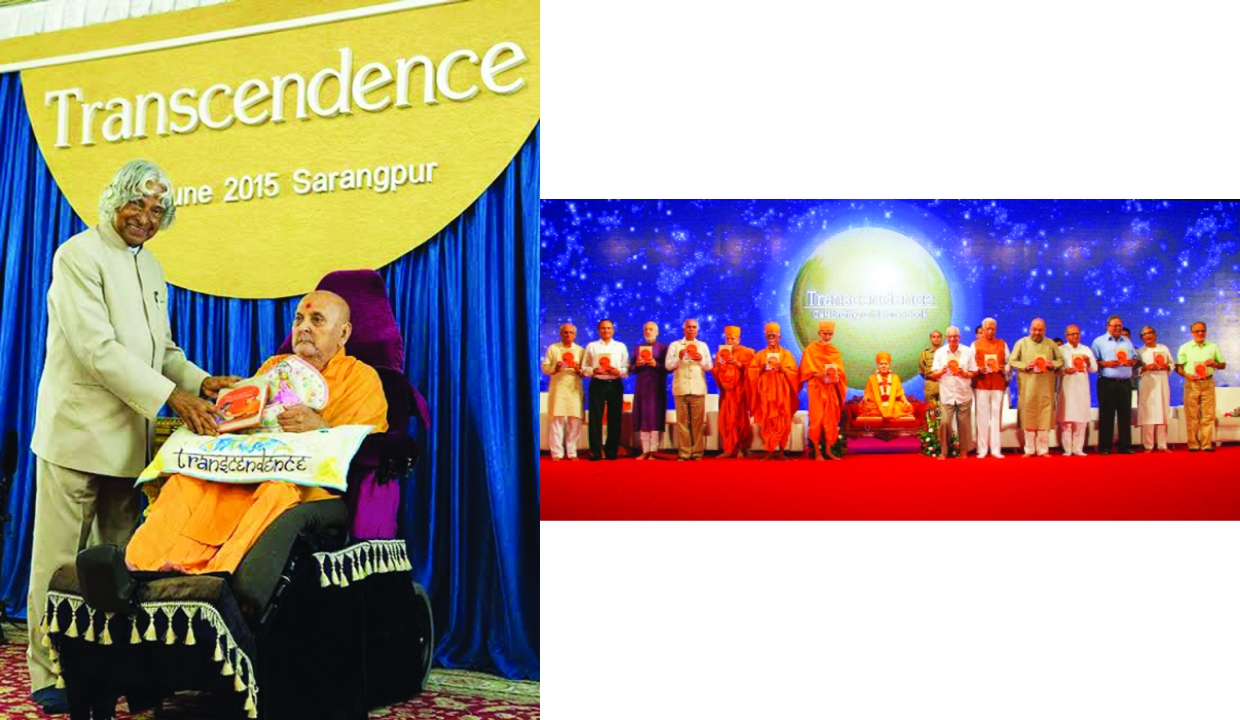
Their friendship ultimately reached a remarkable culmination on 20 June 2015, when Kalam travelled to Sarangpur and personally presented Transcendence to Pramukh Swami Maharaj. The book, which documented fourteen years of their spiritual relationship, had come full circle.
On that occasion, Kalam told Swamishri, “You are a great teacher. From you I’ve learnt to eradicate I-ness and My-ness in life.”
The moment carried a poignant sense of completion. Only weeks later, on 27 July 2015, Dr Kalam passed away in Shillong. Pramukh Swami Maharaj followed him to Akshardham just over a year later, on 13 August 2016.
The story of Kalam and Pramukh Swami Maharaj is therefore much more than the friendship of a scientist and a swami. It is the story of two great lives meeting at the intersection of knowledge and wisdom, achievement and humility, science and spirituality.
And as we approach Dr Kalam’s birthday this 15 October, perhaps we should remember not only the scientist who taught India to dream, but also the spiritual seeker who taught us that the highest human journey is not merely towards greater knowledge, but towards greater humility, purity and God-consciousness.
It was, indeed, a divine bond between a sadhu and a scientist, between spiritual wisdom and scientific brilliance, and between two extraordinary souls who transcended the boundaries of language, position and circumstance.
Dr Swami Gyanananddas is a dedicated follower of the Swaminarayan tradition and has earned a PhD from MS University; Views presented are personal.