The verdict: BJP claims Bengal, TVK pips DMK
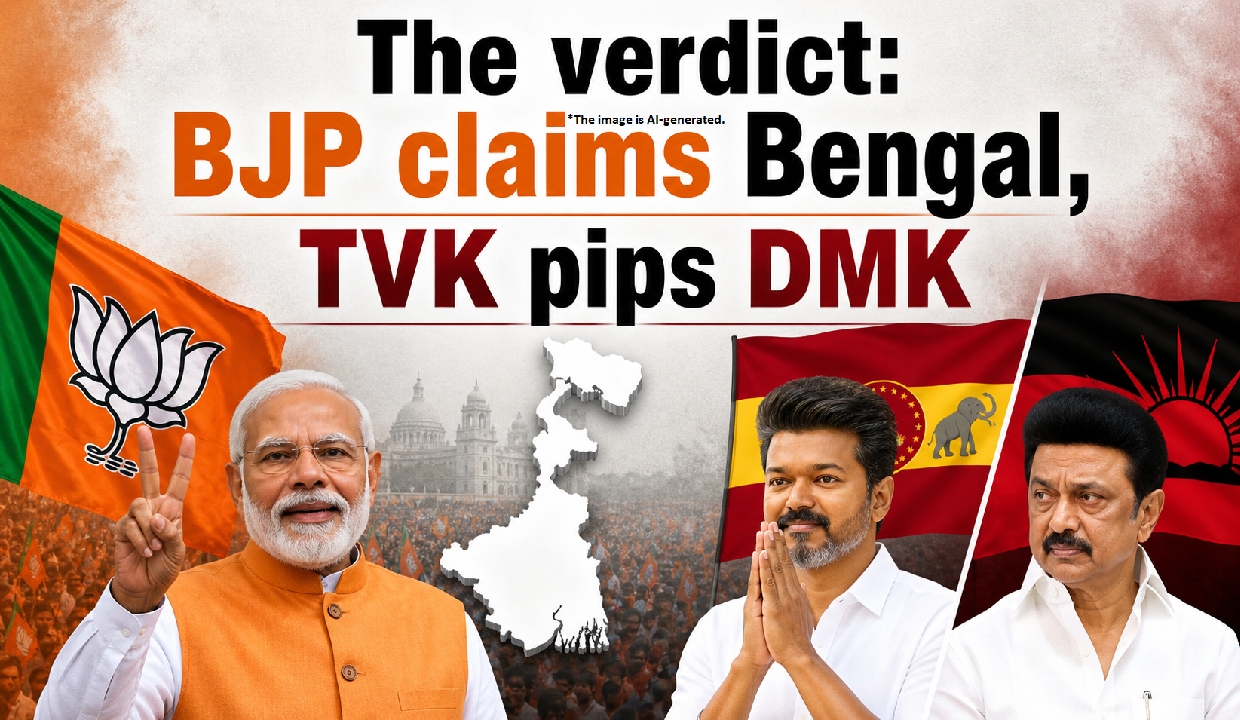
May 4 was all about confirming the strengths and limits of political parties, and the verdict showed that claiming India in its entirety remains a distant goal
The biggest takeaway from the May 4 assembly results is that TMC has been dislodged by the BJP, finally. After three terms, Mamata Banerjee has been ousted by the BJP. Yet another surprise came from down south where Vijay-led Tamilaga Vettri Kazhagam (TVK) dislodged the well-entrenched Stalin-led DMK. Both these results are significant from the national perspective and they will have far-reaching implications for the national politics and next general elections. The May 4 verdict yet again confirmed that Indian politics continues to have a double track — a national perspective which is predominant in the North and a regional narrative that sways voters in the South; this is the narrative which speaks to regional identities and southern issues. A few results have been on expected lines. In Assam, the BJP retained power. The party has been going strong since 2016. It has successfully fused identity politics with governance.
The party under Himanta Biswa Sarma has executed welfare schemes, undertaken infrastructure projects that resonated with the voters. He also tactfully calibrated issues like migration and citizenship, which have helped it consolidate support across communities. The leadership of Himanta Biswa Sarma has further sharpened this appeal, combining administrative visibility with political messaging.
West Bengal, however, tells a more complex story. The defeat of Mamata Banerjee and the ouster of the All India Trinamool Congress (TMC) that came to power in 2011 show the efforts the BJP put in and the anti-incumbency Mamata faced.
Bengal had accumulated grievances — ranging from corruption allegations to concerns about political violence and governance issues, which the voters addressed in their two-phase voting. The BJP’s rise here is less about ideological conversion and more about discontentment with the Mamata style of functioning. Yet, the scale and durability of this shift will only be tested over time. The southern states, meanwhile, played to the Dravidian script, though the third force led by Vijay that appeared recently outsmarted MK Stalin. Thanks to his mass appeal and well-articulate messaging, Vijay became the number one choice of the voters; of course, the anti-incumbency and plethora of mis-governance and corruption charges against the Stalin government helped him dislodge the Tamil Nadu stalwart. In Kerala, power alternated once again, with the United Democratic Front (UDF) displacing the Left Democratic Front (LDF). These outcomes underline the persistence of strong regional political cultures and linguistic identities that have kept the BJP at bay in the south. Despite organisational efforts and growing vote share in a few pockets, the party remains a peripheral player. The broader implication is clear: the BJP’s strength across large parts of the north, west, and northeast contrasts with its limited footprint in the south.
Meanwhile, regional parties continue to hold ground in their bastions, but the Bengal result shows that anti-incumbency, if left unaddressed, can swiftly alter political equations. These results show that India votes in layers and no one can take Indian voters for granted!