Prasthanam: From journey to awakening
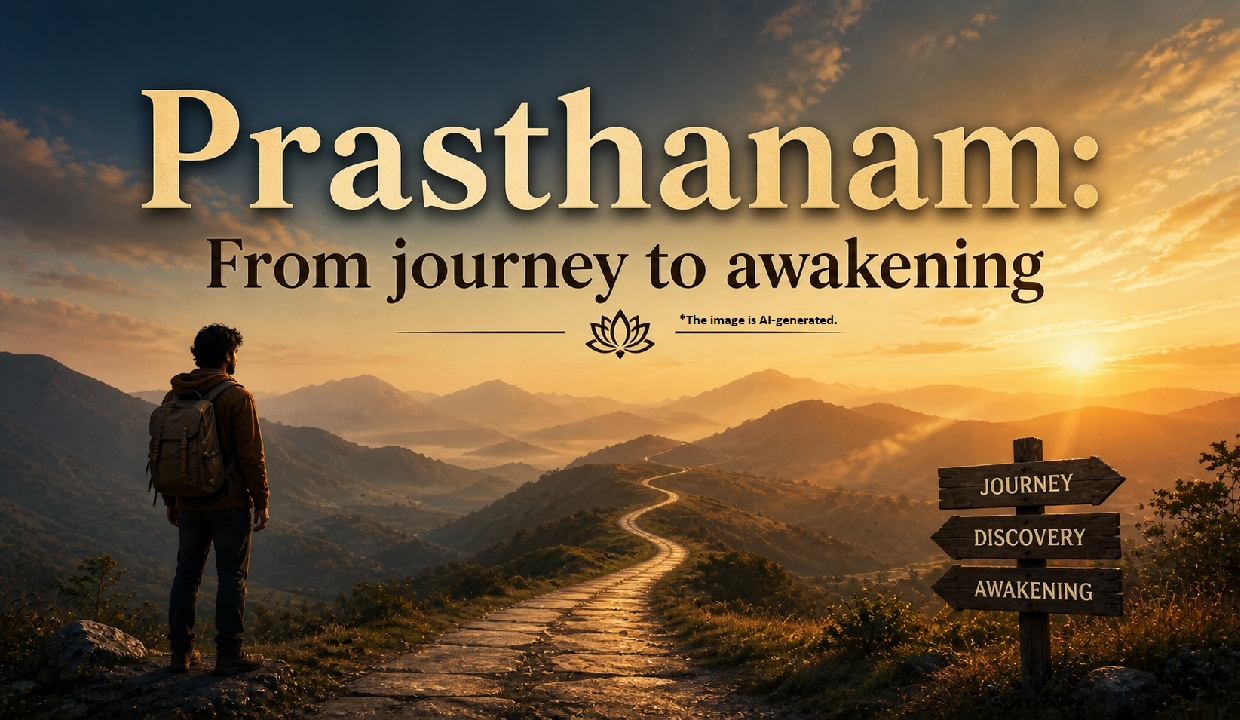
Prasthanam means a journey—moving from one place to another. A journey implies a destination. Without a goal, can it truly be called a journey? Life itself is a great journey. This applies not only to the individual but to humanity as a whole. Yet, this journey is not the same for everyone.
It is marked by striking contrasts and rich diversity. Our background, our way of thinking, our perspective, and our attitude—all play a vital role in shaping it. From a primitive, almost animal-like stage, human beings, endowed with extraordinary thinking ability, discovered language and learned to express their thoughts.
They became civilized. In the evolution of human life, this marks a remarkable phase of progress. Among the many strengths of human beings, observation is one of the greatest.
By keenly observing the world around him, man expanded his knowledge. He recognized the differences between himself and other living beings and came to terms with the harsh truth that birth, growth, and death are inevitable for all life. Then arose a question: how can he give value and meaning to his life? Through higher spiritual inquiry, he came to believe that the union of the individual soul with the Supreme is the noblest path.
Thus, he became a seeker of the Self. This is a significant milestone in the journey of human life. The peace chant from the Brihadaranyaka Upanishad, often called the Pavamana Mantra—Om, lead me from the unreal to the real, from darkness to light…—reveals the spiritual vision of great sages.
It tells us that beyond the worldly journey, there exists a higher path—one they longed to reach. They urge us, too, to cultivate such thought and direct our lives toward it.
This is the path they have shown humanity. We must hold the essence of this mantra in our hearts. It is a profound prayer. Its meaning kindles the flame of spiritual awareness within us and makes it shine. It calls us to move from illusion to reality—from the mistaken belief that the world we live in is permanent and the source of lasting happiness—to the realization of the eternal and the Supreme. Ignorance is darkness; a person without knowledge is like one who is blind. To come out of this blindness, we need the light of knowledge. We must become truly enlightened.
Our seers and the seekers of truth aspired to transcend the cycle of birth and death and attain freedom from rebirth.
Thus, they attain Nirva — a Life is a great Odyssey —endless, ever-changing, and transformative. What lends distinction to an ordinary life is spiritual reflection. Spirituality, at its core, is the flow of noble thoughts within us. Every step a person takes becomes a true journey only when it leads inward, not outward. We should cultivate and practise it. It benefits both individuals and society. We can truly express our gratitude to the rishis—who condensed such vast meaning into this brief prayer —only by walking the path they have shown.
The writer is a columnist, lecturer and radio presenter. He has given several talks on spirituality, literature and done many literary essays on various issue; Views presented are personal.