The unravelling of Dravidian order
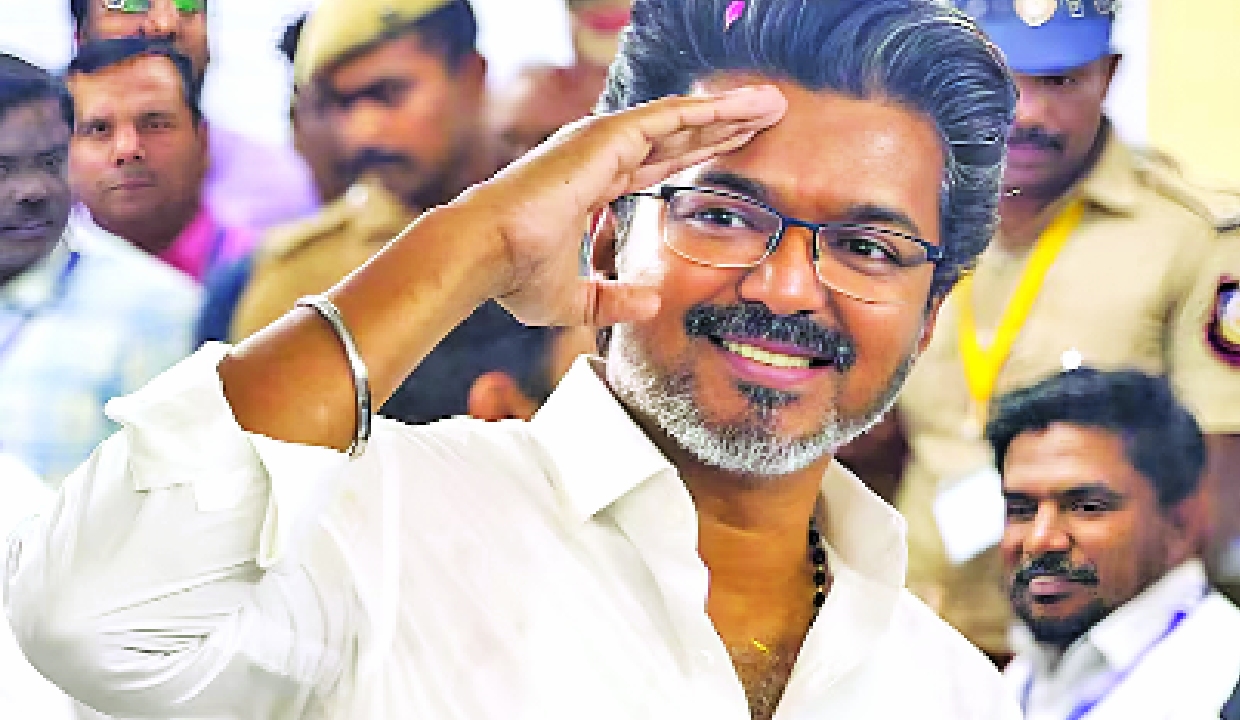
Vijay has emerged as the face of generational anger and anti-establishment politics. But his rise also highlights a political vacuum: the old Dravidian order is losing credibility, while the new alternative remains inexperienced and organisationally weak
Joseph Vijay Chandrasekhar, celebrated for decades as “Thalapathy” — the commander — is now confronting a truth far harsher than cinematic fiction: Tamil Nadu is not a theatre waiting for a hero’s entrance. It is among India’s most politically self-aware states, shaped by decades of ideological struggle, linguistic pride, welfare politics, caste negotiation, and a deeply emotional contract with social justice. Vijay may have conquered the electoral imagination, but the machinery of governance is proving far more unforgiving than fan adulation.
Tamil Nadu today stands at a historic crossroads. The Dravidian order that dominated the state for nearly sixty years is weakening, yet no alternative has fully established legitimacy. The DMK retains organisational strength and administrative continuity, while the AIADMK still survives through welfare-era loyalties and caste-based networks. But both parties increasingly appear ideologically exhausted. Their rhetoric continues to invoke social justice, federalism, and Tamil identity, yet their politics often resemble bureaucratic management rather than transformative mobilisation. Vijay’s rise emerged precisely from this vacuum.
National commentary has often caricatured Tamil Nadu as a state addicted to “cinema politics”, but that interpretation misses the deeper historical reality. MG Ramachandran and J Jayalalithaa succeeded not merely because they were film stars, but because they embedded themselves within the emotional and ideological framework created by the Dravidian movement. In Tamil Nadu, cinema became political pedagogy. Film dialogues carried ideological messages. Stardom mattered only when it resonated with the anxieties and aspirations of workers, backward castes, the poor, and Tamil linguistic identity. The foundations of this politics were laid by EV Ramasamy, whose Self-Respect Movement challenged Brahminical dominance in education, administration, and ritual hierarchy. His attack on caste oppression transformed Tamil politics permanently.
Later, CN Annadurai converted radical social critique into electoral politics through the DMK. The movement shifted political discourse away from elite nationalism towards dignity, representation, and linguistic self-respect. Tamil politics became inseparable from the question of social mobility. This ideological inheritance helped create one of India’s most paradoxical yet successful states. Tamil Nadu remained fiercely regional while becoming deeply integrated into global manufacturing networks.
Tamil Nadu built one of India’s most effective welfare systems. Midday meal schemes pioneered under K. Kamaraj and expanded under MG Ramachandran reshaped nutrition and school attendance. Public healthcare, subsidised food distribution, maternal health programmes, and women-centric welfare schemes produced social indicators that consistently outperform much of the country.
M Karunanidhi, a scriptwriter, ideologue, and political tactician, fused literary performance, welfare governance, and coalition negotiation into a durable political machine. His son, MK Stalin, inherited not just a party but an institutional ecosystem. Under Stalin, Tamil Nadu retained economic growth despite post-pandemic pressures. Welfare delivery expanded through programmes such as doorstep healthcare initiatives, while the state sharpened its resistance to centralisation on issues like NEET, language policy, and fiscal devolution.
Yet the DMK’s central challenge was not administrative failure. It was emotional fatigue. Younger voters inherited the welfare state without inheriting the historical memory that once legitimised Dravidian politics. Anti-Brahmin rhetoric no longer electrifies an aspirational generation working in IT corridors or navigating precarious urban employment. Into this opening stepped Vijay.
Unlike Kamal Haasan, who entered politics through technocratic idealism, Vijay projected emotional populism. He did not initially offer a fully coherent ideological programme. Instead, he offered rupture - a symbolic rebellion against dynastic politics, corruption fatigue, and political stagnation. His appeal rested on accessibility and generational impatience. Importantly, he avoided overt alignment with Hindutva while softening the rigid atheistic tone historically associated with Dravidian discourse. This ambiguity broadened his social appeal.
But electoral momentum and governing capacity are entirely different realities. Cinema rewards singular charisma; parliamentary democracy rewards negotiation, compromise, organisational discipline, and patience. Vijay’s transition from celebrity icon to political administrator has exposed the limitations of charisma-driven mobilisation. Triumphalist rhetoric, strategic inconsistency, and the inexperience of advisers intoxicated by spectacle have complicated his emergence as a credible governing force.
The deeper anxiety within Tamil Nadu’s political establishment reflects fear of displacement. Reports of tactical accommodation between the DMK and AIADMK - once unimaginable rivals — indicate how survival instincts are overtaking ideological hostility.
This crisis has also exposed the transactional nature of alliance politics. Congress leaders who survived electorally through DMK support now flirt with Vijay’s camp in search of future relevance. Alliances increasingly resemble temporary survival arrangements rather than ideological partnerships. Meanwhile, the BJP continues to struggle electorally in Tamil Nadu because Hindutva’s North Indian cultural grammar encounters resistance in a state where linguistic identity historically superseded pan-Hindu consolidation.
Yet Delhi’s influence no longer depends entirely on electoral dominance. Governors, investigative agencies, and coalition engineering increasingly function as instruments of political leverage. Across Tamil Nadu, suspicion persists that constitutional ambiguity may be used to shape outcomes from behind the scenes. The contradiction confronting Tamil Nadu is therefore profound. Economically, it remains one of India’s most advanced states. Socially, it continues to outperform much of the country in education, healthcare, and women’s participation. Politically, however, it has entered an era where no force commands complete moral authority. The old Dravidian order no longer inspires unquestioned loyalty, while the new populist alternative has not yet demonstrated governing maturity.
Vijay’s rise is neither accidental nor miraculous. It reflects the ideological vacuum that emerges when successful societies outgrow their old slogans without discovering a new political language. Voters rejected stagnation without fully trusting disruption.
The danger now is that Tamil Nadu may drift towards personality-driven politics detached from doctrinal seriousness. If the DMK and AIADMK unite merely to block Vijay, they may postpone collapse while accelerating their irrelevance. The state may discover that charisma alone cannot govern industrial growth, fiscal pressures, caste tensions, and federal confrontation simultaneously. Tamil Nadu’s political story is about the uncertain transition from a deeply ideological republic to a more fragmented and emotionally volatile political order. The Dravidian system that once reshaped Indian federalism is no longer secure. It is improvising in real time, searching for a new language of legitimacy in a state that refuses to stand still.
Vijay’s rise is neither accidental nor miraculous. It reflects the ideological vacuum that emerges when successful societies outgrow their old slogans without discovering a new political language. Voters rejected stagnation without fully trusting disruption
The writer is a columnist based in Colombo; Views presented are personal.