
- HOME
- INDIA
- WORLD
- BUSINESS
- STATES
- LAW & JUSTICE
- ENTERTAINMENT
- SPORTS
- VIEWPOINT
- LIFESTYLE
- TECH
Mahavir Jayanti, commemorating the birth of Lord Mahavir, the twenty fourth and final Tirthankara of Jainism in the current era, is a day of profound spiritual significance. The festival marks not merely the advent of a spiritual teacher but celebrates a way of life anchored in non violence, self restraint, and inner awakening. Across the country, Jain communities hold processions, visit temples to pay respect and recite prayers from teachings that have shaped one of the most disciplined philosophical traditions in the world. Within this framework, food assumes a distinctive role of expressing disciplined living through restraint and purity. The cuisine of Mahavir Jayanti thus adheres to the principles of ahimsa and sattva, where every ingredient, method of preparation, and act of consumption reflects a conscious ethical choice. This way of life reflects a deep rooted commitment to minimalism and sustainability, where living with less is not deprivation but a conscious and ethical alignment with nature.

Mahavir, a prince of the Jnatrika Kshatriya clan and the Ikshvaku dynasty, was born as Vardhamana around 599 BCE in Kundagrama (near Vaishali, Bihar). Born to King Siddhartha and Queen Trishala, he renounced his royal life when he was 30 years old to seek spiritual awakening. After 12 years of intense meditation and severe penance, he attained Kevala Jnana (omniscience) and spent the rest of his life preaching the core Jain principles of Ahimsa (non-violence), Satya (truth), and Aparigraha (non-attachment). Jain thought also embraces a philosophy of pluralism, recognising that truth may be understood from multiple perspectives, encouraging humility and openness in both thought and conduct. Jain dietary practices, most visible during this festival, avoid root vegetables such as onion, garlic, potatoes, and carrots in accordance with these principles to avoid causing harm to various life forms. Similarly, the avoidance of fermentation, excessive spices, and processing reflects an attempt to preserve the natural flavour and benefits of ingredients. Fasting and controlled eating become central practices on this day, not as acts of deprivation, but means of cultivating awareness and discipline. In this context, the kitchen is transformed into a sacred space, where cooking itself becomes an extension of spiritual practice.
In the absence of root vegetables the cuisine focuses on gourds, seasonal vegetables, lentils, dairy, and grains to create balanced and nourishing meals. Techniques such as steaming, light sauteing, and slow cooking are preferred, ensuring that ingredients retain their nutritional qualities and are easy to digest. Elders are the guiding force behind the preparations, eagerly recalling traditional recipes and guiding the cooking process, ensuring that this valuable knowledge is passed on to the younger generation. The emphasis remains on simplicity, digestibility, and purity, reflecting a worldview where the body is seen as a vehicle for spiritual progress rather than sensory experiences. The observance of Mahavir Jayanti also extends beyond the household, where acts of charity and the sharing of food with the less fortunate form an integral part of the celebration, reinforcing the principle that nourishment must be inclusive and compassionate.
Among the most commonly prepared dishes are light vegetable preparations such as lauki ki sabzi, tori, and kaddu ki sabzi, where bottle gourd, ridge gourd, and pumpkin are cooked gently with cumin, ginger, and minimal seasoning, allowing their natural sweetness and moisture to be preserved. These are complemented by simple yet nourishing combinations such as turai chana dal and moong dal, where lentils are cooked until soft and tempered lightly with cumin and asafoetida to retain their sattvic character and add nutritional value. Preparations such as sev tameta introduces a gentle tang through tomatoes without relying on onion or garlic. The preparation starts with a tempering of oil, mustard seeds, cumin, and asafoetida, sometimes including ginger, garlic, or green chilies for extra flavor. Chopped tomatoes are added with spices like turmeric, red chili powder, coriander-cumin powder, often with a touch of sugar or jaggery to balance the tanginess. Just before serving, a generous amount of crispy sev (fried gram flour noodles) is added to the gravy, ensuring it provides a crunchy contrast before it has a chance to turn soggy. Kobi vatana nu shaak is another favorite highlighting seasonal vegetables. Its preperation begins with a tempering of mustard seeds, cumin, and asafoetida in oil, followed by finely shredded cabbage and peas seasoned with turmeric, chili powder, and coriander-cumin powder. It is typically steam-cooked in its own juices until tender, then finished with a touch of sugar or jaggery and fresh coriander for a balanced taste.
Grain and lentil based preparations, however, form the foundation of the meal, where khichdi made from rice and moong dal remains central, cooked with turmeric and a touch of ghee to create a dish that is both wholesome and easy to digest. Alongside it, sama ke chawal or barnyard millet is often prepared as a light pulao, particularly for those observing stricter fasting practices. In many households, fada ni khichdi, made from broken wheat, offers another variation that is both hearty and balanced. Traditional dishes such as Jain dal dhokli, adapted without onion or garlic and with sparse spicing, bring together wheat and lentils in a single preparation, reflecting both nourishment and culinary ingenuity within dietary guidelines.
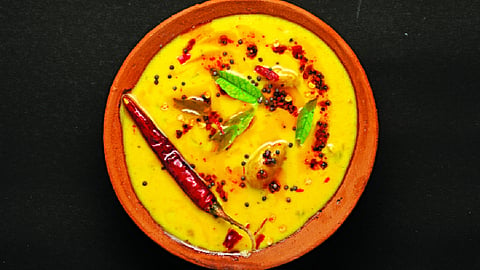
Within this framework, more structured savouries introduce variation in both texture and technique. Dudhi muthia, prepared from grated bottle gourd and gram flour, is steamed and lightly sauteed to achieve a soft yet structured consistency, while patra, made from colocasia leaves layered with gram flour paste, is rolled, steamed, and sliced before gentle tempering. Paneer sabzi, where fresh cottage cheese is cooked with tomatoes and mild spices, offers protein and depth without heaviness, while kadhi, prepared from yogurt and gram flour, is simmered slowly and tempered lightly to ensure both comfort and digestibility. Alongside these, dishes such as gatte ki sabzi bring gram flour dumplings into a lightly spiced gravy, demonstrating how even richer preparations remain aligned with restraint when handled with care.
Flatbreads and accompaniments are prepared with equal simplicity, where rotis made from wheat flour are rolled thin and cooked on a griddle, often finished with a light brushing of ghee. In some regions, puris are also prepared, and served hot and crisp along with vegetables. These breads complete the meal, serving as carriers for dals and vegetable preparations while maintaining balance and proportion.These dishes, when viewed together, form a meal that is complete yet measured, where nourishment is achieved without compromising the principles of simplicity and balance that define the day.
Sweet preparations accompany every meal and are characterised by their moderation and natural sweetness. Rice kheer remains among the most favoured, where rice is slowly simmered in milk until it acquires a gentle creaminess, lightly flavoured with cardamom. Alongside it, lapsi, made from broken wheat cooked with ghee and jaggery, offers a more textured sweetness, while sukhdi, prepared by roasting wheat flour in ghee and binding it with jaggery, is set into soft, nourishing slabs. Traditional sweets such as shrikhand, a strained yogurt preparation delicately flavoured with saffron and cardamom, basundi, where milk is patiently reduced to achieve a rich and layered sweetness, and mohanthal, a gram flour confection roasted in ghee and set into a dense, aromatic form, bring regional depth, particularly from western India. Preparations such as kesar phirni, where ground rice is cooked into a smooth, fragrant pudding, and dry fruit halwa, made from finely ground nuts and gently sweetened, introduce further variation in both texture and richness. Coconut laddoos, shaped from grated coconut and jaggery, remain among the simplest offerings, their ease of preparation matched by their understated flavour, ensuring that even in sweetness, the guiding principle remains balance rather than excess. What emerges across these preparations is a cuisine that prioritises nourishment over indulgence, where each dish is designed to sustain the body while remaining aligned with restraint.
Fruit based preparations further reinforce the principle of natural nourishment, where seasonal fruits such as bananas, papaya, and apples are consumed fresh or combined into fruit chaat with a light seasoning of rock salt and pepper. Dry fruits such as almonds, raisins, and cashews are also included, either consumed on their own or incorporated into sweets, ensuring sustained energy while remaining aligned with dietary restraint.
The diversity of beverages prepared on Mahavir Jayanti reflects the same philosophy of balance and purity. Buttermilk and chaas, lightly spiced with roasted cumin and salt, are commonly served for their cooling and digestive properties. Milk based drinks such as badam milk and kesar milk, prepared with soaked nuts, saffron, and cardamom, provide nourishment and gentle richness. Seasonal beverages such as aam panna offer a refreshing counterpoint, while simple preparations like a sattu drink provide both sustenance and grounding. Fresh fruit juices and light herbal infusions made with ingredients such as tulsi and ginger further complement the meal, ensuring that hydration remains natural and unadulterated.
Across regions, the cuisine of Mahavir Jayanti reflects local availability and culinary traditions, yet remains unified by its underlying principles. In Gujarat and Rajasthan, dishes are shaped by a long tradition of Jain cooking that balances flavour with restraint, while in Karnataka and Maharashtra, rice and lentil based preparations dominate. Despite these regional variations, the essence of the cuisine remains consistent, guided by non violence, simplicity, and mindfulness, ensuring that every preparation reflects a deeper ethical framework rather than mere habit.
In many Jain households, the observance of ekasan, the practice of consuming a single meal during the day, reinforces both discipline and awareness, ensuring that food remains a necessity rather than indulgence. Meals are often consumed before sunset, in keeping with Jain practices that discourage eating after dark.The act of eating itself is approached with awareness, where gratitude is expressed before and after the meal, acknowledging the interconnectedness of life and the effort involved in bringing food to the table. What emerges is not merely a meal, but a practice that integrates nourishment with principles and a way of life. In this way, the festival becomes a call for conscious and ethical living, where sustainable consumption and mindful choices are not abstract ideals but lived realities.
Mahavir Jayanti is thus not merely a celebration of the birth of Lord Mahavir but a reaffirmation of a philosophy that places restraint above excess and awareness above indulgence. The cuisine associated with this festival offers a compelling example of how food can be aligned with ethical and spiritual values. It demonstrates that simplicity need not diminish satisfaction, and that discipline can coexist with nourishment. In an age where abundance often overshadows intention, such traditions offer a quiet yet powerful reminder of balance.
As evening approaches and the observances draw to a close, what remains is a sense of quiet fulfilment. The meals prepared and shared throughout the day leave behind not only physical nourishment but also a deeper awareness of the principles that guide them. I believe that in reflecting upon this, it becomes evident that the cuisine of Mahavir Jayanti offers lessons that extend far beyond the festival itself. It invites us to reconsider our relationship with food, to approach it with mindfulness, and to recognise it as a medium through which values can be expressed and sustained. In preserving these traditions, we do not merely uphold a culinary heritage, but carry forward a way of life that continues to hold relevance in an increasingly complex world.
(The writer is Secretary, Cuisine India Society); views are personal