The sacred bond: Cow as a living symbol of Indian civilisational ethos

Within the intricate mosaic of Indian civilisation, the cow occupies a position of profound significance that transcends its palpable economic utility. Reverentially addressed as Gau Mata (Mother Cow), this bovine figure is not merely an animal but a living embodiment of Dharma (righteous order), Ahimsa (non-violence), and the principle of harmonious coexistence with the natural world. This veneration is firmly anchored in the Vedic epoch, where the cow was revered as a symbol of wealth (gau), nourishment, fertility and cosmic abundance. In deifying the cow, ancient Indian society articulated a distinctive civilisational ethos. This ethos seamlessly integrated economic pragmatism with spiritual symbolism, ethical conduct and an intrinsic recognition of the interconnectedness of all beings.
The cow holds a central and exalted place in the Rig Veda, appearing over 700 times as the quintessential symbol of wealth, fertility and sacred sustenance in the earliest hymns of Indo-Aryan culture. Hymn 6.28, attributed to Rishi Bharadvaja, praises it as a bringer of good fortune: “The kine have come and have brought us good fortune ... may they be plentiful in calves ... and yield through many morns their milk for Indra.” Milch cows are specifically described as “Aghnya”, i.e. “not to be slain”, a term that underscores their protected status and restraint against their slaughter. The Rig Veda associates them with divine forces such as goddess Aditi (the cosmic mother) and the Earth (Prithvi). It portrays the earth as a cow and the sky as a bull, with cosmic milk sustaining creation. This sanctity was not merely poetic. Cows undoubtedly formed the economic backbone of the agro-pastoral Vedic society. Pastoral communities of the Vedic period relied on cows for milk, which formed the basis of their diet alongside barley, while bulls ploughed fields and transported goods. Cattle represented movable wealth. The size of a household’s herd determined social standing. Beyond milk, which nourished families and served as a substitute for mother’s milk in Ayurveda, cows provided curd, ghee (used in Yajnas and daily diet), dung (as fuel and organic fertiliser) and urine (for medicinal and ritual purification). Their five products, collectively called Panchagavya, were integral to Vedic rituals of healing, purification and penance. This practical interdependence fostered a relationship of care rather than exploitation, mirroring the ideal of selfless giving central to Indic thought.
Ancient Indian agriculture relied on oxen for ploughing and cow dung for enriching soil and providing fuel in rural households. This cycle maintained soil fertility without chemical inputs. Arthashastra foregrounds cattle management, highlighting their role in the state economy and welfare. This was not mere pragmatism; it reflected a civilisational tenet in which prosperity arose from restraint and harmony with nature, not domination. The cow thus became a living metaphor for Rita (cosmic order), the Vedic principle affirming that all life sustains itself through balanced interdependence.
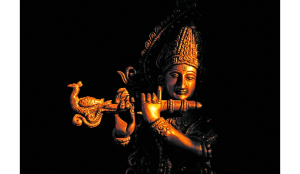
The cow’s rich symbolism extended seamlessly into the divine realm, shaping the imagery and attributes of the gods. Krishna embodies the intimate bond between humans and cows. Shiva’s vehicle, Nandi the bull, represents strength and Dharma. The Manusmriti assigns a fertile cow greater value than a hundred horses, underscoring her multifaceted and lifelong utility, namely providing milk for human nutrition, dung for fuel and soil enrichment, urine for medicinal applications and horns for various practical needs.
In the Epics, Puranas and Dharmashastras, the cow is repeatedly linked with purity, blessing and moral responsibility. In the Anushasana Parva of the Mahabharata, Bhishma tells Yudhishthira that the cow serves as a surrogate mother to humanity by providing milk for life.
The gift of a cow (Go-dana) was considered one of the highest acts of piety, yielding immense spiritual merit. Cow slaughter was regarded as a grave sin, equated with Brahmanicide (the murder of a Brahmin). The Manusmriti and various other scriptures explicitly forbid cow killing. By the Gupta Empire period, it had been declared a capital offence in several regions.
With the passage of time, the cow acquired rich symbolic meaning in Indian thought. In her quiet, continuous and selfless giving, providing nourishment without expectation, the cow echoes the ideal of motherhood. Due to this deep resemblance, she is affectionately called ‘Gau Mata’ or Mother Cow in Indian thought. This idea is not merely sentimental. It becomes a model of nurture without violence, abundance without greed and service without pride. Such symbolic meanings helped transform the cow from an economically valuable animal into a civilisational metaphor.Another crucial dimension of cow reverence in Indian civilisation is its close association with the principle of Ahimsa (non-violence).
One of the most distinctive features of Indian civilisation is the progressive deepening of ethical restraint and compassion towards living beings. The cow became a powerful emblem of this moral evolution. Gentle, non-aggressive and highly productive, it came to embody Dharma so deeply that harming it was viewed as a grave ethical breach. In the classical Indian imagination, the ideal human being is not one who dominates the weak, but one who protects vulnerable and life-giving beings. Cow protection, therefore, came to constitute moral ethics, not merely a social custom.
The cow’s significance in Indian culture and civilisation is vast and multilayered. It is a source of nourishment, a pillar of agriculture, a symbol of motherhood, a marker of prosperity and a living embodiment of Dharma and Ahimsa.
This reverence did not stem from superstition or mere sentiment, but from a profound civilisational understanding of life as interdependent and sacred. To protect and respect the cow is to honour that timeless wisdom, to affirm that genuine progress lies not in domination over nature, but in harmonious coexistence with it. Hence, we need to protect and care for the cow in a manner consistent with the civilisational values we so often invoke. The responsibility for addressing this cannot rest solely with the state. Rather, it calls for a conscious, collective awakening, one that transforms reverence from symbolic sentiment into lived ethical practice. A community-led, community-driven movement is required in which citizens actively participate in the dignified upkeep of cows. This may include the establishment of well-managed, locally supported cow shelters independent of state initiatives, alongside a more proactive and expanded responsibility for RWAs. They should protect cows and not allow them to languish on the streets of residential colonies. Only through such shared responsibility can the sacred bond between humans and cows be meaningfully sustained in contemporary times.
The writer is a former IPS officer and Director, Bharat Ki Soch; Views presented are personal.
Leave a Comment
Comments (1)
गौ माता गोमतीI ॐ श्री गौमाताय नमःII