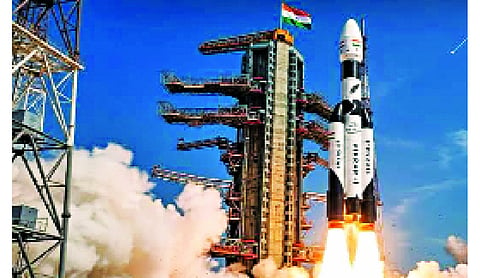

On the morning of July 18, 2026, a seven-storey rocket lifted off from the Satish Dhawan Space Centre in Sriharikota, climbed for roughly fifteen minutes, and placed several payloads into orbit some 450 kilometres above the Earth. The rocket was Vikram 1. The company that built it, Skyroot Aerospace, is not a government arm, not a legacy defence contractor, and not even a decade old. With this single launch, India became only the third country in the world, after the United States and China, where a privately built company has independently designed, constructed, and flown its own rocket into orbit.
It is worth sitting with that fact before moving on to the human story around it, because the number that matters most here is not four payloads or 450 kilometres. It is six. Six years ago, in May 2020, the Government of India announced that the space sector, until then a strict government monopoly, would be opened to private participation. Six years later, an Indian startup has done something only two other nations have managed at the level of private industry. That is an extraordinarily short runway for a result of this magnitude, and it deserves to be the actual headline.
For most of independent India’s history, space was constitutionally the exclusive domain of the state. The Indian Space Research Organisation designed the launch vehicles, built the satellites, and owned the launch pads; private firms, at best, supplied components and hoped for a contract. This was not unique to space. Telecom, coal, aviation, and banking all operated for decades on the same premise: that certain sectors were too strategic or too capital-intensive to entrust to private hands. The costs of that premise rarely show up immediately. They show up as absence: as a generation of engineers who dreamed of building rockets but had exactly one employer to dream about; as capital that might have funded ten competing approaches to a hard problem instead funding one; as innovation that thrives on rivalry never getting a field to compete in. Closed sectors do not just constrain companies. They constrain what an entire generation is permitted to imagine for itself.
The two engineers behind Skyroot understood this from the inside. Pawan Kumar Chandana and Naga Bharath Daka met as scientists at ISRO, one having worked on India’s heaviest launch vehicle, the GSLV Mark III, the other bringing expertise in the avionics that let a rocket sense its own position and correct its path mid-flight. In June 2018, while it was still, in practical terms, unthinkable for a private company to build its own rocket in India, they left secure government careers to start one anyway, with ten people and $1.5 million in seed funding. Eight years and more than $160 million later, that bet has produced a rocket now in orbit.
It is tempting to tell this purely as a story of individual daring, and it is that. But it would be a mistake to read Vikram 1 as proof that the private sector succeeded where the government failed. The truth is closer to the opposite. Chandana and Daka’s technical skill was built inside ISRO, on the back of decades of public investment in their training. More than seventy technologies developed within ISRO have since been formally transferred to private industry, letting companies like Skyroot build on government research rather than start from zero. What changed in 2020 was not the talent. It was the permission, and the establishment of IN-SPACe as a single-window regulator, so a startup no longer needed to navigate ISRO’s internal processes just to test a rocket engine. Government investment supplied the skill; policy reform supplied the outlet. Vikram 1 is what happens when those two things are finally allowed to meet. The rocket’s name is itself a quiet argument for that reading. It honours Vikram Sarabhai, the physicist who founded ISRO in 1969 on the conviction that a poor country could not afford to stay out of space, not to compete with wealthier nations for prestige, but because space technology was how India could leapfrog straight to solving problems on the ground: connecting villages, tracking monsoons, mapping resources. Sarabhai built that vision inside government because, in his era, there was no other institution capable of building it. Chandana and Daka have now shown that the same vision can be built outside it too, not instead of the government’s role, but as an extension of it. There is a strategic dimension worth naming plainly. India’s space economy is currently valued at roughly $8.4 billion, about two per cent of the global total, a modest share for a country that trains a disproportionate share of the world’s engineers. The government’s own projections put that figure at around $44 billion by 2033 and $100 billion by 2040. None of that growth was available while the sector legally belonged to a single government department. More than three hundred private space startups are now active in India, up from a handful five years ago, and the sector already supports close to a hundred thousand jobs. A country that can launch small satellites reliably and cheaply, precisely the market Vikram 1 was built for, is also a country that can become the launch partner of choice for the dozens of developing nations that want satellite access to agriculture data, disaster monitoring, and communications, but will never build a Sriharikota of their own. That is not only a commercial opportunity. It is a geopolitical one, and India is now positioned to claim it early.
None of this guarantees what comes next. Skyroot must still prove it can launch repeatedly, not just once; that it can compete on cost with established players; that international customers and insurers will trust a young company with expensive payloads. Those are real hurdles, and the company has been candid that they remain ahead of it. But the sequence that got India here is not really in dispute: the sector was closed, then it was opened, and within six years of opening, a company with no state backing put a rocket into orbit. That sequence is the real lesson of July 18, not that India has arrived in space, which it did in 1969, but that India has learned something about how to get out of its own way, and did not take nearly as long to learn it as history might have suggested.
The writer is a tech and social entrepreneur and Programme Director (Eastern India) at WHEELS Global Foundation, a Pan-IIT alumni initiative working across 20+ states in India; Views presented are personal.