
- HOME
- INDIA
- WORLD
- BUSINESS
- STATES
- LAW & JUSTICE
- ENTERTAINMENT
- SPORTS
- VIEWPOINT
- LIFESTYLE
- TECH
A new Tamil Nadu Govt is entitled to bring a fresh style and energy to public life. But the measure of governance cannot be the slogans that dominate the headlines. A government that came to power promising change must now demonstrate it through improvements in the lives of people, rather than through political theatre.
Tamil Nadu did not vote for a spectacle. It voted for a government. That distinction should be obvious. In the months since the new administration assumed office, too much of public life began to resemble an election rally extended into government, with high emotions, sharp slogans, carefully staged exchanges and an unrelenting search for the next viral moment. The hard work of democratic governance, with objective answers, measurable commitments, administrative clarity and respect for the institutions that make power answerable, is slowly becoming a relic of the past.
This is not an argument against change. Tamil Nadu’s electorate had every right to seek it. Many young voters, especially, chose to disrupt an entrenched political order. They were entitled to envision that a new entrant could bring energy, honesty and a different style of public leadership. That instinct was not foolish. It was democratic. But no electorate, however hopeful, elects a fan club. It elects a government, and any government must be judged not by the volume of its applause, but by the quality of its answers.
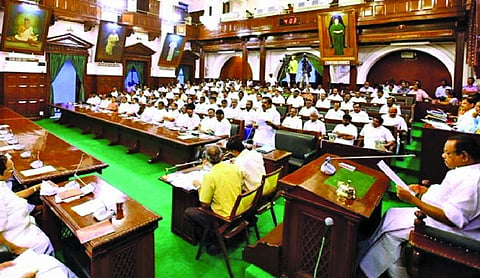
Tamil Nadu’s Legislative Assembly is a platform where elected representatives are expected to speak for people who need safe streets, decent schools, functioning hospitals, reliable jobs, affordable food, dignified welfare and justice without political favour. Tamil Nadu’s politics has long been shaped by the power of speech. Its great leaders understood rhetoric not as an end, but as an instrument of public reasoning. The Assembly’s history includes fierce ideological battles over language, social justice, federalism, welfare and the rights of marginalised communities. The language could be sharp. Politics could be unforgiving. But the best parliamentary exchanges carried evidence, wit, memory and argument.
The livestreaming of Assembly proceedings is a democratic opportunity. Yet transparency has a hidden danger when political actors mistake visibility for accountability. A clipped speech may trend. A taunt may travel farther than a budget reply. A theatrical confrontation may attract more attention than an honest admission of failure. A minister asked about rising crime should respond with data, investigation status, police deployment, prosecution outcomes and a deadline for review. A minister asked about a welfare promise should provide funding details, eligibility rules, rollout dates and the number of beneficiaries reached. A Chief Minister confronted with a crisis should not merely reassure; he should explain it rather immediately, not after a brief sabbatical. Tamil Nadu does not need a quieter Assembly. It needs a more serious one. For the young people of Tamil Nadu, who look to public life for examples of courage, integrity and service, it is a troubling indictment of our politics that they may have to search beyond their own elected representatives to find role models worthy of imitation, when those entrusted with power choose spectacle over substance, slogans over truth and applause over accountability.
Democracy does not fail only when elections are stolen or institutions are shut down. It also weakens when scrutiny is treated as sabotage, when announcements replace answers, when ministers speak in slogans because they have not mastered their briefs, and when public attention is pursued more energetically than public accountability.
A strong Chief Minister is not inherently a problem. Tamil Nadu has known strong Chief Ministers before. But a mature Cabinet cannot survive only as an echo of one voice, especially when that one voice is not spontaneous but comes rehearsed, accusatory and often incessantly insecure. Every portfolio must have a minister capable of defending it. Every promise must have a budget. Every announcement must have a deadline. And every failure must have a name attached to it. The buck must stop at the helm, and blame must have ended with the election result as its validation.
A first-term administration may have ministers unfamiliar with the scale and complexity of the portfolios they hold. That is not a crime. But the remedy cannot be improvisation. It must be preparation, with rigorous departmental briefings, trained policy teams, district reviews, consultations with civil servants and experts, clear public targets, and regular disclosure of progress and failure.
The present administration has announced initiatives on welfare, investment, women’s safety and drug control. Some of these steps deserve a fair hearing: expanded electricity support, crop-loan relief, the closure of certain TASMAC outlets, new women’s-safety measures and anti-narcotics units, and so on. But announcements are not outcomes. Several prominent manifesto commitments have yet to be implemented or have only been partially allocated, including the proposed increase in women’s monthly assistance, free LPG cylinders, a graduate unemployment allowance and statewide free bus travel for women. The government has cited fiscal constraints, while announcing elaborate infrastructure developments and expansion agendas that escape logic or necessity.
A manifesto is not a ceremonial booklet, but it is also a public commitment made in exchange for public trust. If a promise is delayed, say so. If its cost is unaffordable, publish the calculation. If it is redesigned, state the new terms. If it cannot be delivered, the voters must be informed. There is no shame in revising a policy after confronting fiscal reality. There is shame in preserving the language of a promise while quietly abandoning its substance.
No subject demands greater seriousness than violence and narcotics. Families do not need political blame games when their children are exposed to addiction, intimidation and criminal networks. They need a government that treats public safety as a measurable duty. The issue of rampant drug use cannot be fixed overnight, but requires systematic multidisciplinary legislation, public health interventions, including rehabilitation, law enforcement and transparent policing. In a functioning democracy, accountability is not an optional virtue; it is the foundation of good governance. A government that evades questions or reflexively blames its predecessors is not demonstrating leadership; it is confessing that it lacks either the courage or the competence to own the power it now exercises but once criticised.
The administration has also announced anti-narcotics teams, prevention efforts and rehabilitation measures. These are necessary beginnings. But arrest counts and seizure totals are not the final test of success. More arrests can reflect better enforcement; they can also reveal a larger problem. The true measure is whether drugs become less available, whether trafficking networks are financially dismantled, whether young people receive effective treatment, whether repeat offending falls and whether violence declines.
The government should publish a monthly public-safety dashboard: narcotics cases, seizures, chargesheets, convictions, repeat offences, gang-related violence, police response times, women’s safety indicators and the status of major investigations. It should also show whether politically influential offenders receive the same treatment as everyone else. “Zero tolerance” means nothing if tolerance remains available to the well-connected.
Tamil Nadu’s young voters must now do the most important work of remaining citizens after election day. Support for a new leader does not require the surrender of judgement. Admiration does not require silence. Fandom is an emotion; democracy is a responsibility.
Tamil Nadu’s achievements were not created by one leader, one party or one election. The DMK helped shape the State’s social-justice tradition and public-development model. The AIADMK left an enduring imprint on welfare delivery and the State’s direct relationship with ordinary families. Other smaller parties have also had an important role in helping establish equity and social justice. Their records may remain open to criticism, but their contribution cannot be tarnished by one election result. Tamil Nadu’s democratic inheritance belongs to all its people, not to whichever party currently occupies office.
Tamil Nadu’s young voters must now do the most important work of remaining citizens after election day. Support for a new leader does not require the surrender of judgement. Admiration does not require silence. Fandom is an emotion; democracy is a responsibility
The writer is a physician, psychiatrist and public health scholar with the US Department of Veterans Affairs in the USA; Views presented are personal.