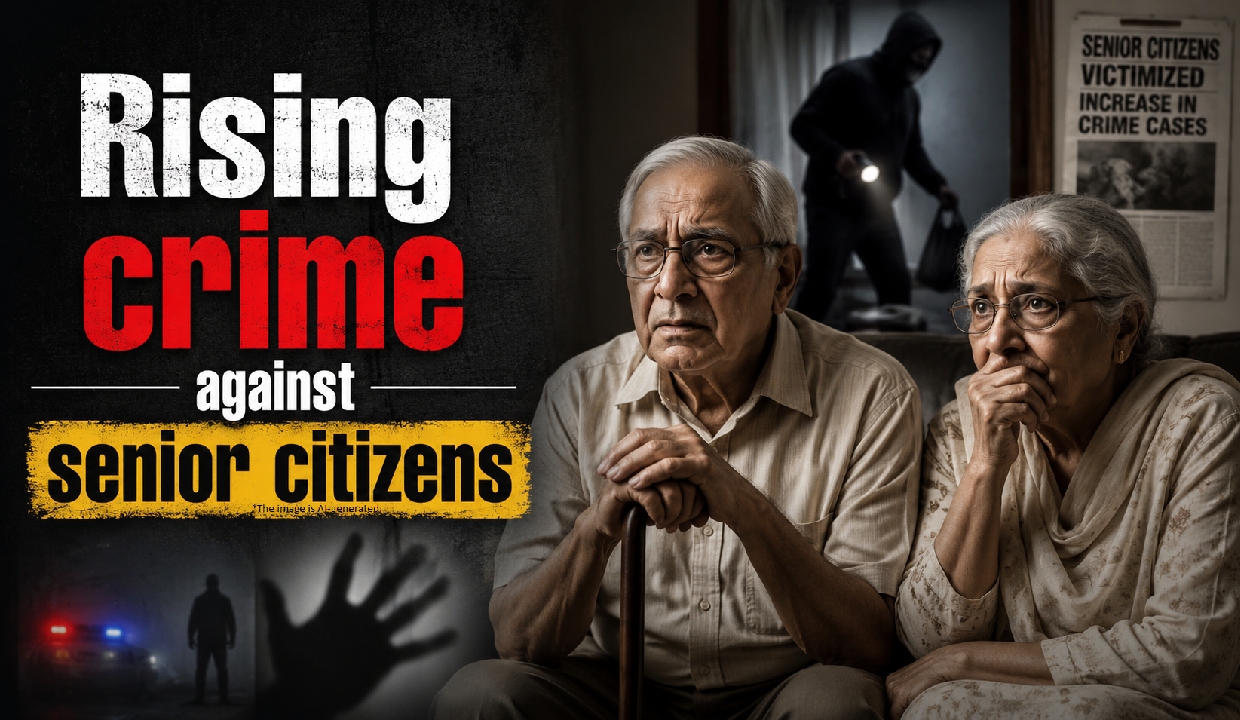
Rising crime against senior citizens
As India moves steadily towards becoming an ageing nation, ensuring safety, dignity and emotional security for senior citizens must become a national priority
India, at present, is a young nation, but is ageing rapidly. By 2050, the country will have a significant elderly population. As the country progresses and new technologies emerge, they also have a downside: they are alienating a large section of society - senior citizens who find it difficult to cope with evolving technology and changing times. They are increasingly becoming vulnerable as the joint family system gives way to nuclear families and fast-paced life becomes the norm. They often find themselves emotionally, physically and mentally vulnerable. Adding to this, some people take advantage of their vulnerability and exploit them for personal gain. It is both disturbing and shameful that there is a steady rise in crimes against senior citizens, which reflects a society undergoing rapid social and economic change without creating adequate systems of care and protection for its elderly.
According to the latest National Crime Records Bureau (NCRB) report, crimes against citizens aged 60 and above are on the rise. Crimes against the elderly rose by nearly 17 per cent in 2024, increasing from 26,306 cases in 2023 to 31,067 cases this year. While Madhya Pradesh and Maharashtra continue to remain among the worst places for the elderly, Delhi leads metropolitan cities in crimes against senior citizens. This is a disturbing statistic. It is not merely a law-and-order issue; it reflects the neglect and insecurity faced by those who were once the backbone of families and the nation.
Urbanisation and migration have weakened the traditional joint family system, while no adequate support system has emerged in its place. Many children leave home for employment opportunities, leaving ageing parents to fend for themselves. Their dependency makes them easy targets for theft, fraud, cheating and physical abuse.
Increasing digitalisation has also exposed many elderly people to cyber fraud, financial scams and identity theft, as their familiarity with digital technologies may be limited. Often, abuse comes from within families themselves, driven by property disputes, inheritance conflicts or financial dependence. The decline in social values and respect for elders has created a silent crisis that is rarely discussed. Many elderly people hesitate to report crimes because of fear and the difficulties associated with legal procedures. As a result, many continue to suffer in silence. The real scale of the problem may therefore be much larger than official figures suggest. Addressing this challenge requires both institutional reform and societal introspection. There is a strong case for dedicated senior citizen cells within police departments and regular monitoring of elderly people living alone. Community policing and periodic welfare visits can improve their sense of security. Technology can also play an important role through emergency helplines, wearable alert systems and awareness campaigns on cyber safety. Resident welfare associations, local communities and civil society organisations must create networks to regularly engage with and assist senior citizens. If senior citizens continue to live in fear and insecurity, it will represent not just a failure of governance, but also a failure of society.