Modern Parenting: Discipline or convenience?
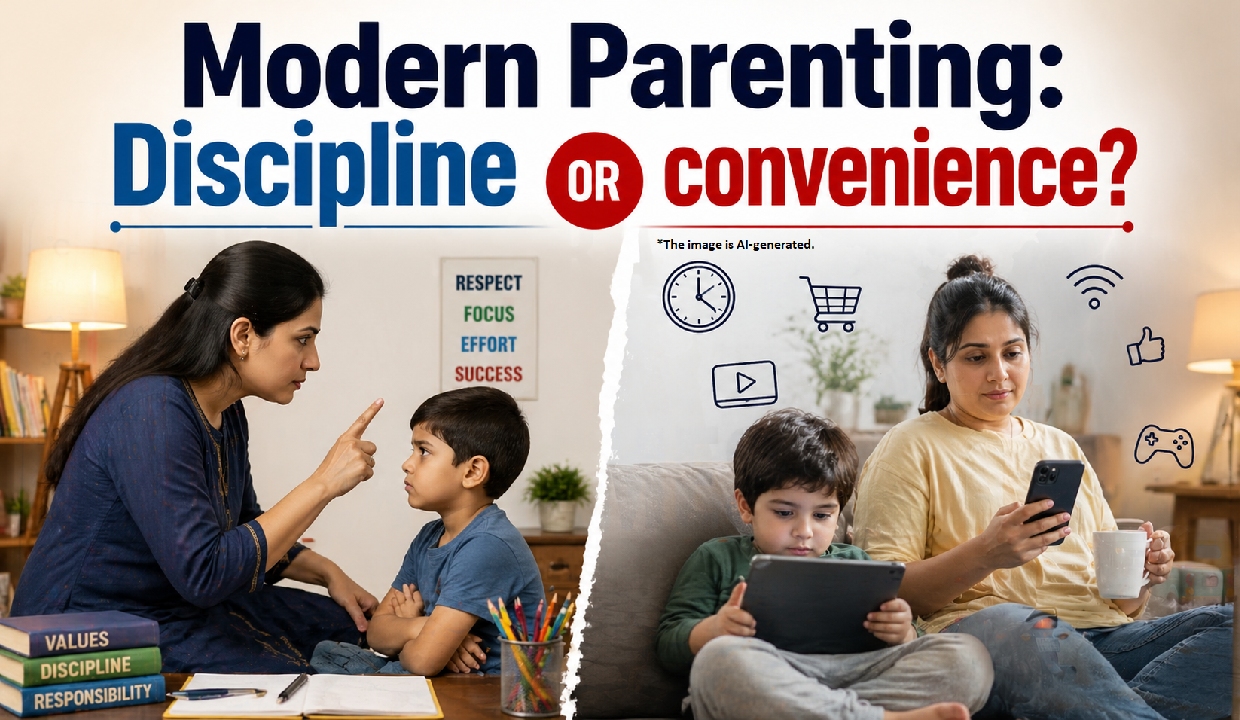
In an age defined by speed, noise, and constant distraction, an uncomfortable question confronts us: are we truly raising disciplined children, or merely managing their behaviour for our own convenience? The distinction may appear subtle, but its consequences are already unfolding in homes, classrooms, and society at large. Discipline, in its truest sense, is not about control or punishment; it is about guidance, self-regulation, and the steady shaping of character. What often passes for discipline today swings between two extremes—rigid restriction or complete absence of boundaries. Both are equally harmful. Consider the increasingly common sight of children pacified with smartphones in public spaces. While this may offer parents immediate relief, it creates a deeper dependency. Instead of learning patience or emotional control, children begin to rely on instant gratification. This pattern, visible in restaurants, homes, and even schools, replaces long-term development with short-term convenience. To be fair, modern parenting is not easy. Dual-income households, academic pressures, and the pervasive influence of digital media stretch parents to their limits. In such circumstances, convenience often becomes a coping mechanism.
Yet, when convenience replaces conscious effort, discipline becomes the first casualty. The impact is evident in classrooms. Educators increasingly encounter students who struggle with basic skills such as attentive listening, patience, and the ability to accept feedback. These are not intellectual deficits but signs of weakened discipline. Such behavioural gaps do not emerge overnight; they are the result of gradual neglect in nurturing essential habits. Technology plays a decisive role in this shift. Today’s children grow up in a world of constant stimulation—likes, views, instant answers, and endless comparison. Algorithms are designed to capture attention, not build character. When children become accustomed to immediate rewards, the slower, effort-driven processes of real learning begin to feel burdensome. A child abandoning a difficult math problem within minutes is not necessarily lacking intelligence, but endurance—the very quality discipline is meant to cultivate. Equally concerning is the growing reluctance to say “No.” Many parents fear that setting limits may harm a child’s self-esteem or strain their relationship. However, discipline without boundaries is directionless.
A child who never encounters refusal does not become confident, but entitled—ill-equipped to handle rejection or responsibility. Even simple routines, like fixed bedtimes, play a vital role in building self-regulation. Their absence often manifests in irritability, lack of focus, and declining performance. It is also crucial to distinguish discipline from punishment. Harsh scolding or humiliation may enforce temporary compliance, but they do not foster understanding. True discipline is rooted in consistency, explanation, and example. It teaches children how to respond to failure—with reflection and resilience, not frustration or blame. Importantly, discipline is not the sole responsibility of parents. Schools, communities, and media collectively shape a child’s environment. Discipline cannot flourish in contradiction. The reality, then, is uneven. While many parents and educators strive to instill values, there is a growing tendency to prioritise ease over effort and freedom over responsibility. What we need is not stricter control, but smarter discipline—built on consistency, clear expectations, meaningful dialogue, limited digital exposure, and an emphasis on effort rather than mere outcomes.
The writer is an educator and councillor; Views presented are personal.
Leave a Comment
Comments (1)
I completely agree with your article, and I would like to share a opinion that I wrote, about 3 years ago.