Lebanon and Trump’s imaginary peace deal
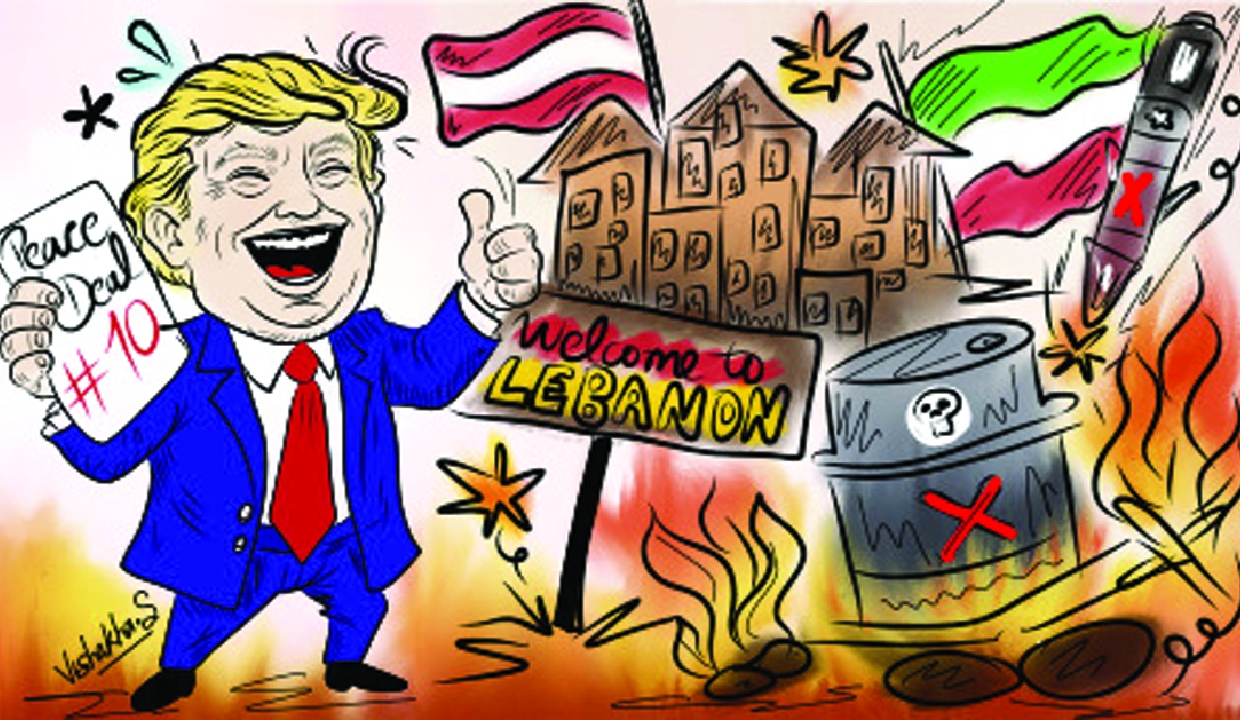
When Donald Trump announces another ‘peace deal’, the claim often dissolves under scrutiny. His latest assertion — ending an Israel–Lebanon war — adds to a pattern of victories declared online but absent on the ground
Last year, the United States Department of State had released a contested post on the social media of President Donald Trump, claiming that he had ended 7 wars in 7 months. The list had included the wars in Rwanda-Congo, Kosovo-Serbia, Egypt-Ethiopia, India-Pakistan, etc. They later issued a dramatically revised list of 8 wars in 8 months to include what they claimed was the end of the Israel-Hamas war (it is still on). Recently, Trump continued his unsubstantiated claims by announcing that he had previously solved 9 wars (he did not clarify which 9th war) across the world, and now had just ended the Israel-Lebanon war as his 10th peace deal.
Not known for his sense of history, facts, or even nuance in what he keeps claiming, the historically wounded and deeply fractured land of Lebanon becomes the latest “trophy” in Trump’s make-believe accomplishments. Besides the fact that Delhi has explicitly denied any hand of the United States of America in ending the Indo-Pak war, Serbia has clarified that it had no intention of going to war with Kosovo, and meanwhile, the violence in Congo and the Israeli war with Hamas continues unabated. Going by the credibility of Trump’s claims, the missing 9th war that he is supposed to have ended could only be speculated to be the US-Israeli war on Iran, but that too is far from over.
So far, the invading Israeli military has killed more than 2,100 people in Lebanon, including nearly 200 children, and displaced over 1.3 million people (one-fifth of the country’s population). This Israeli invasion was in reaction to the firing of rockets at a military site (importantly, not on a civilian area) in the Israeli city of Haifa by Iran’s co-sectarian Hezbollah, immediately after the US-Israeli attack on Iran. Implicit in the weak Israeli argument for invading Lebanon by the Benjamin Netanyahu dispensation is the untenable logic that while it can attack a sovereign like Iran, it cannot allow any force (read, Hezbollah) to attack Israel in the name of standing up for Iranians. The Hezbollah rocket attack had led to two Israeli deaths, and the subsequent Israeli reprisals were reminiscent of the gross disproportionality à la Gaza Strip (where 70,000 Palestinians have been killed), with the same flattening of townships and razing of villages on the Lebanese side. As always, Trump has chosen to remain selectively mealy-mouthed about Israeli excesses on the Lebanese front, just as he chose to look away whilst the Gaza Strip was reduced to rubble, with utter impunity and immunity.
Trump may never know that the Lebanese war with Israel predates Hezbollah. Beirut had joined Arab states in opposing the creation of Israel in 1948. The Israel-Lebanon border has never really been peaceful, with earlier Israeli invasions of Lebanon (1978 and 1982) setting the stage for the creation of Hezbollah. Today, with Iran busy warding off the challenge from American attacks, Israel realises that Hezbollah is essentially without the usual Iranian support, and hence the opportunity to push on, whatever the human consequences. This is despite the fact that Pakistani PM Shehbaz Sharif had clarified that Lebanon was part of the ceasefire and any strikes from Israel would be a violation. Israel did invade Lebanon nonetheless, and the seemingly hapless Trump administration was left meekly stating that it was a “legitimate misunderstanding”, thereby giving the Israelis a clean chit yet again. American allies in the European Union have openly leaned in favour of Lebanon by calling upon “all sides to implement the ceasefire, including in Lebanon”. Like the unheeded warning in the Gaza Strip earlier, the World Food Programme has warned of a similar food insecurity crisis in Lebanon, but the Trump-Netanyahu duo remains unrepentant and unconcerned.
There are good political reasons for Netanyahu to keep the pot boiling with Hezbollah in order to retain a state of emergency, which distracts from his unpopularity on the domestic front and serious charges against him personally. He instinctively favours brute force over diplomacy, and in Hezbollah, he has a convenient handle. The history of invasions of Lebanon (including 2006) is instructive: angst against Israel can never be clamped down by force. The current invasion, if not pulled back by the Israeli Defense Forces (IDF), will lead to an even bloodier and existential war for survival. Hezbollah will go flat-out to counter the occupation in its own limited way, and perhaps that bloodshed is exactly what Netanyahu seeks to prolong his own relevance. Meanwhile, Donald Trump is busy singing hosannas in his own favour on account of some mythic peace that he supposedly brokered between the Israelis and Hezbollah, when Israeli soldiers continue to occupy Lebanese land. Serendipitously, Trump has a like-minded and shifty Lebanese President in Michel Aoun, who is known to shift loyalties.
As a Christian leader, Aoun has very limited say in the affairs of Shiite Hezbollah, and therefore any talks of peace with the Lebanese government are not the same as talks with Hezbollah directly. Ultimately, peace in Lebanon is dependent on how Trump ends his own ill-advised war on Iran, and the outcomes of the same will have the only tangible impact on ending the war in Lebanon. Short of that, history repeats itself, and Nero in Washington, DC dances as Lebanon burns.
As a Christian leader, Aoun has very limited say in the affairs of Shiite Hezbollah, and therefore any talks of peace with the Lebanese government are not the same as talks with Hezbollah directly
The writer, a military veteran, is a former Lt Governor of Andaman & Nicobar Islands and Puducherry; Views presented are personal.