Learning from Ramayana: the ill effects of psychological manipulation
We live in an age when information travels within seconds. Social media, artificial intelligence, online news and phone algorithms have transformed how we encounter events and opinions. Yet our greatest challenge today is often not a lack of information but the difficulty of telling reality apart from narratives designed to shape how we feel about it.
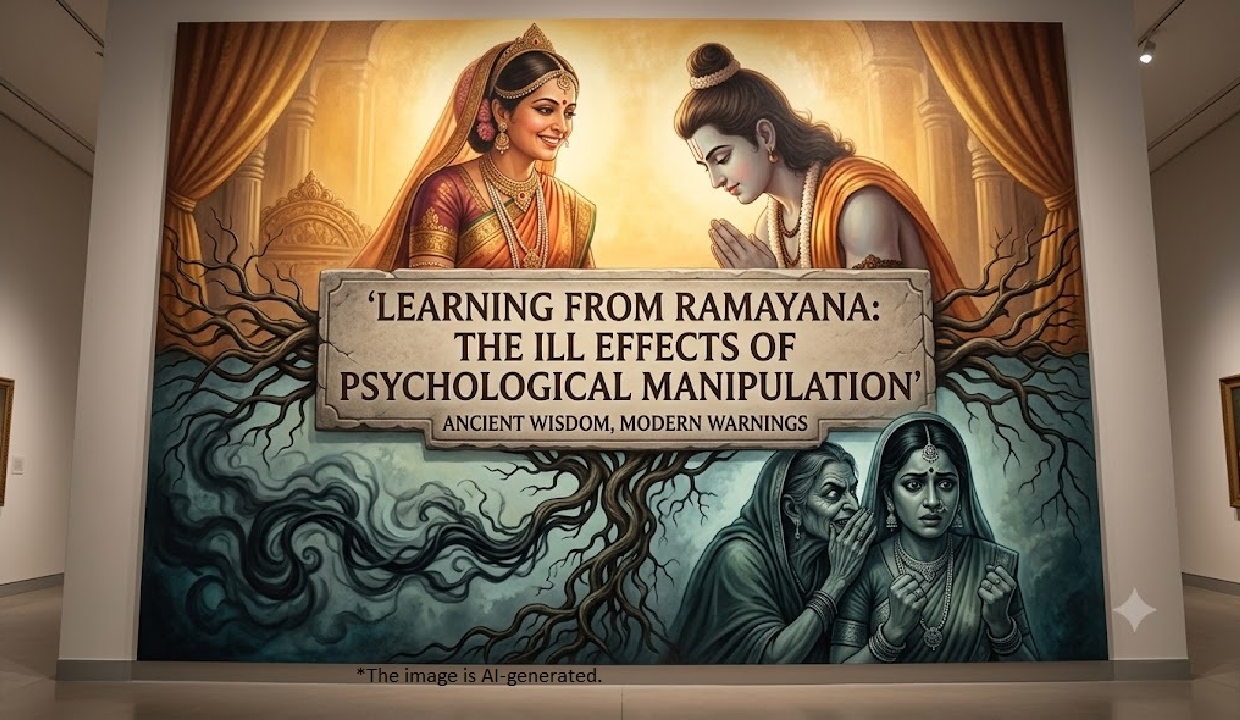
Long before any of these technologies existed, the Valmiki Ramayana offered a strikingly detailed portrait of exactly this problem - through the relationship between Manthara, Kaikeyi and king Dasaratha. The episode is usually read through the lens of ambition, family conflict and dharma, and rightly so; it is one of the most layered relationships in the epic, and Kaikeyi’s own reasoning and grief are as much a part of the story as anyone’s influence over her. But alongside that reading, the episode also rewards a second look - as an early and remarkably nuanced illustration of how perception, once altered, can alter judgment and how judgment, once altered, can alter the fate of an entire kingdom.
Changing the Lens, Not the Picture
At the start of the episode, Kaikeyi is affectionate towards Rama. When she learns he is to be crowned, she reacts with genuine happiness, telling Manthara that Rama is as dear to her as her own son Bharata:
(Ayodhya Kanda, 2.8.18)
"Rama is as dear to me as Bharata, and serves me with even greater devotion than Kausalya’s own son."
This matters, because it tells us Kaikeyi’s starting point was not suspicion but warmth. Manthara does not need to invent a new reality; she only needs to change how an existing one is interpreted. She begins by turning celebration into unease:
(Ayodhya Kanda, 2.8.2)
"Foolish one, why do you rejoice at what should trouble you? You do not realise you stand in the middle of an ocean of grief."
She then steers Kaikeyi’s attention toward an imagined, frightening future:
(Ayodhya Kanda, 2.8.39)
"The day Rama gains the kingdom, Bharata will surely be ruined."
Nothing in Kaikeyi’s actual circumstances has changed at this point - only the story she is being told about her circumstances. This is in essence how framing works even today: repetition lends weight to a possibility and a vivid enough possibility can begin to feel like a certainty. What is worth remembering, though, is that the epic does not present Kaikeyi as passive throughout this exchange - she resists initially, asks questions and only gradually is drawn in. The manipulation succeeds not because she is foolish but because fear, once seeded, is difficult to reason one’s way out of - a very human vulnerability not a flaw unique to her.
From the Persuaded to the Persuader
The more consequential turn comes when Kaikeyi, having been moved by Manthara, approaches Dasaratha herself. She does not present a political argument; she draws on the emotional bonds between them - his affection for her, his sense of obligation, and an old promise of two boons:
(Ayodhya Kanda, 2.9.20)
"Ask your husband for the two boons - the coronation of Bharata, and the exile of Rama for fourteen years."
Dasaratha is not persuaded through argument; he finds himself caught in a bind between two honest commitments - his word to Kaikeyi, and his duty as king and father to Rama. Both are genuine values. The tragedy is that they have been placed in direct opposition to one another, at a moment when he is least equipped, emotionally, to weigh them clearly. The Bhagavad Gita - speaking, admittedly, in an entirely different context, that of spiritual discipline rather than statecraft - nonetheless offers a useful description of how sustained emotional focus can cloud judgement:
(Bhagavad Gita, 2.62-63)
"From dwelling on objects of attachment grows longing; from longing, desire; from thwarted desire, anger - and from anger, the ruin of memory and judgement."
Read alongside the Amrtabindu Upanisad’s observation that "the mind alone is the cause of bondage and liberation" (2.2), the episode suggests something worth sitting with: that clarity of judgement is fragile, and that even good people - a loving stepmother, a devoted king - can be led to outcomes neither would have chosen with a clear mind.
An Old Lesson for a New Medium - Psychological war fare
Manthara does not need to whisper in a palace corridor today. Her modern equivalent might be a notification, a selectively edited clip, or a message repeated until it feels familiar. Social media and digital platforms have, on balance, done a great deal of good - they have widened access to information and given ordinary citizens a voice they didn’t previously have. But systems built to hold our attention will often reward what is emotionally loud over what is merely accurate, because outrage and alarm travel faster than careful explanation.
The deeper risk is not always outright falsehood. Even true information can mislead when it is stripped of context, repeated relentlessly, or arranged to provoke a particular reaction. The lesson from Manthara is not that we should distrust every message we receive - that would be neither possible nor healthy. It is that we might usefully pause before trusting our own immediate emotional reaction to one. A few simple questions can help: What is the evidence here? Who benefits if I believe this? What context might be missing? Am I being shown facts, or simply being walked toward a conclusion?
The Ramayana, read this way, offers a gentle but enduring caution: the most consequential influence rarely begins by changing the facts in front of us. It begins, more quietly, by changing how we see them. That is as true of a palace in Ayodhya as it is of a phone screen today - the technology has changed considerably; the underlying psychology, perhaps, rather less.
We all too must recognise that information manipulation can become a form of invisible governance sabotage. So, we must be very conscious before believing anything. The Ramayana ultimately offers a deeper warning. The most consequential manipulation may not begin by changing reality. It begins by changing the way reality is perceived. Manthara changes Kaikeyi’s interpretation. Kaikeyi then changes Dasaratha’s choices. A mischievous private psychological intervention consequently can produce a public catastrophe which can also impact national security adversely. Gullible minds can become easy bait to unscrupulous foreign elements to promote strife and destabilize the country. In the digital age, a whisper can become a notification and repetition of a lie can reach millions within minutes. The technology is new but the psychology is ancient. The enduring lesson is therefore that protecting a democracy requires not only securing its institutions but also preventing sabotage through misinformation.
Dr. Bharat Dash, Professor and Dean Sri Sri University lead guide of Bharat Ki Soch & Dr. Manashi Ghosh, Junior Research Fellow, Bharat Ki Soch; Views presented are personal.