India eyes Amphibians for coastal watch
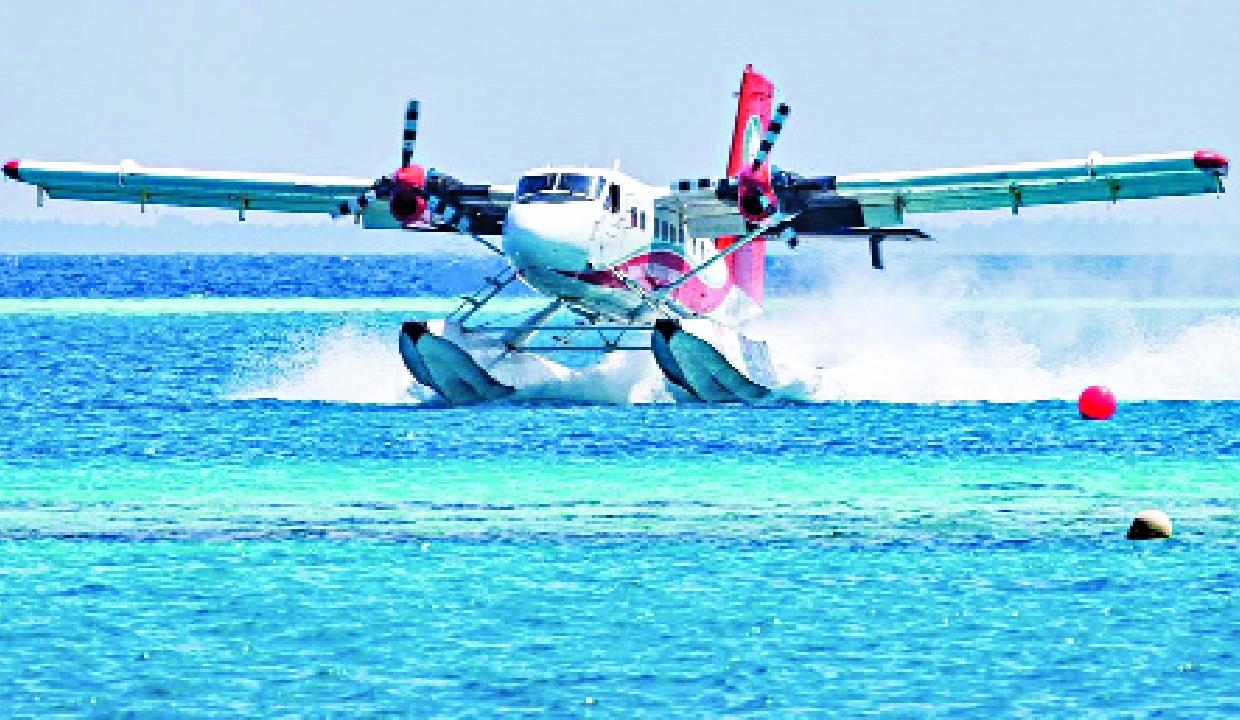
From disaster relief and coastal defence to tourism, the future of India’s maritime aspirations will depend upon innovative technologies. in this scenario amphibian aircraft emerge as a crucial yet underexplored option — one that could reshape India’s preparedness, connectivity, disaster response and maritime dominance
The description of India as a vast Himalayan sub-continent overshadows India’s claim as being the world’s second-largest peninsula, with the Tropic of Cancer bisecting the country into two equal halves. Peninsular India, surrounded by the Arabian Sea to the west, the Indian Ocean to the south, and the Bay of Bengal to the east, has a formidable maritime boundary running unbroken for 7,500 kms. The geostrategic importance of India’s peninsular boundary becomes critical in light of her maritime neighbours - the Maldives and Pakistan to the west, and Bangladesh, Myanmar, Thailand, Malaysia, Indonesia, and Sri Lanka to the east and south. The archipelagos of Lakshadweep and the Andaman and Nicobar Islands further define her position as a maritime nation.
Till now, the peninsular location of India has protected it from misadventures by unfriendly neighbours. But history does not give any advance notice of a strategic paradigm shift.
The strategic aspect of India’s maritime dream is comprehensively captured in India’s Maritime Doctrine 2025, authored by the Indian Navy, while the economic aspect is covered by the Maritime Vision 2030 released by the Ministry of Ports, Shipping and Waterways. The first document highlights the ever-lurking threats in waters within India’s sovereign zones and beyond, and the need for extensive and intensive patrolling. The second document underlines the need to fully exploit the economic benefits of our maritime assets and the steps necessary to secure our Blue Economy dream.
In light of recent political developments in the Gulf that have altered the global order, India is faced with new realities regarding the nature and direction of hidden threats. It is now commonly accepted that the costs of land wars may far outweigh the gains. The loss of civilian lives, damage to schools and hospitals, and the cost of maintaining and feeding a huge army in peacetime amount to self-goals. Among the newer and more cost-effective ways to cripple an enemy would be selective attacks on logistics and the choking of supply lines, leading to the depletion of agricultural and industrial inputs. Moving away from the era of land wars, such attacks are likely to be launched from the sea, air, land, or through a combination of all three.
Securing India’s maritime dreams will require a different kind of wings in the air and hulls in the water. Before India can become Atmanirbhar in the range of equipment required to safeguard its maritime boundaries, it must first identify its precise requirements and create a critical inventory capable of responding to emergencies. The changing nature of warfare is also likely to render huge inventories of traditional military hardware obsolete. Can India’s manufacturing infrastructure — both public and private - along with its defence research capabilities, address these emerging needs?
The changing nature of warfare also demands a reassessment of how we perceive threats. We need to clearly pinpoint and assign responsibility for guarding India’s maritime interests. Is it the responsibility of the state police in coastal states, the Indian Coast Guard, or the Indian Navy? The seas on both sides of the Indian peninsula are replete with unidentified, unregulated, and unregistered vessels sailing casually. These may well be the prying eyes and spying ears of hostile forces.
The Indian Coast Guard, the guardians of our coastline and the first line of coastal defence, has performed an exemplary role in patrolling the seas. It can claim credit for several daring rescue and reconnaissance missions. Hundreds of distress calls are made to the Coast Guard every week, and it is expected to respond each time.
This brings us to the moot point: what equipment do we currently possess that can effectively meet the challenges along our maritime borders? Of course, we can create more road access to the coast and along the coastline, or build new airports and heliports. However, roads and airports require land acquisition and often result in environmental degradation through the depletion of arable land and green cover. Airports can also become vulnerable targets, easily crippled by a well-directed attack. Helicopters are limited by their range and speed. Speedboats? Pirates may possess faster vessels equipped with superior avionics and firepower.
Pirates have mastered the art of deception by flying misleading flags and even waving casually at our coast guards, fully aware that Coast Guard Dornier aircraft cannot land on water and are not weaponised. At best, they can alert nearby vessels, but reaching the location may take considerable time. How do we rescue naval crews in response to an SOS from a stranded vessel in the high seas? Or respond swiftly to distress calls from India’s offshore oil rigs? History has repeatedly demonstrated the catastrophic cost of delays in reaching burning oil rigs despite timely SOS signals.
Disasters have also occurred in the Himalayas - avalanches, glacial lake outbursts, and earthquakes. Is there a vehicle capable of rapid rescue and evacuation in such conditions? The answer lies in the emergency services provided by amphibian aircraft. They can conduct search, rescue, and evacuation operations on virtually any surface, including alpine glaciers. They fly faster than helicopters, possess greater range, can operate in adverse weather, and carry heavier payloads.
Today, specialised amphibians perform highly diverse roles. Fire-retardant water scoopers can collect 6,000 litres of water in just 12 seconds while in motion, dump the load instantly, reload within minutes, and repeat the process. As forests in Kumaon continue to burn, India still appears to lack a robust solution. Amphibians can also be modified into air ambulances equipped with operating theatres and ICUs — effectively becoming flying hospitals.
Amphibians can be weaponised to land alongside pirate vessels unexpectedly and identify illegal, unregulated, or falsely registered ships. As India strengthens its domestic borders, the coastline increasingly becomes the preferred route for unauthorised entry. One only has to recall how Ajmal Kasab and his associates used the sea route to reach Mumbai and enter the Taj Mahal Palace Hotel.
India’s maritime responsibility also extends to disaster mitigation and regional humanitarian assistance. India aspires to be regarded as the most dependable neighbour in the Bay of Bengal, the Indian Ocean, and the Arabian Sea during natural disasters and crises. This requires the capability to deliver relief rapidly. Amphibian-enabled rapid response systems for tsunamis, floods, and volcanic eruptions would strengthen India’s diplomatic standing as a soft power. The world remembers the first responder to a disaster; others are relegated to footnotes. One of the world’s most dramatic rescue missions, undertaken by the USAF and the US Marines in 1956 under “Project Magnate”, involved rescuing six stranded scientists and crew members after an air crash deep in Antarctica in sub-zero temperatures. With only a few hours available for survival, the amphibian aircraft flew hundreds of miles in inclement weather, located the wreckage, and landed on ice when the sea proved too rough. All six survivors were rescued and flown to safety. Does India possess an amphibian aircraft with such capabilities? Hundreds of Himalayan lakes could be accessed using such aircraft, whether requiring landings on ice, water, or makeshift dirt tracks.
A maritime economy fundamentally uses water as a resource for mobility, economic value creation, livelihoods, and sustenance. More than 18 per cent of India’s population lives in 72 districts situated along the coastline across nine states. These regions include fishing communities, coconut growers, rice and cashew farmers, and skilled workers engaged in tourism, healthcare, and wellness industries.
With coastal tourism emerging as one of the fastest-growing sectors for sustainable employment, Maritime India is strongly positioned to become a major beneficiary of India’s growth story. India is blessed with eighteen “Blue Flag” certified beaches distributed across the nine coastal states, awaiting development. However, private-sector investment will materialise only with reliable all-weather connectivity. Many of these beach destinations remain pristine and hold enormous development potential.
One of the major constraints in offshore tourism development is island connectivity. Both Lakshadweep and the Andaman & Nicobar Islands are archipelagos consisting of numerous islands and atolls, many of which remain connected only by slow-moving boats. India’s ultimate maritime dream, recently unveiled, is the transformation of the Andaman & Nicobar Islands into a world-class destination rivalling Hong Kong and Vietnam. This would involve the creation of new townships, resorts, recreational centres, and hotels. Yet, inter-island connectivity infrastructure remains virtually absent today. The Maldives operates nearly 200 amphibian aircraft lined up along the keys like a fleet of black-and-yellow taxis. In the Andamans, a tourist may look out from a hotel window at a nearby island without any practical means of reaching it. India needs to rethink amphibian aviation. Large international aircraft can bring tourists into metropolitan hubs, after which amphibians could instantly connect them to islands - or even directly to hotels. Amphibian flying can also transform commuting and water sports. It could reduce travel time from Mumbai to Alibaug to a few minutes, Navi Mumbai Airport to the Gateway of India to ten minutes, Mumbai to Lonavala to forty minutes, and Delhi to Rishikesh to about an hour.
The writer was associated with the Tata Group and is an aviation expert as well as a trained pilot; Views presented are personal.