FIFA World Cup: Spain rules the world again
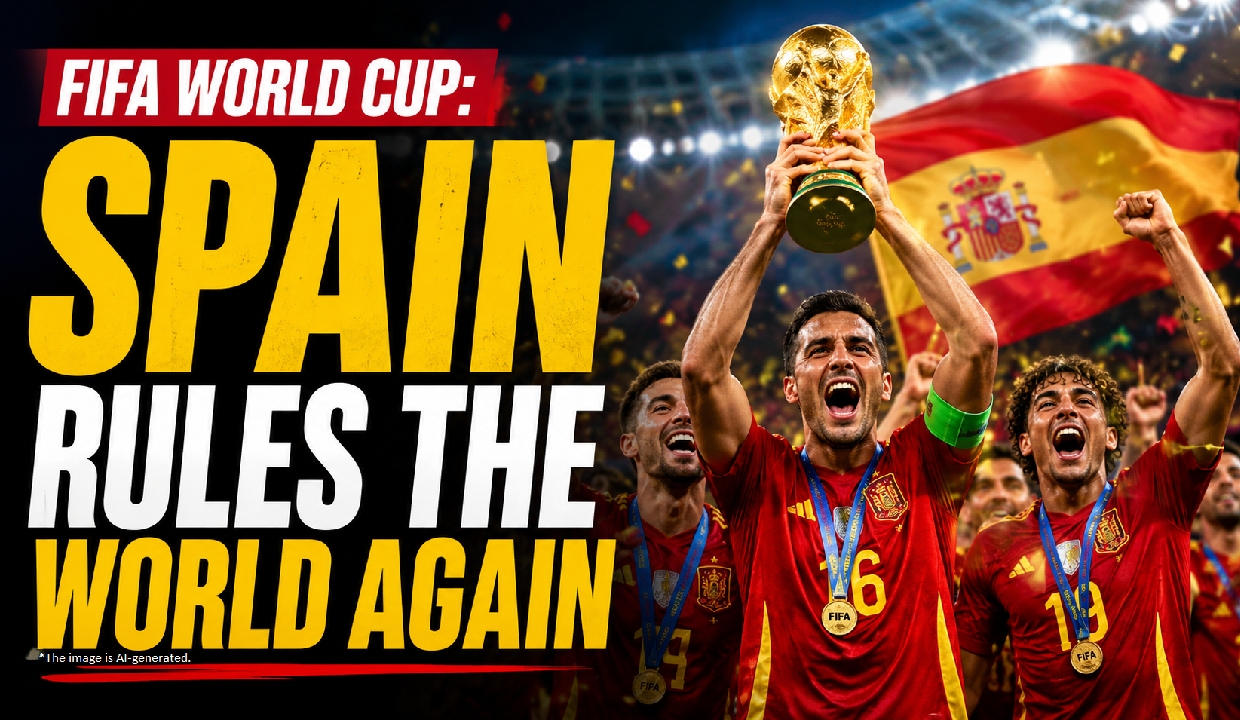
Football once again demonstrated its unrivalled global appeal, uniting nations, cultures and generations in a way few events can
Cricket may be the religion of the Indian subcontinent, but football is the religion of the world. Sunday’s proof came from MetLife Stadium in New Jersey, where Spain outlasted Argentina 1-0 in extra time to become world champions for the second time. Substitute Ferran Torres settled a stubborn final in the 106th minute, likely closing the book on Lionel Messi’s extraordinary World Cup career and confirming what football fans have suspected for two years: this Spanish side is the finest on the planet.
La Roja’s route was no procession. World Cup debutants Cape Verde defended heroically to hold them to a goalless draw in the opener, but Spain settled quickly, topping their group unbeaten before knockout-round scalps of Cristiano Ronaldo’s Portugal and, in the semi-final, Kylian Mbappé’s France. Along the way, goalkeeper Unai Simón set a World Cup record with six clean sheets, and Spain conceded only once in seven matches - the tightest defence any champion has fielded.
Nineteen-year-old Lamine Yamal, still managing an injury picked up before the tournament, became only the third-youngest player ever to feature in a World Cup final. Individually, the honours were shared. Rodri, Spain’s captain, imperious midfield anchor and the 2024 Ballon d’Or winner, won the Golden Ball ahead of Messi and Mbappé — recognition that control, not chaos, wins tournaments. Mbappé, despite France’s fourth-place finish, claimed the Golden Boot with ten goals, his second in as many World Cups and the first time anyone has repeated the feat. Messi, who dragged a young Argentina side to the final at 39, collects a Silver Ball as consolation in what he has said will be his last World Cup.
For Spain, this is more than another trophy. Paired with their Euro 2024 title and a 38-match unbeaten run, it confirms that a golden generation - Yamal, already a Ballon d’Or runner-up at 19, alongside Pau Cubarsí and Pedri — has inherited the tiki-taka blueprint and fused it with a defence built to match. Luis de la Fuente’s side has delivered back-to-back major titles, echoing the legendary 2008-2012 dynasty that won three in a row, and with most of this core still in their early twenties, a run at Euro 2028 already looms.
Spanish academies remain world football’s most reliable factory of champions. And yet in India, this triumph will register as a footnote beside the next cricket series. India’s men’s team is ranked 138th in the world, this year’s ISL season was disrupted by a boardroom dispute serious enough to reach the Supreme Court, and no Indian city has ever hosted a senior FIFA World Cup fixture. Cricket’s commercial machine — the IPL, blanket television coverage, a fan base nurtured since colonial times — leaves little oxygen for football to grow beyond pockets in Kolkata, Kerala, Goa and the Northeast. Sunil Chhetri’s era inspired millions, but India still awaits a true successor and, more urgently, the grassroots pitches and school-level coaching that turn passion into a footballing nation. Until administration catches up with appetite, India will keep watching the world’s game from the boundary line.
Leave a Comment
Comments (2)
France look like serious contenders, but one thing I always enjoy during the World Cup is following the historical side of the tournament. The mention of Algeria ending its long drought reminded me how many national teams are still waiting for a major trophy. I’ve been using https://trophydrought.com to keep track of those streaks—it adds an interesting layer to every match.
One thing I enjoy before and after every World Cup is looking at how long each nation has been waiting for a major international trophy. Seeing those droughts end (or continue) adds another layer to tournaments. This tracker is quite interesting: https://trophydrought.com.