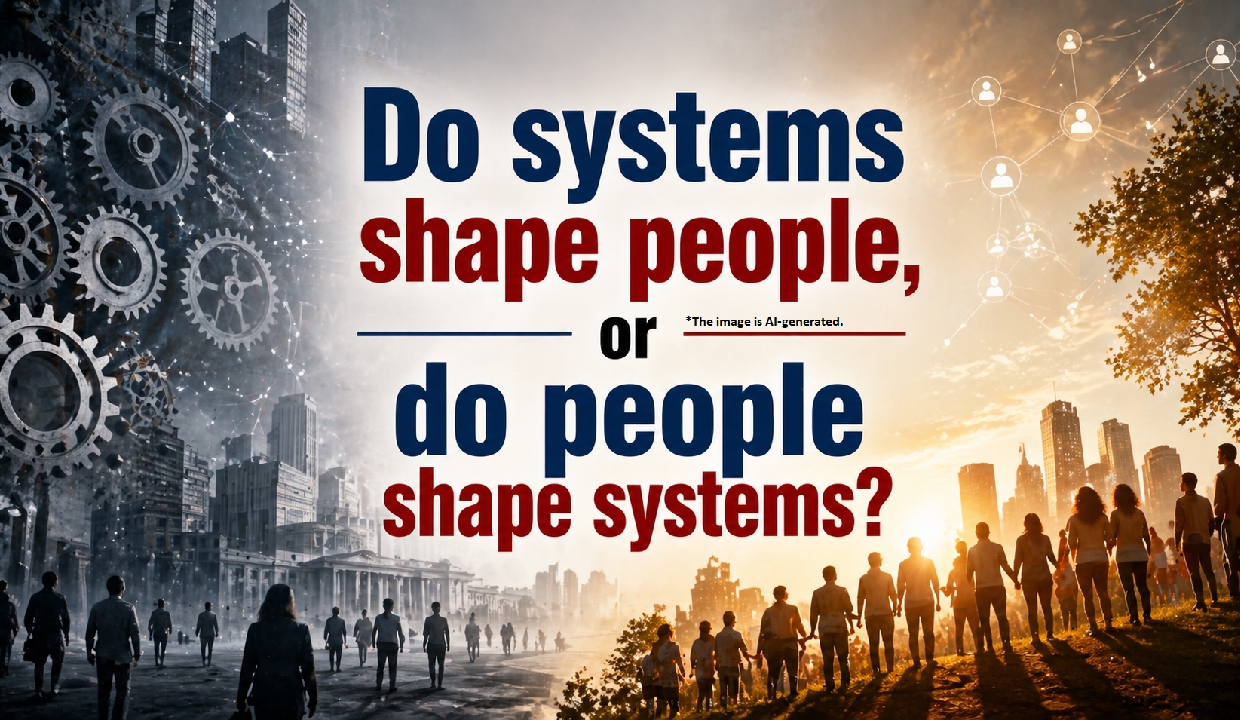
Do systems shape people, or do people shape systems?
My recent vacation in Germany left me with a lingering question: do people create systems, or do systems shape people? I wrote earlier about unruly behaviour in public spaces. This time, however, my experiences were not about people, but about systems-specifically, the much-regarded German railway network, Deutsche Bahn (DB).
We were to travel from Prague to Berlin by train. Even before we had begun our journey from India, we received an email informing us that our scheduled train had been cancelled. An alternative was suggested, but it was either unavailable or not easily traceable on their website. Eventually, we decided to make the journey by road-a decision that turned out to be fortuitous, allowing us to take in the landscape along the way.
For the final leg, from Berlin to Frankfurt, uncertainty continued. It was only upon reaching the station and checking the display board that we discovered our train would terminate about an hour short of the destination. What followed was a series of hurried adjustments-two train changes, heavy luggage in tow, and the added strain of limited communication with station staff due to language barriers. This was not the railway system I remembered from nearly three decades ago, when punctuality and efficiency were almost synonymous with it. Today, I found that DB had become, in some circles, a subject of quiet humour. These experiences led me to reflect on similar challenges that foreign travellers might face in our own country, particularly when navigating long-distance train journeys. There is much that still needs improvement. And yet, there are examples that point in another direction-instances where systems have not only functioned well, but have set benchmarks.
I had the opportunity to be associated with the construction of the Delhi Metro in its early years. Its Managing Director, E. Sreedharan placed unwavering emphasis on punctuality-first in construction, and later in operations. More importantly, this emphasis was not enforced merely through rules, but internalised by the people who worked within the system. Each individual became a custodian of that culture, contributing to what eventually emerged as a world-class transportation network. Even in personal life, he would ask his driver to continue circling a venue so as not to inconvenience the organizers if he was early. Japan offers another example. On one occasion, a mediator escorting us to a meeting ensured that we reached the vicinity well in advance, but deliberately made us walk around the block so that we would enter the office exactly at the appointed time. His reasoning was simple: arriving early or late would inconvenience the host and disrupt their schedule. Such experiences suggest that systems and people are not independent of each other. Systems may provide structure, but it is people who give them meaning. At the same time, well-designed systems can influence behaviour, nudging individuals towards discipline and consideration. Perhaps the real question, then, is not whether people create systems or systems shape people, but whether we are willing to take responsibility for both. It is easy to attribute failure to institutions and success to individuals, but in reality, each mirrors the other. Systems falter when people disengage, and people drift when systems lose clarity and purpose. If there is to be any lasting improvement, it will come not from expecting one to correct the other, but from recognising that discipline, accountability, and respect must flow in both directions-quietly, consistently, and without exception.
The writer is founder of Kala - Krazy About Literature And Arts, is an author, speaker, coach, arbitrator, and strategy consultant; Views presented are personal.
Leave a Comment
Comments (1)
We the people, can make our country great. Only if we practice best practices around the world. We learn, relearn and perform...like a child faltering. But we must choose to act. The time is now. It's good to know you were associated with one of the greats. I hope to learn from you....