Communication ethics in an age of conflict
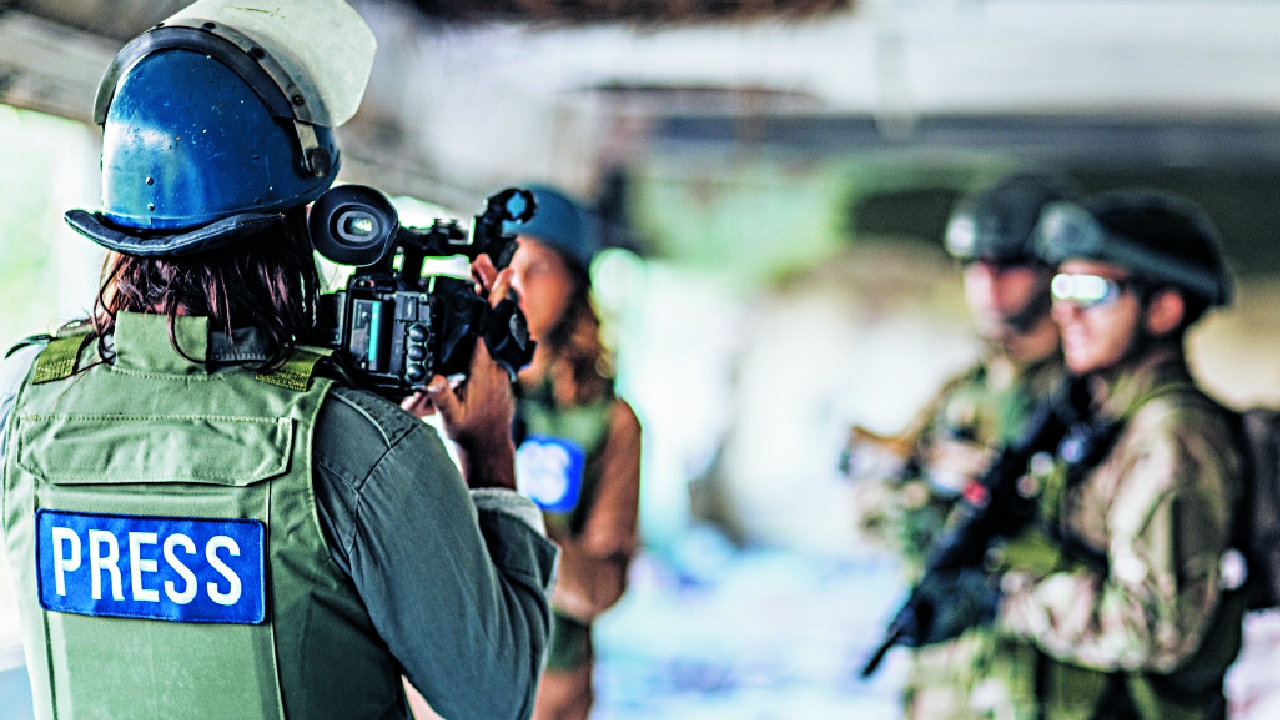
In today’s media environment, wars rarely remain confined to battlefields. They unfold just as vividly on television screens, digital platforms, and social media timelines. Every strike, every explosion, every movement of troops travels across the world within seconds. Technology has made it possible for audiences thousands of miles away to witness conflict almost as it happens. Yet this unprecedented access has created a strange paradox: the more we see of war, the less we often understand it.
What we are witnessing is the emergence of a new communication order around conflict. Information moves at extraordinary speed, but reflection rarely keeps pace with it. Images circulate faster than context. Algorithms amplify the most dramatic footage, and broadcasters compete for attention in an increasingly crowded media landscape. In such a setting, communication itself becomes part of the battlefield. While military operations determine the physical outcomes of war, the information environment shapes how societies interpret those events, how they emotionally respond to them, and sometimes even how they participate in them.
War reporting has not always looked like this. For most of the twentieth century, there was a distance between the battlefield and the newsroom. Journalists filed reports after verifying what had happened, often hours or even days later. That delay, though frustrating at times, created space for editorial judgment and context. Stories were written with the benefit of reflection rather than immediate reaction. Today, that distance has almost disappeared. Twenty-four-hour news cycles and real-time satellite feeds have transformed war into something that resembles a continuous broadcast event. The shift is subtle but important: we are no longer only reporting war, we are broadcasting it.
Television studios increasingly resemble control rooms for a global spectacle. Large digital screens display animated maps, missile trajectories, and radar simulations. Footage of explosions is replayed repeatedly from multiple angles. Anchors narrate unfolding events with urgency and drama. Graphics and sound design sometimes mirror the visual language of cinema or sports broadcasting.
In this environment, visual intensity often replaces informational depth. The purpose quietly shifts from explaining events to capturing attention. Ratings, viewership metrics, and digital engagement begin to shape editorial decisions. War becomes a form of content.
This raises an uncomfortable but necessary question: when conflict is presented as spectacle, does the audience gradually become a spectator rather than an informed citizen?
Images, of course, have always played an important role in communication. Powerful visuals can humanise distant suffering and generate empathy across borders. They can make the consequences of war visible in ways that statistics never could. But images also have the power to distort reality when they are presented without context.
In contemporary conflict coverage, viewers often encounter an endless loop of explosions, missile launches, and night-vision footage. Cameras gravitate toward the most dramatic scenes, fireballs lighting up the sky, buildings collapsing under airstrikes, or tracer rounds cutting through darkness. What receives far less attention are the quieter and slower dimensions of war: displaced families, fragile diplomatic negotiations, economic disruptions, or the long and complicated process of rebuilding societies after violence.
The result is a kind of visual hierarchy of war. The most spectacular moment dominates the narrative, while the structural realities that explain conflict remain largely invisible. Audiences are exposed to bursts of violence but rarely to the deeper political, historical, and economic contexts that led to the conflict in the first place.
Over time, this can produce something even more troubling: normalisation. When viewers encounter dramatic imagery of violence day after day, war can begin to resemble a form of high-stakes entertainment rather than what it truly is, a catastrophic breakdown of political order.
A newer challenge is now intensifying this dynamic: the growing use of artificial intelligence in visualising conflict. Some broadcasters have begun using AI-generated imagery or digital simulations to reconstruct how an attack might have unfolded, how missiles may have travelled, or how military planners might have executed a particular operation. These visualisations are often presented as explanatory tools, but they occupy a complicated space between journalism and dramatisation. Even when clearly labelled as simulations, the realism of AI-generated imagery can blur the boundary between fact and speculation. For many viewers, the difference between a verified image and a reconstructed scene may not always be obvious.
More importantly, such simulations often prioritise visual drama over analytical clarity. Stylised animations of military operations risk turning strategic violence into something resembling a cinematic sequence. What is presented as explanation can easily slip into oversimplification, or worse, a kind of theatrical staging of conflict. In an era already struggling with misinformation and manipulated media, the casual use of such imagery deserves far more scrutiny than it currently receives.
At its core, the issue is not technological but ethical. Media institutions across the world have developed elaborate codes of conduct for elections, political reporting, and even public health crises. Yet when it comes to the communication of war, reflection often gives way to speed.
Several uncomfortable questions, therefore, remain insufficiently discussed. Should broadcasters repeatedly display the mechanics of weapons used in attacks? Does visualising military capabilities inadvertently glorify violence or reveal sensitive information? How much speculative reconstruction should be permitted in news coverage? And perhaps most importantly, at what point does reporting cross the line into dramatisation?
These are not minor editorial dilemmas. They point to a deeper problem within the global communication environment: communication itself rarely undergoes introspection during conflict. The urgency of reporting tends to overshadow the responsibility of representation.
Perhaps it is time to think about a clearer ethical boundary. In sports, certain violations are so serious that they trigger an immediate red card. It is a simple but powerful signal that a line has been crossed. Everyone understands the rule, and everyone understands the consequence.
Conflict communication might benefit from something similar, a conceptual “red card” for media ethics. Such a framework would not exist to censor reporting but to establish limits that protect the integrity of journalism. Certain practices could clearly fall into this category: presenting speculative military scenarios as factual visuals, repeatedly looping violent imagery purely for dramatic effect, revealing tactical details that may escalate tensions, using AI-generated visuals without clear disclosure, or framing conflict in ways that trivialise human suffering. The goal would not be to silence journalism but to recalibrate it. Because the media ecosystem today is global, such questions cannot be addressed by individual broadcasters alone. A broader conversation is needed among international journalism bodies, academic institutions, and organisations concerned with information ethics. Together, they could help articulate a set of shared principles for responsible conflict communication.
Such principles might begin with a simple but important idea: context should always come before spectacle. Historical background, diplomatic developments, and humanitarian consequences should accompany battlefield imagery. Audiences deserve to understand not just what is happening, but why it is happening.
Transparency should also guide the use of digital reconstructions and AI simulations. If such visuals are used, they must be clearly labelled and treated as illustrations rather than evidence. At the same time, the human cost of war must be represented with the same prominence as military developments. Civilian suffering, displacement, and long-term societal damage are not side stories; they are central to the reality of conflict. Editors should also be mindful of how visual repetition shapes perception. Endless loops of violent imagery may attract attention, but they can also desensitise audiences and distort understanding. And in the relentless race to break news first, verification must never become secondary to speed.
Ultimately, the question is not whether wars will continue to be reported in real time. That is inevitable. The more important question is how societies choose to communicate war.
Media institutions hold immense power in shaping public perception. Their narratives influence how people interpret global events, how governments respond to crises, and how societies emotionally process conflict. Communication can inflame tensions and amplify fear, but it can also foster understanding and restraint.
The emerging communication order around war therefore, demands more than technological sophistication. It requires moral imagination. The ability to broadcast instantly must be matched by the wisdom to decide what should be broadcast, and how it should be presented.
In a world where war can be watched live from living rooms across continents, communication carries an enormous responsibility. Journalism must resist the temptation to turn conflict into spectacle. Its task is not to amplify the noise of war, but to illuminate its meaning.
The author is a Commentator and Writer on Cinema, Branding, Media Management and Geo-Strategic Communication. Inputs provided by Zoya Ahmad and Vaishnavie Srinivasan; views are personal