Communal violence clouds Balen Shah’s 100-day tenure
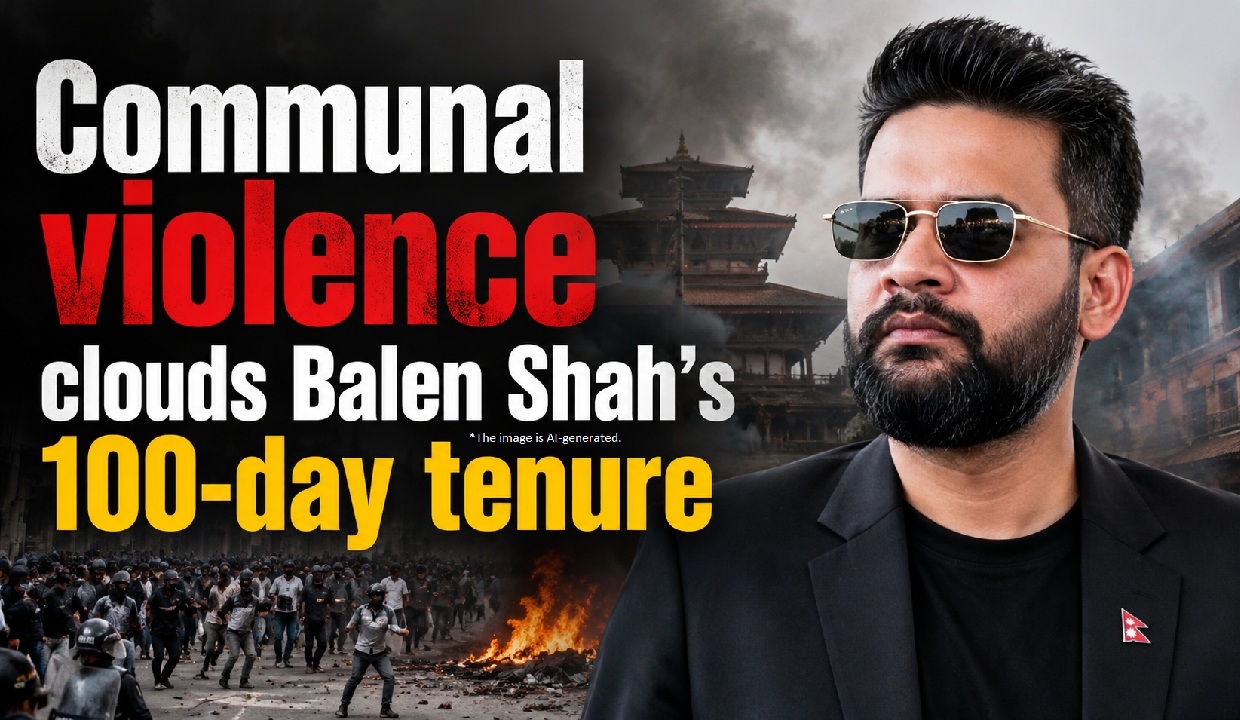
Nepal’s communal violence tests whether Balen Shah can fulfil his promise of an efficient government capable of restoring order in the Himalayan kingdom
Prime Minister Balen Shah, the rapper-turned-politician, recently completed 100-days in office. However, what should have been a cause of celebration was drowned in the noise of communal violence. What began in Kaptanganj in Sunsari, in Nepal, on July 26 over religious flags and loud music during separate Hindu and Muslim programmes quickly turned violent. Police firing killed at least one person and the unrest spread into parts of Madhesh Province. By July 30, the death toll had risen to three, with curfews imposed in several districts and the Army deployed to restore order.
Nepal’s Terai is a densely interconnected social space where religious, ethnic, caste and political identities overlap. A quarrel over a flag or loudspeaker can become combustible when mistrust is already high. Provocative social-media content, identity-based mobilisation and the perception that the state is slow or partisan can turn a small dispute into a communal confrontation. That is where the 100-day record of Shah’s government becomes relevant.
Shah came to power on an anti-establishment mandate, promising clean government, efficiency and rapid reform. His administration has begun anti-corruption investigations, administrative changes and digital-governance initiatives. Yet only about one-third of the government’s 100-point agenda had been delivered by the 100-day mark. The violence raises a larger question: can a government promising to reform the state also make the state visibly fair, fast and effective at the grassroots?
The handling of Sunsari will matter beyond restoring order. The Balen Shah government must ensure an impartial investigation, prosecute instigators irrespective of community, scrutinise the use of lethal force and compensate victims. The National Human Rights Commission has already called for an impartial probe and accountability. Appeals for brotherhood will not be enough; equal justice is the only credible antidote to communal fear.
For India, this is not a distant crisis. Sunsari and the wider Madhesh belt lie close to the open India-Nepal frontier, where families, traders and tourists daily cross the border. Instability in Nepal’s southern plains can have consequences for border security, trafficking, misinformation and local tensions in adjoining Indian areas. I
New Delhi’s response should therefore be firm but restrained: reinforce border vigilance and information-sharing, remain in close contact with Kathmandu, and avoid any perception of interference in Nepal’s internal affairs. India has a direct interest in a stable, democratic and inclusive Nepal, but stability cannot be built by taking sides in Nepal’s communal politics.
The direction of Nepal now depends on whether this episode becomes a contained warning or the beginning of a pattern. Shah won power as the face of political renewal. His real test is whether that renewal can protect Nepal’s tradition of coexistence.