America’s Akshardham: A Beacon of Indian Culture and Spirituality
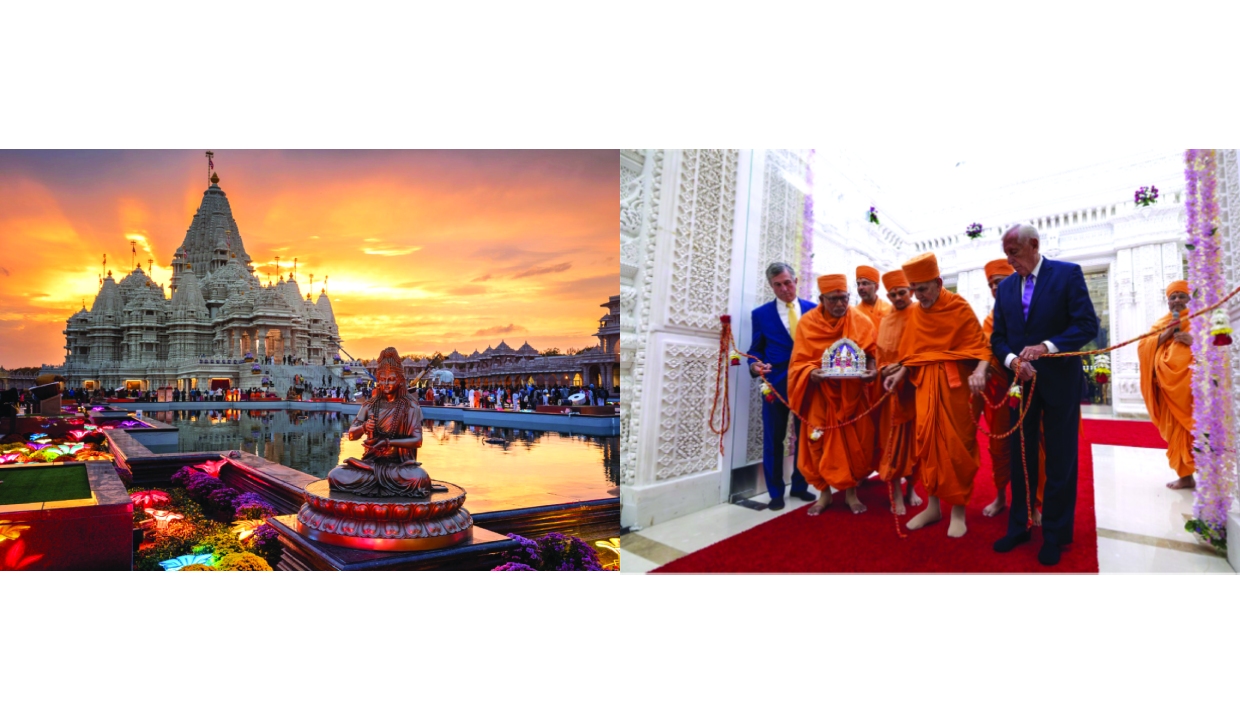
Carved in stone yet alive with timeless ideals, Akshardham stands majestically on American soil as the largest Hindu mandir of the modern world. Its grandeur reflects the brilliance of India’s spiritual and cultural heritage, while its message transcends all boundaries, inviting humanity toward peace, harmony, selfless service, and universal brotherhood. More than a monument, it is a shining beacon of Sanatan Dharma for generations to come
Thousands of visitors from around the world arrive in Robbinsville, New Jersey, and stand in awe before a sight few expect to encounter on American soil. Rising majestically against the skyline, BAPS Swaminarayan Akshardham, the modern world’s largest Hindu mandir, captivates with its breathtaking grandeur and intricate artistry. Through its timeless message of spirituality, harmony, selfless service, and universal brotherhood, Akshardham is illuminating the Western world with the enduring wisdom of ancient Indian civilization.
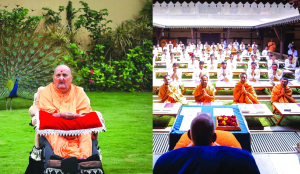
The word ‘Akshardham’ means ‘a timeless abode’, a place that transcends the boundaries of time and geography. This profound vision was cherished by His Holiness Pramukh Swami Maharaj, the inspirer of the project, who often expressed a simple yet powerful wish: that every person who enters Akshardham, regardless of faith, nationality, or background, should experience peace, inspiration, and inner upliftment. Today, that vision stands realized in stone.
Remarkably, the BAPS Swaminarayan Akshardham was built between 2011 and 2023 through the extraordinary efforts of 12,500 volunteers from across America. Millions of hours of selfless service were dedicated to transforming a dream into reality. Their contribution reflects one of the most cherished values of Indian culture, seva, or selfless service. Every carved stone and every architectural detail bears witness not only to artistic excellence but also to the devotion and sacrifice of countless volunteers.
Spread across more than 183 acres, the main mandir structure measures 255 feet in width, 345 feet in length, and rises to a height of 191 feet. Designed according to the principles of ancient Hindu scriptures, the mandir embodies a harmonious blend of sacred architecture and spiritual symbolism. Its design includes one main shrine, twelve sub-shrines, nine shikhars, and nine pyramidal shikhars, each representing profound spiritual ideals rooted in India’s civilizational heritage.
Perhaps the most astonishing aspect of Akshardham is the journey of its stones. Built to endure for a thousand years, the monument incorporates nearly two million cubic feet of stone sourced from different parts of the world. Limestone arrived from Bulgaria and Turkey, marble from Greece, Italy, and Turkey, granite from India and China, and sandstone from India. These stones traveled across continents before reaching India, where skilled artisans meticulously carved them into intricate forms. The carved pieces were then transported to New Jersey and assembled like an enormous three-dimensional puzzle.
This remarkable international collaboration conveys a profound message: One World, One Family. The coming together of stones from different nations to form a single sacred monument beautifully symbolizes the unity of humanity and the harmony that can exist among diverse cultures and civilizations.
Visitors are immediately captivated by the temple’s breathtaking artistry. More than 10,000 statues and statuettes adorn the complex, depicting spiritual themes, cultural motifs, ancient Indian musical instruments, and traditional dance forms. Every carving serves as a silent storyteller, preserving the artistic and philosophical treasures of India for future generations. The monument also houses the largest elliptical dome ever constructed in traditional stone architecture, demonstrating the extraordinary engineering capabilities embedded within ancient architectural traditions.
Among the many unique features of the campus is the Brahma Kund, a traditional Indian stepwell containing water collected from more than 300 bodies of water across the globe. The Brahma Kund beautifully symbolizes the spiritual and cultural union of two great nations, reminding visitors that while cultures may differ, the human quest for peace and meaning remains universal.
Beyond its architectural grandeur, Akshardham stands as a testament to responsible stewardship of the environment. The project incorporates sustainable practices, including a solar panel farm generating clean energy, environmentally friendly fly-ash concrete, and careful preservation of surrounding wetlands. These initiatives reflect the Hindu principle that nature is not merely a resource to be exploited but a sacred trust to be protected.
At a time when societies across the world are grappling with division, loneliness, and cultural uncertainty, the emergence of Akshardham carries a deeper significance. It stands as a reminder that progress need not come at the cost of tradition, and that modernity can coexist with spirituality. The monument offers visitors not merely a glimpse into India’s glorious past but also a vision for humanity’s future, one rooted in peace, understanding, service, and unity.
In this sense, the BAPS Swaminarayan Akshardham is not simply a temple in America; it is a beacon of civilization, illuminating hearts with the light of wisdom, harmony, and devotion. Yet as we admire its grandeur, we should remember that behind this extraordinary achievement stands the tireless dedication of Mahant Swami Maharaj, whose selfless efforts fulfilled Pramukh Swami Maharaj’s cherished vision and transformed a dream into reality.
Dr Swami Gyanananddas is a dedicated follower of the Swaminarayan tradition and has earned a PhD from MS University; Views presented are personal.