A quiet map to the inner life
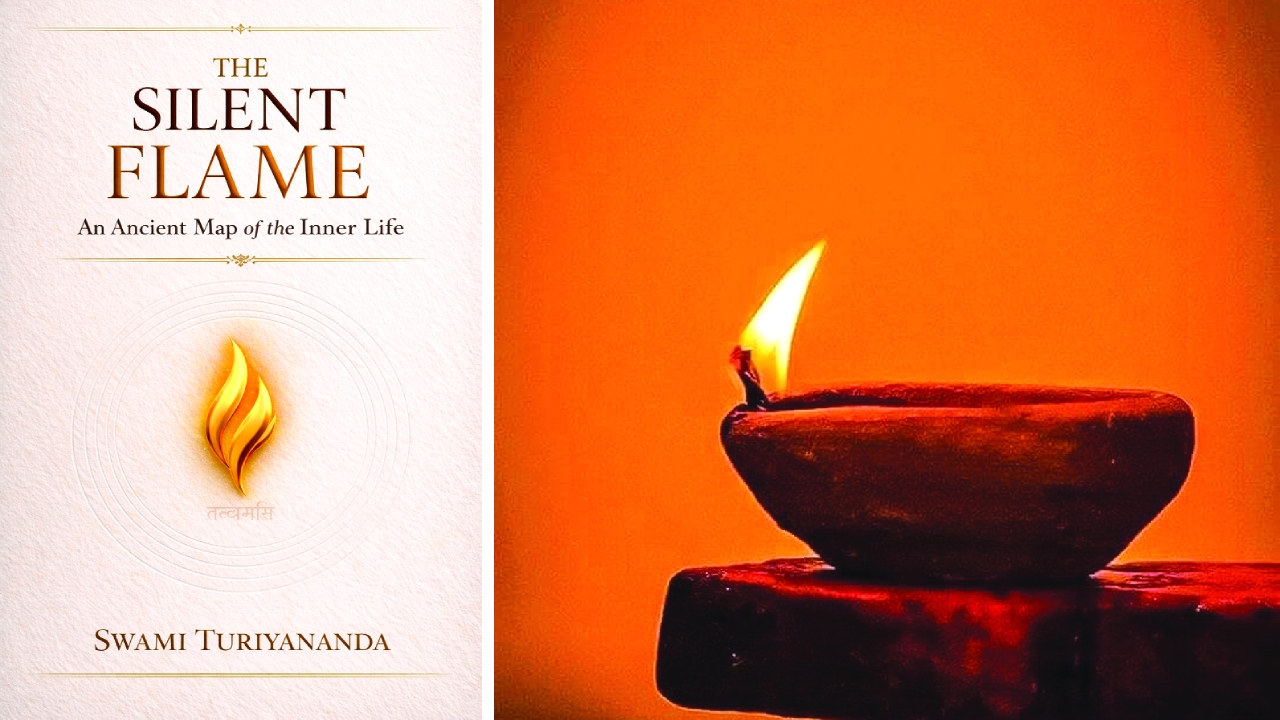
In The Silent Flame - An Ancient Map of the Inner Life, Swami Turiyananda offers a contemplative yet intellectually rigorous exploration of the human inner landscape. Drawing from the ancient wisdom of the Taittiriya Upanishad, the book introduces readers to the concept of the Panchakosha — the five layers of human existence and presents it not as religious doctrine but as a practical framework for understanding the modern condition of inner fragmentation. The book begins with a strikingly simple but profound moment: a question that arises unexpectedly in the author’s life while flying over the Arabian Sea. Despite a successful career in global finance, the author finds himself confronting a quiet but persistent inquiry: What is all of this leading toward? This moment becomes the gateway to a deeper exploration of life beyond external achievement. What makes the book particularly compelling is its refusal to frame the modern individual as “broken.” Instead, Turiyananda argues that contemporary life disperses attention across endless responsibilities and stimuli, leaving the inner dimensions of the self underdeveloped. His central insight-that human beings are not broken but dispersed-forms the philosophical core of the book.
The framework he introduces, the Panchakosha, describes the human being as a layered architecture: the physical body (Annamaya), the energetic field of breath and vitality (Pranamaya), the mental and emotional landscape (Manomaya), the faculty of discernment (Vijnanamaya), and the innermost ground of quiet awareness (Anandamaya).
These layers, the author explains, are not metaphysical abstractions but observable dimensions of everyday experience. When aligned, they produce clarity and steadiness; when fragmented, they generate the subtle unease many high-functioning individuals quietly carry.
Structurally, the book unfolds in three movements. The first, “The Audit,” examines the pressures and rhythms of modern life that pull attention outward and crowd out stillness. Rather than condemning ambition or achievement, Turiyananda simply
asks readers to look honestly at what has been neglected in the pursuit
of success.
The second section, “The Blueprint,” introduces the Panchakosha in accessible language, grounding each layer in lived experience. Here the author’s background in analytical disciplines becomes evident; he presents ancient philosophy with clarity and precision rather than mysticism.
The final section, “Integration,” explores how alignment among these layers can be restored. Importantly, the author does not advocate elaborate spiritual techniques. Instead, he emphasises recognition — a form of knowledge the Upanishadic tradition calls jnana. This recognition involves rediscovering a quiet inner continuity that has always existed beneath the surface turbulence of life.
What distinguishes The Silent Flame from many contemporary spiritual books is its tone. It avoids sentimental reassurance and dramatic promises of transformation. Instead, it offers something rarer: a carefully drawn map. Readers familiar with works by thinkers such as Eckhart Tolle or Viktor Frankl will recognise a similar search for meaning, though Turiyananda’s contribution lies in grounding that search within the structured philosophical framework of Vedanta.
The prose itself reflects the spirit of the book-measured, contemplative, and quietly persuasive. Rather than instructing the reader what to believe, the author invites careful observation of one’s own experience. In an age of constant motion and external achievement, The Silent Flame serves as a reminder that clarity does not arise from adding more activity but from understanding the architecture of one’s own being.
About Author
Swami Turiyananda represents an unusual bridge between two worlds. An All-India ICSE Board topper and Singapore Government Scholar, he studied engineering at Nanyang Technological University before completing an MBA in Finance at the University of London. He then worked in investment banking with institutions such as Barclays Capital and CLSA in London and Singapore.
A turning point came when a persistent existential question led him to leave finance and pursue years of disciplined study within the Vedantic tradition in the Himalayas. Today, from his ashram in Badrinath, he teaches contemplative philosophy to students from around the world, translating ancient frameworks into language accessible to modern professionals.