131 flights cancelled due to low visibility at Delhi airport
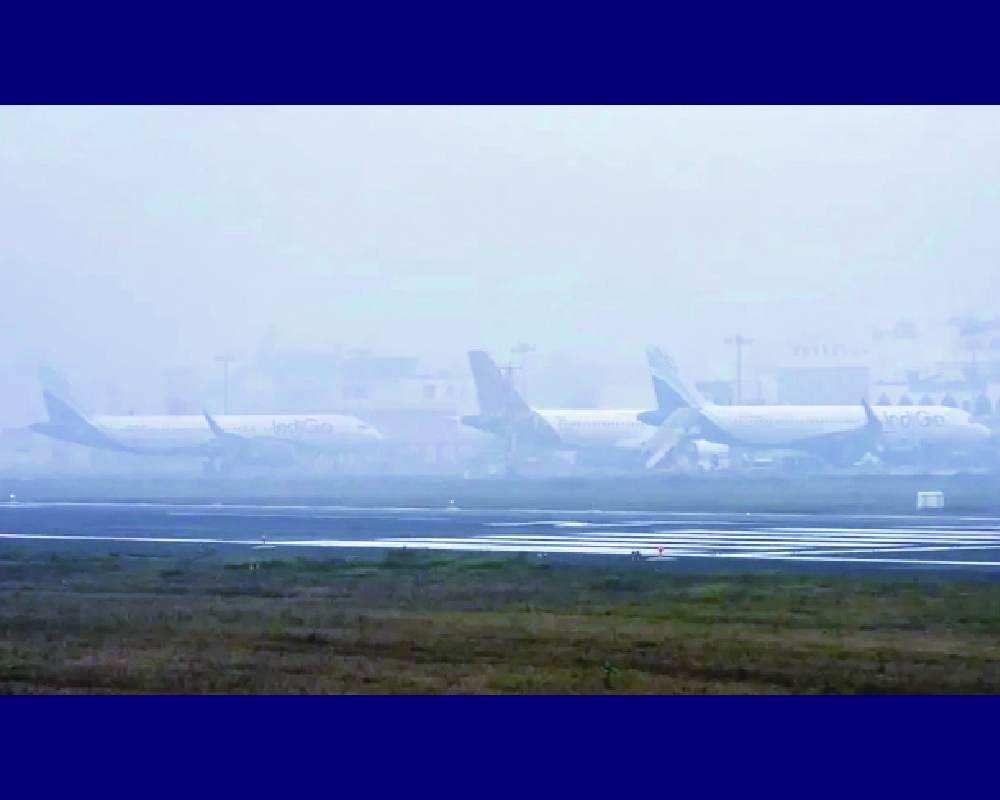
Low visibility conditions disrupted flight operations at Delhi airport on Tuesday, leading to airlines cancelling 131 flights. "Due to low visibility, 52 departures and 79 arrivals have been cancelled so far at Delhi airport," according to officials.
The northern parts of India, including Air India's primary hub, Delhi, experience low visibility due to dense fog, with a potential to have a cascading impact on flight schedules across the network.
The Directorate General of Civil Aviation (DGCA) has announced December 10- February 10 next year as the official fog window during this winter. In a related development, crisis-hit IndiGo cancelled 113 flights across its network due to disruptions caused by bad weather at Delhi airport on Tuesday.
Besides, the airline also said it will not operate 42 flights on Wednesday on account of bad weather at Delhi airport. As winter sets in, early mornings across northern India can bring fog that may occasionally slow down flight movements, IndiGo said in a post on X.
"Our teams are well prepared and closely monitoring weather conditions," IndiGo said, adding that wherever possible, "we are making thoughtful adjustments on the ground to reduce inconvenience and ensure any waiting time is as comfortable as possible.
As part of the fog operations (CAT-111b) norms, Airlines have to mandatorily roster crew, which is trained to operate in low-visibility conditions, as well as aircraft compliant for such operations.
Category-III is an advanced navigation system that empowers an aircraft to land under foggy conditions. Category-III-A is a precision instrument approach and landing that enables a plane to land with a runway visual range (RVR) of 200 meters, while Category-III-B helps in landing with an RVR of under 50 metres.
Delhi has been grappling with extremely poor air quality for several weeks, with the Air Quality Index (AQI) frequently in the ‘severe’ category, levels known to harm public health and visibility around the city. Data from the Air Quality Early Warning System for Delhi indicated that PM2.5 concentration stood at 154.96 micrograms per cubic metre, while PM10 levels were recorded at 260.9 micrograms per cubic metre.
PM2.5 refers to fine inhalable particles that can penetrate deep into the lungs, while PM10 includes slightly larger particles. India's National Ambient Air Quality Standard for PM2.5 is 40 micrograms per cubic metre.
As per the Decision Support System for Air Quality Management in Delhi, transport emerged as the major contributor to pollution at 3.079 per cent, followed by construction activities at 1.732 per cent and stubble burning at 0.218 per cent.
The dense smog affected daily life, with poor visibility and health concerns troubling residents and visitors. A city resident said heavy smog made commuting risky, forcing people to take precautions such as wearing masks.