Yoga Day and the Rise of a Vishwa Guru
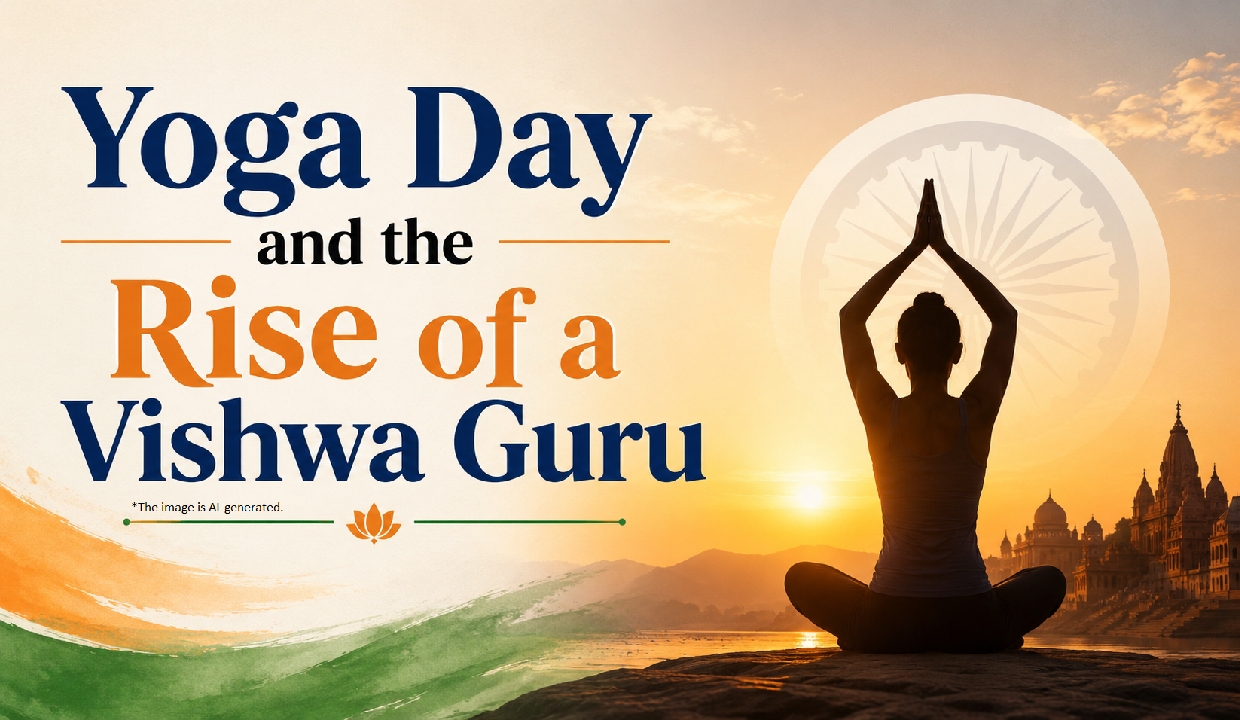
International Yoga Day once again underscored that India’s greatest export is its ancient wisdom — a gift that resonates deeply in a chaotic world
Yoga, India’s ancient art of living, is now its most prestigious and recognised export to the world. Long before the yoga studios in New York came up and holistic wellness became a buzz word, yoga had established its immense potential for spiritual, mental and physical health. However, after it was after UN announced June 21 as Yoga Day, it has become a rage.
From the United Nations Plaza in New York to the beaches of Sydney, from Red Square in Moscow to the deserts of the UAE, people of every nationality, faith, and political persuasion lower themselves onto a mat and breathe together. International Yoga Day, observed since 2015 after India’s proposal won near-unanimous backing at the UN General Assembly, has quietly become one of the most successful unifiers the modern world has seen.
This is not power exercised through coercion or capital. It is power exercised through resonance. Yoga asks nothing of its practitioner except presence — no conversion, no allegiance, no ideology. That neutrality is precisely what makes it such an effective ambassador for India. While geopolitics increasingly fractures along lines of sanctions, tariffs, and military alliances, yoga offers something rarer: a shared vocabulary of stillness that transcends borders.
Herein lies India’s opportunity — and its responsibility. The term Vishwa Guru — world teacher, is often invoked with nationalist pride, but its real meaning is more modest and more profound: a civilization that has metabolised suffering into wisdom, and is willing to share that wisdom freely. India’s contribution to the world need not be military bases or extractive trade. It can be mentorship — in the literal sense of helping other nations and peoples find equilibrium amid chaos. Consider the moment we are in.
Conflicts simmer or rage across Eastern Europe, the Middle East, and parts of Africa. Anxiety, displacement, and mistrust rule the world. Diplomacy alone, built on negotiation and deterrence, struggles to address this deeper exhaustion.
This is where India’s spiritual inheritance — yoga, meditation, the contemplative traditions of the Upanishads and Buddhism — can do work that treaties cannot. They do not resolve conflicts, but they can heal the people who must live through and after them. This is also where India must be careful not to squander its advantage. Soft power is fragile; it dies the moment it starts to feel like propaganda or commercial branding. If India wants to be taken seriously as a Vishwa Guru rather than merely the original supplier of a global wellness industry, it must invest in scholarship, accessible teaching, and authentic cultural exchange — not just spectacle. The opportunity is real.
No other nation possesses a living, continuous tradition of contemplative practice with this much global goodwill. If India can pair its ancient inheritance with humility, openness, and genuine intellectual rigor, it will not need to declare itself a Vishwa Guru. The world, mat by mat, breath by breath, will simply start calling it one.