Why we need a new information world order
In an age where information moves faster than our ability to process it, clarity is giving way to confusion. What we are witnessing is not just a period of global instability, but a deeper crisis in how conflict is communicated — and understood
There’s a strange kind of fatigue in the air right now.
You can feel it when you open your phone in the morning. Another alert. Another headline. Another “breaking” situation somewhere in the world that suddenly feels a little too close for comfort. Wars don’t feel distant anymore; they feel immediate, almost personal. And not necessarily because we understand them better, but because we’re constantly watching them unfold in real time.
But here’s the thing no one really talks about enough: we’re not just living through a time of conflict; we’re living through a crisis in how that conflict is being communicated. And that changes everything.
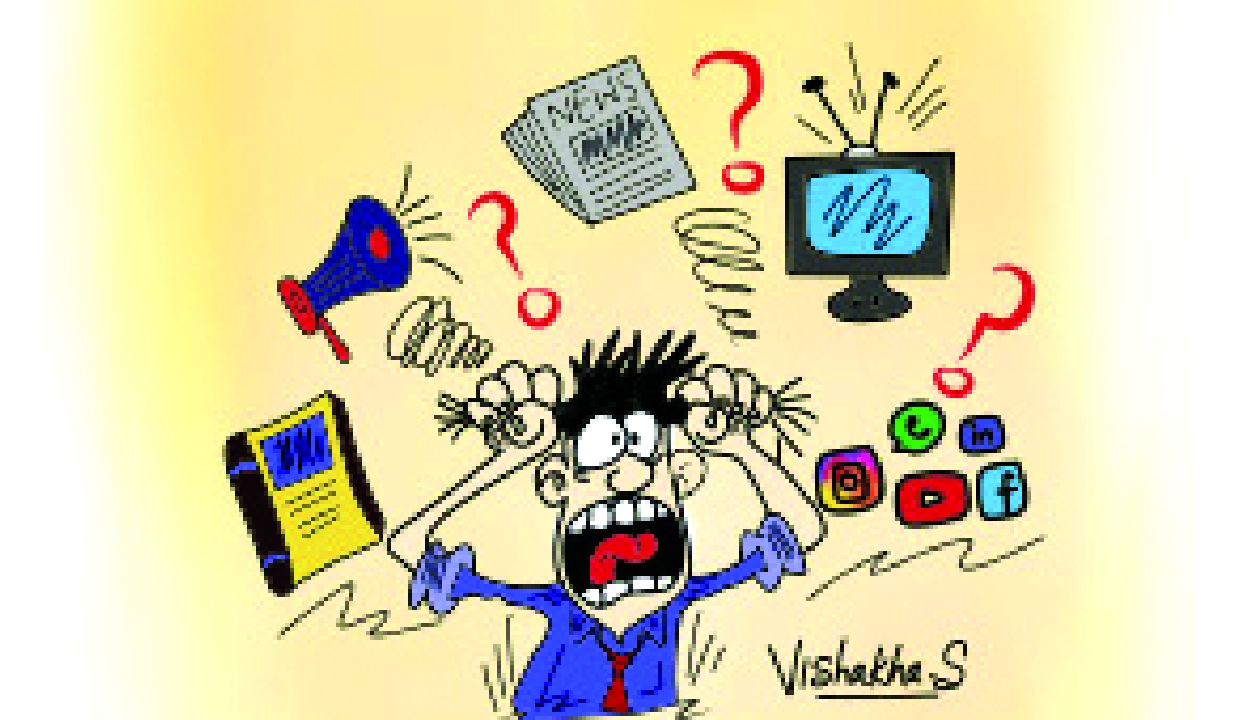
We’ve built a world where information moves faster than we can process it. There was a time when news came with some kind of pause-time to verify, to reflect, to contextualise. That gap doesn’t exist anymore. Now it’s instant. Continuous. Overwhelming. And in theory, that should make us more informed. But in reality, it often just makes us more anxious.
Because when everything is urgent, nothing is clear. You see a video, but you don’t know when it was shot. You read a headline, but you don’t know what’s been left out. You scroll through opinions that sound like facts and facts that are framed like opinions. Somewhere in all of this, truth starts to feel… slippery.
Whenever things get messy in the information space, the instinct is to swing to extremes. Either clamp down, control the narrative, restrict information, filter what people can see-or do the opposite: let everything flow freely and assume the truth will somehow sort itself out. Both approaches sound logical. Both fail in practice.
Over-controlling information creates distrust. People start questioning what’s being hidden, and that uncertainty often does more damage than the information itself. But a completely unfiltered environment isn’t any better. It rewards the loudest voices, the most dramatic takes, the content that triggers reaction, not reflection. So, we’re stuck in this loop. Too much control feels suffocating. Too little control feels chaotic. What we actually need is something far more nuanced-and, honestly, far more difficult.
This is where the idea of a basic framework, or even an informal SOP, for crisis communication begins to make sense. Not as a tool to dictate what people can or cannot say, but as a way to shape how things are said when the stakes are high. Because in moments of conflict, communication is not casual-every word carries weight. Tone matters more, timing matters more, and the impact of even the smallest misstep is amplified.
A slight exaggeration can spiral into widespread panic. A half-verified update can unintentionally escalate tensions. A dramatic headline can distort perception, making a situation feel more immediate or more severe than it actually is. In such an environment, the way information is framed becomes just as important as the information itself.
What complicates this further today is the role of technology, particularly AI-generated content. We are no longer just dealing with misreporting or bias; we are dealing with entirely fabricated realities that can look convincingly real. AI-generated images, deepfakes, synthetic audio, and manipulated videos can circulate within minutes, often before they are even questioned. A single fabricated visual, if believable enough, can influence public sentiment, trigger outrage, or even provoke real-world consequences before the truth has a chance to catch up.
This makes the responsibility around dissemination even more critical. It is no longer enough to verify what is being said; we now have to verify what we are seeing and hearing as well. The burden of discernment has increased-not just for media institutions, but for individuals too.
Responsible dissemination, then, does not require complicated rules or rigid control. It simply calls for a few grounding principles: slowing down just enough to verify before amplifying, offering context rather than isolated fragments, clearly separating what is known from what is still uncertain, and avoiding language that triggers unnecessary alarm. It also means being cautious with visual content, especially in a time where authenticity itself can be manufactured. Equally important is the willingness to acknowledge uncertainty when it exists, rather than filling gaps with speculation.
None of this takes away from people’s ability to speak. It does not silence voices or restrict expression. It simply asks for a little more awareness, a little more care, and a little more intention in how those voices are used-especially when the line between reality and manipulation is becoming increasingly difficult to draw.
Now this is where it gets interesting. Because while traditional systems are struggling to keep up, an entire generation has found its own way of dealing with all of this. Gen Z isn’t sitting around waiting for perfectly curated information. They’re reacting in real time. Processing in real time. And a lot of that processing is happening through humour.
Memes, jokes, dark humour about “the world ending”-on the surface, it can look unserious. Almost detached. But it’s actually the opposite. It’s how people cope when things feel too big to fully grasp. When someone jokes about “impending doom”, it’s not because they don’t care. It’s because sitting with the full weight of reality all the time is exhausting.
Humour becomes a filter. A buffer. A way to stay engaged without being completely overwhelmed. But even this space isn’t immune to problems. Because the same tools that help people cope can also blur lines-between satire and misinformation, between commentary and distortion. And when everything is wrapped in irony, it sometimes becomes harder to tell what’s real.
It’s not about removing emotion. That’s impossible-and, honestly, not even desirable. People are going to feel things, react, and interpret. But perhaps responsibility, in this moment, looks like balance: not feeding fear just because it gets attention, not simplifying complex situations into easy narratives, not turning every development into a “turning point”.
It also means institutions stepping up-not by controlling the narrative, but by being clearer, faster, and more transparent. Because when official communication is slow or vague, speculation fills the gap instantly. And it means all of us-because, at this point, we are all part of the information ecosystem-pausing for a moment before we share, react, or amplify. Maybe this “new information world order” does not come from one big policy or global agreement. Maybe it is something quieter-a shift in how we treat information when things feel uncertain. A little more care. A little more awareness of impact.
A recognition that what we say, and how we say it, can shape how others understand the world. Because right now, the real danger isn’t just conflict itself. It’s confusion. And if we’re not careful, that confusion becomes its own kind of crisis. At the end of the day, this isn’t about restricting voices. It’s about making sure those voices don’t unintentionally make an already fragile situation worse. Because in a world where everything feels constantly on edge, clarity is no longer a luxury. It is stability.
A little more care. A little more awareness of impact. A recognition that what we say, and how we say it, can shape how others understand the world
Chaitanya K Prasad is a commentator and writer on cinema, branding, media management, and geo-strategic communication. He has co-authored the book When Branding Met the Movies, published by the National Book Trust. Inputs were provided by Zoya Ahmad and Vaishnavie Srinivasan; Views presented are personal.