UP-Japan Investment Summit: Yogi’s push to put UP on the fast track
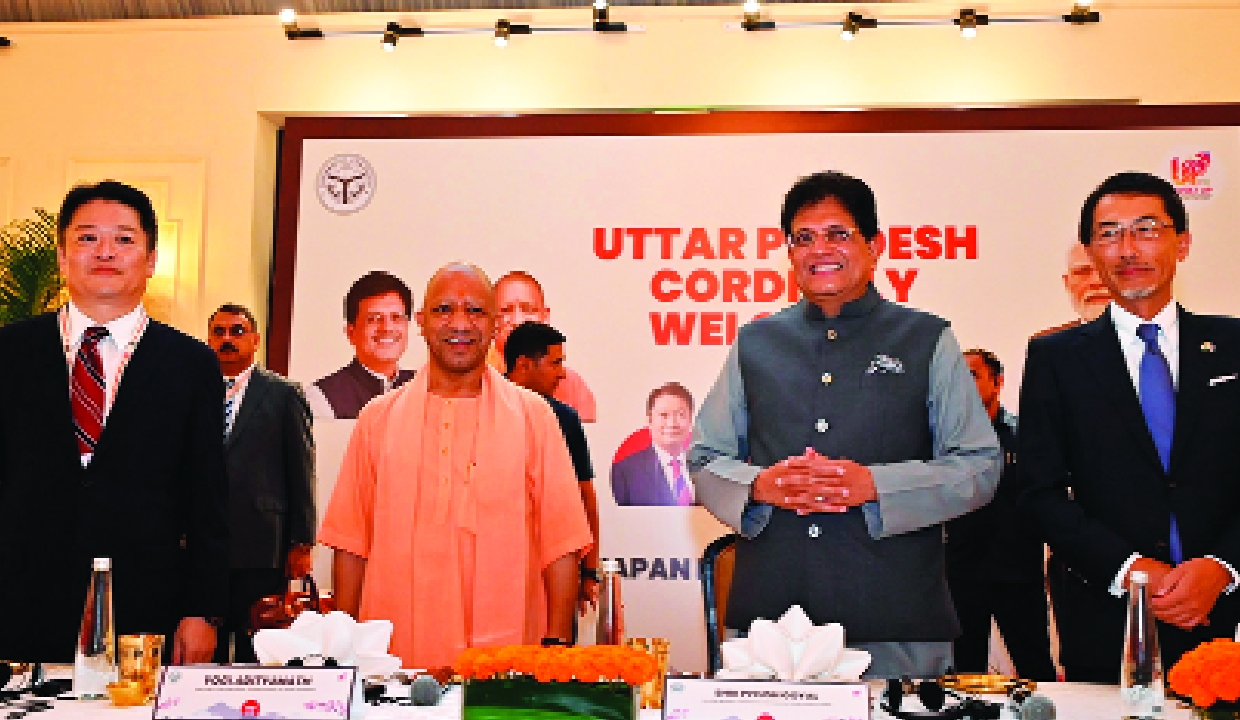
There is a synchronicity to the UP-Japan Investment Meet this week. It was in February this year that Uttar Pradesh Chief Minister Yogi Adityanath travelled to Japan. It was his maiden foreign trip in the last year of his second term. The preceding years had been spent preparing the foundation for what was to come.
And in August, it arrived. More than 200 Japanese CEOs, industrialists, investors and policymakers are participating in the UP-Japan Investment Summit, a five-day engagement spanning Delhi, Lucknow, Agra, Greater Noida and Varanasi.
The delegation is led by Yamanashi Governor Kotaro Nagasaki. Yamanashi, the prefecture to the west of Tokyo, is known traditionally as the home of Mount Fuji but has developed a modern, almost futuristic character as an important centre for precision manufacturing, fuel-cell research and green hydrogen technology.
Green hydrogen technology is, in particular, very useful to an emerging manufacturing hub like Uttar Pradesh. Green hydrogen is produced by using renewable energy to split water and is seen as a way to decarbonize industries that cannot be easily electrified. It has potential applications as diverse as steel, chemicals and fertilizer production. An agrarian state like UP has a high dependence on the ammonia used in fertilisers; green hydrogen offers the possibility of reducing dependence on fossil fuels. The emphasis on green hydrogen indicates that the interaction is not simply about attracting Japanese investment but also the technology that a future-facing Uttar Pradesh will need to expand its industrial capability.
There is an understated cultural motive as well. Yamanashi has demonstrated how a region can preserve cultural provenance while also developing technological and manufacturing capabilities. This aligns with Yogi’s emphasis on cultural preservation and continuity, without succumbing to a model of progress that creates distance from cultural inheritance in the name of modernity.
Encouragingly, the interaction seeks to become institutional as opposed to episodic. Governor Nagasaki has been an advocate for direct cooperation between Japanese prefectures and Indian states, creating an international economic corridor based on an exchange of strengths.
It would be easy to dismiss the headlines as another economic summit, but the story is deeper than the headlines suggest. Yogi’s economic vision for UP is entering its next phase, after years spent laying the foundations necessary to position the once-BIMARU state as a reliable business partner. Domestic interest grew as his policies began to bear fruit on the ground. Japanese interest is the international dividend accrued after years of sustained effort to pull UP out of the margins of the India story.
And at the heart of this is Yogi’s audacious goal of making UP a trillion-dollar economy.
For a state that was once central to conversations about developmental deficits and lawlessness, this aspiration signals a striking reversal: the Chief Minister, and by extension the state, is seeking to define itself by its possibilities rather than its problems.
This means Uttar Pradesh has to look outwards rather than inwards. Yogi’s Japan outreach produced MOUs of around ?11,000 crore on the first day itself. But MOUs are promises on paper; what matters is what follows.
The arrival of such a significant and diverse Japanese delegation just six months later suggests that the conversation has moved beyond ceremony. Japanese executives are now evaluating specific opportunities, while projects involving Escorts Kubota and Minda Corporation, representing an investment of nearly ?3,200 crore, with the possibility of creating 10,000 new jobs, are moving to the ground-breaking stage.
This is bricks and mortar stuff, not paperwork.
Yogi’s vision seems to divide UP’s transformation into two seasons. The first was about constructing the foundations: law and order, expressways, airports, power supply, industrial corridors and administrative reform. The next is about setting the table, and the seats are filling up fast.
Those roads must now bring supplies and workforce to the factories; those new airports must connect UP to markets and expertise across the country and abroad. Industrial corridors must buzz with the turning of global supply chains. The trillion-dollar goal means UP’s Chief Minister must sell UP not only in Mumbai and Bangalore but also in Singapore and Tokyo. Uttar Pradesh is now not only about change but about being competitive.
The trillion-dollar target is not simply a large number attached to a government presentation; it is an organizing principle. Will it move Uttar Pradesh from being primarily viewed through the scale of its problems to being understood for the scale of its economic potential? Yogi Adityanath has seen the possibility. Increasingly, so has the country. Will the world? Stay tuned. This is just the beginning of a new season.