The West Asia conflict: Trump’s hegemony is fading
Trump’s promise to stop all ongoing wars and not start any new ones got him a second term in the White House. He claimed to have brought a ceasefire between eight pairs of warring countries in the first few months of this term and then pitched for the Nobel Peace Prize for himself, while the major wars between Russia and Ukraine and Israel and Hamas continued. In the middle of a 12-day-long war between Israel and Iran in June 2025, US forces bombarded Iranian nuclear sites in Operation ‘Midnight Hammer’, and Trump claimed to have obliterated all nuclear enrichment facilities in Iran. Even after this, he continued claiming the Nobel Peace Prize. However, Maria Corina Machado, a Venezuelan activist and prominent opposition leader, was awarded the 2025 Peace Prize.
Keeping an eye on Venezuelan oil and Greenland’s rare earth and critical minerals, his desire for controlling regimes gained prominence. In ‘Operation Absolute Resolve’ on 3 January 2026, he extracted Venezuelan President Maduro and his wife and brought them to Washington for trial. Vice President Delcy Rodríguez was sworn in as Acting President three days later. Trump dictates to her and has full control over the regime’s oil and gas. His desire to grab Greenland, an autonomous island under Denmark’s administration, angered his NATO allies and was opposed by all of them. On some occasions, he uttered disrespectful words on public forums against the Canadian PM, French President, and UK PM. Some of them took the opportunity to retort.
On the advice of Tel Aviv, he joined Israel in attacking Iran. Since 28 February, missiles and drones have been flying in the Middle East. There has been a flip-flop from Trump in specifying the objectives of the conflict. He has been changing the goalposts every time he speaks. Whether he wanted regime change, to damage the nuclear programme, to destroy long-range missile manufacturing capabilities, or to obliterate the Iranian Navy-none has been specified.
The US and Israeli offensive began with the killing of Iran’s Supreme Leader Ayatollah Ali Khamenei and several senior Iranian figures. It was followed by precision strikes on nuclear facilities, attacks on missile sites, naval infrastructure, and an Iranian girls’ primary school, killing 165 children and teachers. Iran has also responded by attacking Israel and US bases in the Middle East. Iranian Security Chief Ali Larijani was also killed in an Israeli attack on the 18th day of the war. Iran has retaliated strongly to this as well. After two weeks of war, Trump claimed that he had won a war that could end in a few more days. Despite his claim, Iran continues to launch extensive missile barrages against Israel and US-linked sites, using hard-to-intercept weapons such as the Sejjil (‘dancing missile’), Khorramshahr-4, and Qadr ballistic missiles. These missiles often use cluster warheads to overwhelm air defences, targeting Israeli and US military bases.
A total war of destruction on Iran, however, has threatened Chinese and Russian interests. Both countries have condemned the strikes and offered only restrained diplomatic support, and neither is engaging in direct confrontation with the US. Before the war started, Trump’s approval rating was below 40%, which has further dipped as the war has progressed. US citizens are facing high commodity prices and inflation, and a few Republicans have joined Democrats in denouncing the administration for going to war. Trump’s Director of the National Counterterrorism Center, Joe Kent, has resigned from his post, saying that he could not back the war as Iran posed no imminent threat to the US. Last week, a lower-level Trump appointee, Sameera Munshi, resigned from the White House Religious Liberty Commission, citing the war as a major factor.
The Strait of Hormuz connects the Persian Gulf to the Gulf of Oman and is used for trade between Persian Gulf countries and the rest of the world via the Arabian Sea. Besides a wide range of goods, the strait provides passage for nearly one-fifth of global energy requirements. The shipping lane is restricted to 3 km, out of a 33 km-wide strait at its narrowest point, as large ships pass through lanes where the water depth is more than 100 metres.
The strait is guarded by the Iranian Navy and IRGC and has been made into a choke point. Iran has vowed to block US and European ships through the strait and permit only ships to and from friendly countries. Beijing’s discounted oil and gas continue to flow through this choke point. With supply disrupted, oil prices have soared from $70 a barrel to $110 a barrel. Iran’s main purpose in blocking ships through the Strait of Hormuz is to force a surge in oil prices up to $200 a barrel. This would lead to a major global economic crisis.
Inflation would rise and the prices of all commodities would spike. This is the last thing Trump wants when the midterm national election is six months away. After denouncing Starmer for rejecting military support for the war on Iran, he requested allies, as well as China, to send warships to the Strait of Hormuz to protect shipping. China is a competitor of the US, so why should it safeguard ships to and from the US and the European Union? Even NATO allies have refused to send warships to protect ships and unblock the choke point. None of the allies wanted to involve themselves in US military operations in Iran. Trump wants Greenland and does not miss an opportunity to humiliate his allies-how can he expect them to support him in the war?
As the war continued towards the end of the third week, the US, in its effort to unblock the choke point, used its B2 stealth (special bunker-buster) and bombarded Iranian land near the Strait of Hormuz. 2,200 kg bombs penetrated 100 metres below the ground and damaged stocks of anti-ship missiles as well as 30 mine-laying ships. Iran responded by bombarding Israeli military facilities.
At home, Trump finds that his MAGA base and its ideologues, wary of endless wars, are rejecting any military intervention. Polls show that his core supporters, who once cheered ‘America First’ against US actions in the Bush era, are denouncing what they see as betrayal in Gaza, Venezuela, Greenland, and more strongly in Iran. This may hand Democrats major gains in the midterm elections.
Trump’s assessment that there would be an uprising in Iran after the leaders were eliminated has also proved wrong. People are seen rallying around the flag after the death of the Supreme Leader earlier and now Ali Larijani. Continuous bombardment has weakened Iranian capabilities, yet Iran continues to respond to aggression from the US and Israel.
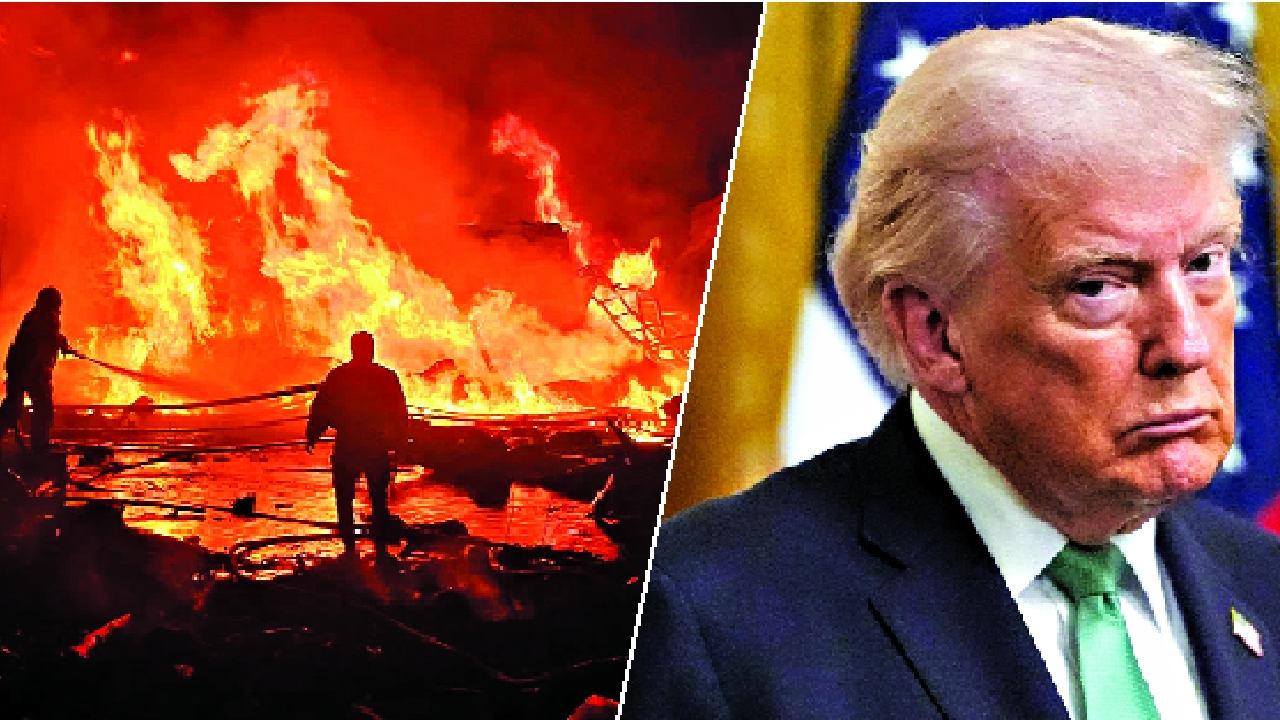
Bombardment of oil infrastructure, refineries, and depots in Iran, Israel, and other Middle Eastern countries has posed one of the biggest environmental challenges. The air in the region is full of smoke and flames, releasing poisonous pollutants into the atmosphere. Billowing smoke
and towering oil fires have turned the horizon orange, and oily smoke hung over Tehran the next morning. Unburnt oil drained into the lanes. Human health in the region is the immediate casualty, and as toxic air mixes into the atmosphere, emissions intensify and their consequences are not localised to the region but extend globally.
Tehran has experienced acid rain, which can cause skin and throat irritation. Oxides of nitrogen and sulphur pose risks to the lungs and heart, while cancer-causing benzene and acetone present even greater health risks. Trump has to be blamed for this.
Wherever the US has been involved in prolonged wars-be it Iraq, Afghanistan, Libya, or Vietnam — it has suffered loss of human life and humiliation. Trump knows this, but he does not know how to come out of the current conflict.
The writer is the former Head of Forest Force, Karnataka, and teaches economics at the Karnataka Forest Academy; views are personal