The new age of resource geopolitics
In a sweeping overhaul of America’s global footprint, last month, Trump authorized US to withdraw from 66 international organisations. Among the pull-outs are the major climate-linked global bodies including the UN Framework Convention on Climate Change, the global counterterrorism forum, intergovernmental panel on Climate Change, the peacekeeping fund, UN democracy fund, UN energy etc. US officials say that these organisations promote hostile and inefficient policies that no longer serve the country’s interests. The officials have also criticized climate related bodies for imposing undue burden on US businesses and industries without reciprocal commitments from major emitters like China and India. These observations of the US are laughable. China and India are not comparable in annual emissions. While China emits 14 Giga tons CO2 annually, India’s emission is 3 Giga tons. Per capita emission of China, too, is high.
After withdrawing from the Paris climate agreement and not sending a US delegation to the latest climate CoP30 held at Belem, Brazil, his pullout from global climate-related groupings has been devastating. Historically, US is responsible for warming the planet and the climate disruptions we are facing; how can Trump not take these facts into account?
As 2026 unfolds Trump’s second term is marked by muscular interventions in Venezuela, and now Iran and also there are open threats against Nigeria, Somalia and Cuba and quite remarkably and inexplicably, menacing Denmark, Canada and Mexico.
Trump consistently accused Venezuelan President Maduro for running a drug cartel and sending drugs to America, and in an operation ‘Absolute Resolve’ on 3rd January President and his wife were extracted from the Caracas military base and taken to the US for trial. His focus is on Venezuelan oil. Six days after the operation, major oil giants like ExxonMobil, Chevron and ConocoPhillips were invited to Whitehouse where Trump seek an investment of $100 billion in the next ten years to expand production, an agreement for immediate oil deliveries to the US to the tune of 50 million barrels per day. Citing past asset seizures and current instability in the country, the Exxon CEO called it “un-investable”. Oil giants needed significant policy changes and guarantees before committing large sums.
The peak level of oil production in Venezuela was 4 million barrels per day in the 1990s. The country faced US sanction since 2019 and since then the production has tapered to 1 million barrels per day. Though the country is estimated to have 300 billion barrels, surpassing Saudi Arabia and Iran, but the reserves are in Orinoco belt (eastern Venezuela) which are heavy crude oil and difficult to extract. The extraction and refining costs would be exorbitant, and it has considerable environmental costs. Western Venezuelan oil were comparatively light and less polluting and has been exhausted by now. What remains is the heavy crude oil in the east.
The International Energy Agency also estimates that such crude is six times more methane-intensive and 10 times more flaring-intensive than the global average. Ramping up oil production could risk a ‘methane bomb’. Methane is one of the potent greenhouse gases that would be emitted during venting, flaring during production and also during transport and storage. If the oil production is increased to 4 million barrels per day, it would add additional emission of 730 million tons (.73 Giga tons) of CO2 annually. A higher production would proportionately increase the emissions.
The US National Security Strategy has laid out that the country will assert and enforce the Monroe Doctrine (western hemispheric hegemony) for its dominance in the region. Trump likes to call it the ‘Donroe doctrine’. After gaining control over Venezuela, he doubled down to annex Greenland. He announced that all options to gain semi-autonomous territory from Denmark, including use of military is on the table. He also wrote to the Norwegian PM that Norway did not consider him for the Nobel Peace Prize, and he does not feel obliged to think purely of peace.
The 1951 agreement between the US and Denmark allows the US to open bases on Greenland. The US can develop, maintain and operate any number of bases on the island. Today, several bases and installations are closed down, and only Pituffik Space Base is operational. The agreement does not prohibit US to expand military presence on the island to counter China and Russia. The security challenge is only an eyewash; Trump wants to control oil and critical minerals. Melting of ice in the Arctic region is opening new sea sailing routes, and also making oil and mineral deposits easily accessible. Greenland’s formidable environment, underdeveloped infrastructure, and challenging geology have prevented mining of critical minerals, crucial for high-tech products. To counter China’s near-monopoly on global rare-earth supply, US has already committed hundreds of millions of dollars and acquired stakes in several rare-earth companies. To find a solution to the strategic dilemma, Trump is wresting control of Greenland from Denmark.
Nowhere is the contradiction between Trump’s rhetoric and actions more glaring than in the torching of Iran. After the operation ‘Midnight Hammer’ last June, Trump announced that Tehran’s nuclear capabilities are completely obliterated, yet he launched another operation ‘Epic Fury’ to obliterate the regime’s growing nuclear capability and missiles that can reach US soil. Successive US administrations have wanted to control West Asian oil, and Trump has moved a step forward in this direction. Last month US administration took a key step toward opening new leases for oil and gas drilling across millions of hectare lands in the Arctic National Wildlife Refuge - a pristine and biodiverse expanse in Northern Alaska and one of the last wild lands in the US still untouched. It was a project that was always opposed in Biden’s administration. The expansion of oil, gas, and rare and critical minerals programs would make the planet warmer. The Arctic is warming four times faster than the global average rise in temperature. More oil and gas production may cut the speed and scale of the transition to green energy. Greenhouse gases at unprecedented levels will continue to be pumped into the atmosphere, intensifying climate disruptions.
The Intergovernmental Panel for Climate Change has highlighted Toronto University researchers’ finding that while land and vegetation reflect less than 50% solar radiation, snow reflects 80 per cent. Snow plays an important role in keeping the warming in check. Icebreaker fleets are used for accessing new Arctic shipping lanes and tap oil, gas and minerals hidden beneath the surface of the earth.
One of the recent bold proposals of Trump is to significantly expand the US icebreaker fleet. The loss of ice-sheets would reduce solar reflectivity and accelerate the warming of the planet.
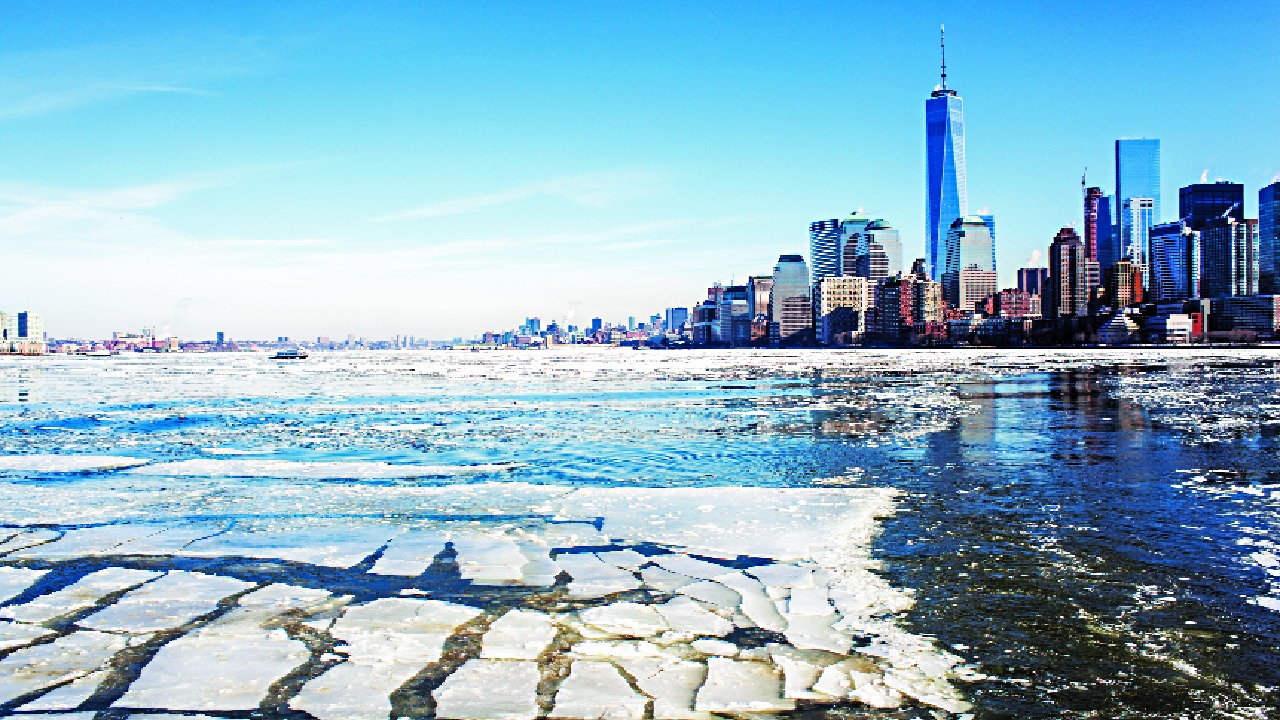
A storm called the Arctic polar vortex causes the jet stream to bring down frigid air from the stratosphere to the troposphere and then shift northwards if it is orderly and southwards if it is disrupted. The distorted and wavy jet stream causes warm air surge north into the Arctic and frigid air to plunge south, moving quite far up to lower latitude regions of the globe. This year it has brought snowstorms repeatedly in US, Europe, Russia’s Far East, Japan and India’s Himalayas, causing human deaths and also disrupting lives and livelihoods, including the cancellation of flights.
Though Scientists have not correlated the impact of climate change in influencing the polar vortex, there is a clear signal of the Arctic region warming faster than the rest of the planet, a phenomenon known as Arctic amplification. With the retreat of sea ice, the exposed earth absorbs more sunlight, causing faster heating and altering the atmospheric circulation pattern over the polar region. The present race for oil and rare earth minerals can accelerate the disruption of the polar vortex even further. All such activities in the Arctic region must be stopped.
B K Singh former Head of Forest Force, Karnataka and teach “Economics” in Karnataka Forest Academy; views are personal