The lost art of ethical rule: Revisiting Milinda’s inquiry

Most of the time, what we see in modern rulers is reminiscent of a Turkish proverb: when a clown enters a palace, he imagines he will become a king, but the palace instead turns into a circus. Democracy is ironically crumbling, yet a new form of governance has not yet emerged. The most pragmatic governance, as outlined in anarchist thought, has been grievously distorted, and the popular conception now equates anarchism with violence and disorder. However, seminal texts and contemporary interpretations by thinkers such as Noam Chomsky reaffirm that anarchism, properly understood, offers mechanisms to dismantle structural inequalities and bureaucratic apathy, enabling participatory and decentralised decision-making. Yet the gestation of a new paradigm of governance inevitably exceeds the temporality we anticipate, and perhaps only in the coming decades might an unprecedented, universal mode of administration take shape.
Meanwhile, it is lamentable to observe what has transpired in nations nominally anchored in Buddhist principles. Presently, most Buddhist-majority countries suffer from extreme corruption, with political systems that have ossified into nearly irreparable constructs. Leaders no longer trust monastic institutions; temples have transformed into quasi-financial conglomerates sustaining the ostentatious lifestyles of monks.
The ethical substratum the Buddha enjoined — equanimity, compassion and selfless service — has largely vanished. As Aravind Adiga remarks in his novel The White Tiger, if the Buddha were to witness the contemporary state of his religious progeny, he would depart immediately without a backward glance. Societies that once pursued ethical coherence and dharmic governance have now
become distorted caricatures of their philosophical ideals.
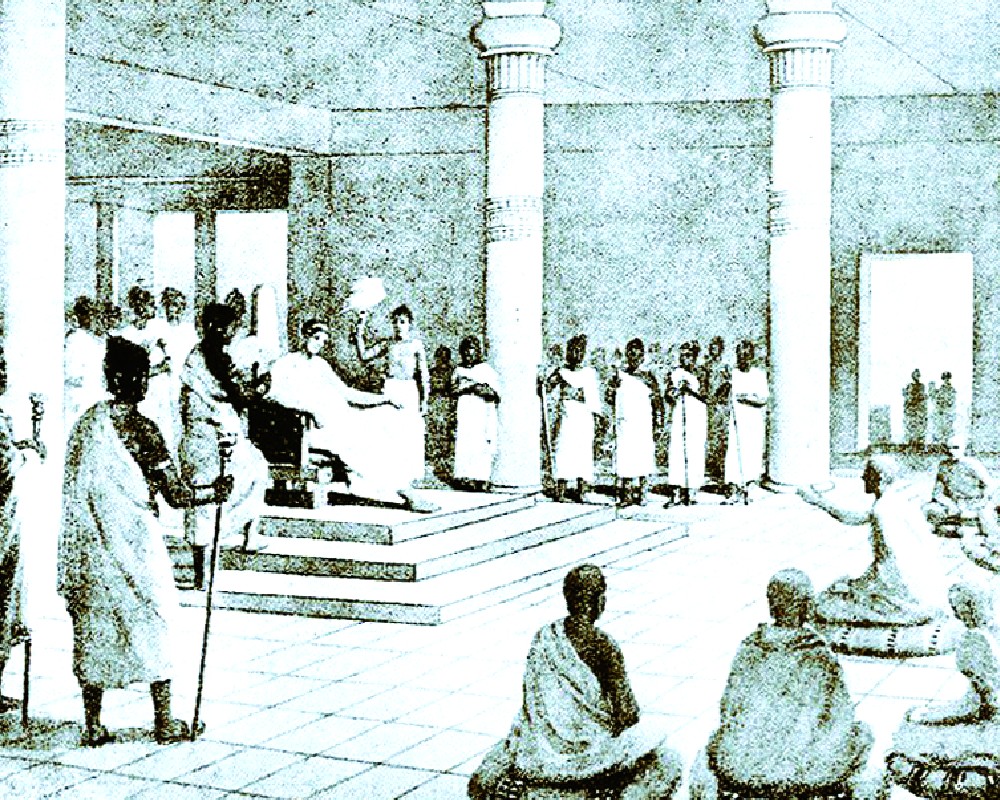
It is precisely here that the Milinda Pañha provides an intellectual corrective, a text of extraordinary lucidity and profundity which, while ostensibly a religious-philosophical dialogue, contains the kernel of a governance ethos that modern rulers might desperately need. The text chronicles the engagement between King Menander I, the Indo-Greek sovereign remembered in Buddhist tradition as Milinda, and the venerable monk Nagasena. Menander, who reigned c. 165-130 BCE, roughly a century after Emperor Ashoka, presided over a geographically modest realm encompassing parts of north-western India and Afghanistan. Unlike Ashoka, whose Mauryan empire was vast and centrally administered, Menander ruled a fragmented polity more reflective of Hellenistic city-state governance. His coins, with Greek inscriptions and iconography fused with Indian motifs, and surviving inscriptions attest to a sovereign both culturally syncretic and administratively shrewd. While no extant source suggests he learned directly from Ashoka, the philosophical and religious atmosphere shaped by Ashoka’s dissemination of Buddhism undoubtedly influenced the intellectual milieu Menander inhabited. The Milinda Pañha thus enshrines a historic cross-cultural encounter: a Hellenistic king engaging rigorously with Indian philosophical traditions, adopting an epistemological humility and openness that modern rulers conspicuously lack.
The dialogues themselves exemplify a method of inquiry that parallels the Socratic and Platonic traditions. Milinda’s questions are probing, sometimes sceptical, at times provocative, much like Plato’s interlocutors in The Republic or Meno. Nagasena responds with meticulous reasoning, often employing analogies such as the chariot, the rope and snake, the river and the lamp. Consider the famous opening exchange: “Venerable sir, what is your name?” asks Milinda. Nagasena replies, “I am called Nagasena, Majesty. But this is only a name, a designation, a convenient expression. In the ultimate sense, there is no Nagasena here.” When Milinda presses, “How can you say there is no Nagasena? Are your robes Nagasena Is your bowl Nagasena? Is your body Nagasena Is your mind Nagasena?” Nagasena elucidates, “No, Majesty. None of these is Nagasena. Yet because all these parts occur together, people use the name ‘Nagasena’, just as one speaks of a chariot, though no single piece is the chariot.” The sophistication of this method, rooted in Buddhist epistemology and the doctrine of impermanence, mirrors the Socratic elenchus, where a proposition is deconstructed through critical questioning and dialectical
reasoning.
What makes this dialogue extraordinary for contemporary governance is that it instantiates an ethos of disciplined inquiry and ethical reflection that is evidently absent in today’s political apparatus. Milinda’s probing mirrors the inquisitiveness that should guide a state’s executive: questions not merely about power or prestige but about the self, ethical action and the consequences of policy. The text repeatedly foregrounds the impermanence and interdependence of phenomena, as exemplified in Nagasena’s extended metaphors: “A fruit tree does not bear fruit the moment you plant it; it must mature. In the same way, karma ripens when conditions are right.” Here, the philosophical principle of conditionality offers a remarkable lesson for policymakers: outcomes depend on the interplay of multiple variables, and rash or short-sighted interventions invariably yield unintended consequences.
Historically, Menander’s engagement with Buddhist philosophy was not mere ornamentation; it influenced his governance ethos. While his kingdom remained smaller than Ashoka’s, it displayed a striking pragmatism intertwined with ethical deliberation, a feature reinforced in the Milinda Pañha. By contrast, modern Buddhist-majority nations frequently conflate religiosity with ceremonial display or institutional patronage rather than ethical governance. The erosion of dharmic principles is compounded by excessive bureaucratisation, monetisation of monastic institutions and prioritisation of personal or party gain over collective welfare. A Milinda-inspired polity would not conflate the symbolic with the substantive; it would foreground reflective engagement with moral and structural consequences.
Interestingly, the questioning method in the Milinda Pañha is anticipated in earlier Buddhist texts such as the Kalama Sutta, wherein the Buddha exhorts practitioners not to rely on tradition, hearsay or authority alone, but to test teachings through reasoned analysis and direct experience. “Do not go upon what has been acquired by repeated hearing; nor upon tradition; nor upon rumour; nor upon what is in a scripture,” the Buddha advises, encouraging a culture of scrutiny and empirical ethical reasoning. This same epistemological rigour underpins Nagasena’s dialogues: the king is urged not merely to accept Buddhist doctrine but to interrogate it until understanding is internalised. In contemporary governance, such a principle is strikingly absent; policy decisions are rarely subjected to sustained dialectical examination or reflective critique, and when they are, incentives for superficial compliance often outweigh those for substantive analysis.
The parallels with Greek philosophical methodology deepen here. Socrates, in the Platonic dialogues, similarly interrogates interlocutors to reveal inconsistencies in their understanding of justice, virtue and knowledge. Menander, although a foreign king in a non-Greek land, essentially embodies a Hellenistic inquirer transported into the Buddhist epistemological universe. In both traditions, authority is decoupled from truth: the king’s power or the interlocutor’s status does not confer correctness. This detachment is precisely what is missing in today’s political spheres, where charisma or inherited office substitutes for reflective ethical reasoning, and where institutional and religious oversight often becomes perfunctory or complicit. Moreover, the Milinda Pañha demonstrates that inquiry is inseparable from ethical imagination. Questions about the self, impermanence and moral causality are not abstract; they carry direct implications for governance. Policies enacted without such reflection are analogous to rulers attempting to drive a chariot without understanding its wheels or axles: the structure may move, but direction and integrity are compromised. Modern Buddhist-majority nations, by ignoring this model, have allowed corruption, patronage networks and institutional sclerosis to metastasise. Practically, this has meant temples act as financial hubs, civic oversight is subordinated to political expediency, and the teachings of the Buddha are commodified into ritualised spectacle, divorced from ethical praxis. Without the missing links of Milinda’s wisdom, can modern Buddhist rulers ever move beyond a hollow performance?
The writer is a columnist based in Colombo; views are personal