The Climate Cost of the War Machine
There is a particular dissonance that comes with reading the news in the current age. On one page, a missile strike; on the next, a climate summit. On one channel, footage of a city under bombardment; on the next, a report on record ocean temperatures. We have learned to hold these two realities at the same time without connecting them, consuming one as geopolitics and the other as science, treating them as simultaneous emergencies that happen to share a world but not a cause. This separation is not accidental. It is one of the most consequential errors the modern mind makes, and its consequences are measured not in misunderstanding but in carbon and in blood. The refusal to see that these two crises share a root, are fed by the same engine, and cannot be solved while that engine continues to run, is not merely an editorial convenience. It is the ego's oldest defence: keep the problems in separate compartments, and neither will ever demand a reckoning with the one who is producing both.
They are not parallel catastrophes but the same catastrophe wearing different faces.
The first face is familiar: a border is contested, an ideology threatens, a regime must be contained. Armies mobilise, weapons are procured, and the world watches the spectacle of human beings organised to destroy each other. The second face is slower and less dramatic: carbon accumulating in the atmosphere, temperatures rising by fractions of a degree each decade, coral bleaching, aquifers draining, glaciers retreating at rates that satellite data now measures with discomforting precision. These two faces belong to the same creature: the unexamined ego operating at the scale of nations, and it cannot be understood by studying either face alone.
The Emissions the Treaties Forgot
The world's militaries account for an estimated five and a half percent of global greenhouse gas emissions. To appreciate what this means: civil aviation, which most people regard as a significant climate problem and which has been the subject of intense public scrutiny and regulatory pressure, accounts for roughly two percent. The militaries of the world emit nearly three times as much as all the world's commercial flights combined, and this figure is almost certainly an underestimate, because military emissions are the one major category of human activity that is systematically excluded from climate accounting. If all the world's militaries were counted as a single country, they would rank as the fourth-highest emitter on the planet, behind only the United States, China, and India.
This exclusion has deep roots. During the Kyoto Protocol negotiations of 1997, the United States pushed hard for military activity to be carved out of binding emissions targets, and it succeeded. Under the current UN climate regime, the situation has improved only marginally: military emissions reporting by major powers remains incomplete, inconsistent, and in practice largely voluntary. The three countries with the largest military establishments in the world, the United States, Russia, and China, either do not report their military emissions to the United Nations at all, or do so in ways that cannot be independently verified. According to the Conflict and Environment Observatory, as of late 2025, disclosure by major military spenders remains poor and shows no meaningful sign of improvement. The gap is not a relic of a less enlightened era of climate diplomacy. It is widening as militarisation rises, at the precise historical moment when the urgency of a complete carbon inventory has never been greater. The world is attempting to manage a civilisational crisis with a structural blind spot at the centre of its data, and that blind spot is growing.
The United States military alone is the largest single institutional consumer of hydrocarbons on the planet. If it were a nation, its emissions would rank it forty-seventh in the world, ahead of Portugal, Sweden, and Denmark. Between 2001 and 2018, total Pentagon emissions reached an estimated 1.3 billion metric tonnes of carbon dioxide equivalent, a figure that dwarfs almost any other single-institution accounting in human history. Of this, the wars in Afghanistan, Iraq, Pakistan, and Syria accounted for 440 million metric tonnes, with the Iraq invasion alone responsible for 250 million. To hold these numbers in perspective: 180 countries in the world have total annual emissions below 250 million metric tonnes. A single invasion, measured conservatively, out-emitted the majority of the world's nations for the period of its conduct. And crucially, two-thirds of total US military emissions in this period came not from active war zones but from the peacetime existence of the military machine itself: bases, training exercises, fuel logistics, and the sprawling supply chains that feed a permanent war-readiness posture. The climate cost does not wait for the shooting to start.
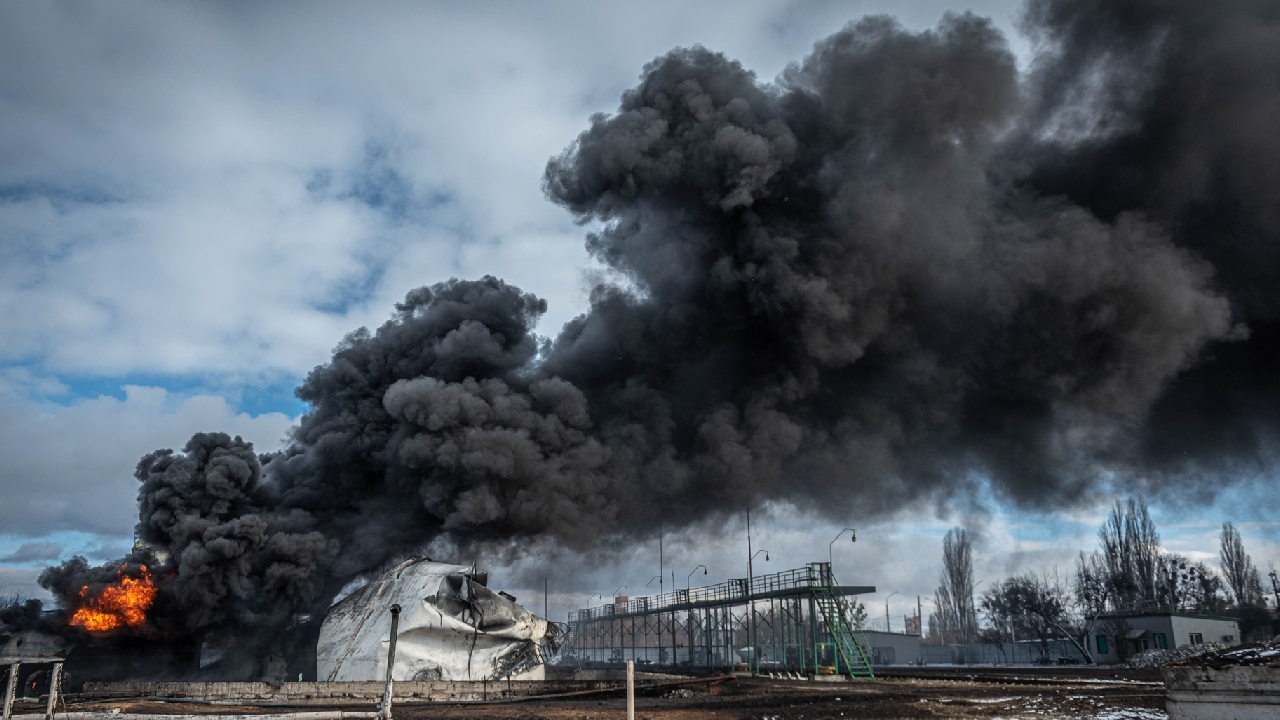
When a war is actually fought, the accounting becomes staggering. Three years of the Russia-Ukraine conflict generated 230 million tonnes of carbon dioxide equivalent, more than Spain's annual greenhouse gas output, and a figure equivalent to the combined annual emissions of Austria, Hungary, the Czech Republic, and Slovakia. The largest single source was warfare itself, the fuel burned by tanks and fighter jets, the manufacture and detonation of ammunition, the construction of fortifications, accounting for 36% of the total. Reconstruction came second at 27%, and this proportion is not incidental: cement and steel, the two materials on which post-war rebuilding depends most heavily, are among the most carbon-intensive industrial products on earth. Every building reduced to rubble releases the carbon locked into its construction, and the energy required to manufacture its replacement releases a comparable quantity again. The war's carbon trail extends further still: assessments of Ukraine's total war footprint include emissions from rerouted commercial flights forced to avoid conflict airspace, fires ignited by strikes on industrial and energy infrastructure, and the long-burning release of carbon from oil and gas systems hit by bombardment. War does not merely burn fuel in tanks and jets. It disrupts, ignites, and reroutes entire energy systems, none of which appears in any country's climate commitments. Meanwhile, the first fifteen months of Israel's bombardment of Gaza generated an estimated 32 million metric tonnes of carbon dioxide equivalent, roughly equal to Croatia's entire annual emissions, a figure that does not include the emissions that reconstruction will eventually require. Ukraine has quantified the climate damage from Russia's aggression at over forty-two billion dollars and intends to seek reparations on this basis, inaugurating what may become a new chapter in international climate law.
And all of this is happening while military spending is accelerating. Global military expenditure reached $2.7 trillion in 2024, a 9.4% increase from the previous year and the steepest annual rise since the Cold War. The world is spending more on the instruments of destruction at the precise historical moment when the cost of that spending, measured in atmospheric carbon and diverted climate finance, has never been higher.
The Same Engine, Running Both
The richest nations of the world spend thirty times more on their militaries than on climate finance for the countries most vulnerable to climate breakdown. UNEP estimates that developing countries will need up to $387 billion annually by 2030 simply to adapt to the climate damage already locked in. That sum is less than fifteen percent of what the world spent on military budgets in 2024. A relatively modest reallocation of what the world spends on preparing for war could cover the full adaptation needs of the most vulnerable nations on earth. The money exists; the political will does not, because the political will is being consumed by the same appetite that is generating the emissions.
The opportunity cost is not only financial. Research on employment consistently shows that military spending produces an average of five jobs per million dollars invested, compared to roughly thirteen in education, nearly nine in healthcare, and six to eight in clean energy and infrastructure. The same expenditure redirected toward the energy transition would generate more than twice the employment while reducing the emissions that the military is simultaneously producing. The security argument for military prioritisation turns out, on close examination, to purchase less security than the alternative it displaces, whether that alternative is measured in stable employment, climate resilience, or megatonnes of avoided carbon.
The ego that launches a war and the ego that cannot stop burning carbon are not two different egos with different problems. They are the same ego with the same problem: the refusal to identify with anything beyond the immediate boundary of the self, whether that self is called a nation, a civilisation, a generation, or simply the quarterly earnings cycle. Both the warmonger and the climate-indifferent consumer are running the same programme: consume, expand, secure, do not look at the cost. The military-industrial complex and the fossil fuel complex are not separate systems that happen to cause overlapping damage. They are the same system, the organised institutional expression of what an unexamined ego does when it reaches civilisational scale, embedded in the same governments, funded by the same tax revenues, and defended by the same rhetoric of necessity and security.
When a government argues that it cannot reduce military spending because security is under threat, and simultaneously argues that it cannot fund climate adaptation at the required level because resources are constrained, it is not making two separate arguments. It is making one argument: the present emergency, visible and named and emotionally galvanising, must take priority over the slower, more abstract, more inconvenient emergency whose gravest consequences fall on populations in other countries and on generations not yet born, neither of whom have a vote in its elections. This is not a failure of reason but a structural feature of the ego's operation. The ego will not sustain attention on what does not immediately threaten it. It is not that it cannot; it is that looking honestly at the slow emergency would require it to look at itself. This is why the climate crisis, which is a present-tense emergency by every scientific measure, is treated in the political calendar as a future problem, while each new military crisis is treated as requiring immediate and unlimited response.
There is also a feedback loop that the standard analyses do not capture. Wars produce emissions, those emissions accelerate climate change, and climate change destabilises regions, depletes water and agricultural resources, and generates the conditions of scarcity and displacement that have historically functioned as accelerants of conflict. The war does not end when the shooting stops; it continues in the atmosphere, warming the planet that the next generation of belligerents will inherit, primed for the next conflict by the environmental damage the previous one left behind. This is not a hypothesis: researchers studying the Ukraine conflict have noted explicitly that the war is exacerbating the very climatic conditions, drought, heat extremes, increased fire risk, that will make the region's recovery harder. Climate change creates conditions for conflict; war accelerates climate change; the cycle tightens with each iteration.
The Accounting That Is Never Done
Wars are said to be fought out of necessity, and the necessity is real enough as the ego experiences it: security is under threat, the adversary is not similarly restrained, survival requires force. None of this is being denied. What is being asked is something simpler and more uncomfortable: whether a civilisation conducting an honest accounting of what it spends and what it produces would be willing to include, in every military budget, the atmospheric cost of what is being burned and destroyed. Whether the necessity that justifies the war also justifies the silence about what the war costs the planet. Whether the same governments that cannot fund climate adaptation at $387 billion can explain why they can sustain military budgets of $2.7 trillion.
That accounting is not being done, and its absence is not accidental. Military emissions are exempt from the frameworks that govern every other source of human carbon output. The countries most responsible for global warming are the same countries that dominate global military spending. The carbon released by three years of war in Ukraine, and fifteen months of bombardment in Gaza, appears in no nation's Paris Agreement commitments. The emissions from the weapons manufactured and shipped and detonated, from the cities reduced to rubble and eventually rebuilt, from the rerouted flights and burning pipelines and struck refineries: none of this appears in the ledger against which the world measures its progress toward the temperature targets it has set itself.
This is not bureaucratic failure but the ego's oldest and most consistent manoeuvre: the refusal to be the object of its own scrutiny. Every accounting system reflects the priorities of the one doing the accounting. A system that accounts for the carbon in a return flight to London but not for the carbon in a sortie over a conflict zone is a system organised around the protection of certain categories of human activity from the consequences of their own costs. It is the same refusal that prevents the individual ego from looking honestly at its own motivations, scaled up to the level of international law.
The peace that follows a war is not peace. It is the interval during which the damage accumulates in forms that do not yet have names, in parts of the atmosphere and in ecosystems and in the long-term health of populations exposed to the toxic legacy of what was burned and detonated, before the next occasion for conflict presents itself. The climate accounting that is avoided is not merely a statistical gap. It is a mirror that, if held up honestly, would show the full cost of the life a civilisation has chosen, and demand an answer to the question it has always preferred to leave unasked: what, exactly, are we defending, and from what, and at what cost, and to whom?
When you read about military budgets and feel, underneath the numbers, a quiet reassurance, your interests protected, notice what that feeling is made of. It is made of the same material that the ego has always used to make its case: the present threat, vivid and nameable, against the future cost, slow and statistical and happening to someone else first. The ego that will not conduct an honest accounting of its own costs is not a problem confined to governments and militaries. It is the individual ego, operating at its own scale, consuming what it consumes and sanctioning what it sanctions without looking at the ledger it is helping to fill. The governments that refuse to account for military emissions did not arrive from nowhere. They were elected, tolerated, and applauded by people running the same programme of exemption on a smaller scale.
That question, honestly pursued, is more dangerous to the ego than any weapon. And so it goes unasked, and the carbon accumulates, and the temperature rises, and the next war begins.
Acharya Prashant is a teacher and author whose work centres on self-inquiry and its application to contemporary life.
Leave a Comment
Comments (47)
Very informative and eye opening article. The impact war has on climate change is immense and successfully ignored by the nations for their own interests. The feedback loop is dangerous. The real assessment of the climate cost of war has to be done and they need to be addressed first . But in reality common people think they are doing their part to become carbon neutral by using EV, renewable energy, recycling etc. Common man need to hold the war mongers accountable. For that we need clarity like this in the common people. Thank you Acharya Prashant for explaining the root cause in such a lucid manner. His voice need to be heard by everyone.
The ego will not sustain attention on what does not immediately threaten it.
Cimate change and war are not two different things.they come from same origin our ego.
Acharya ji, I want to thank you for explaining very well how war is no different from climate change.
Hopefully these words atleast awakens Some People. ......The Way the Whole world is ignoring Climate Change Now is as that it doesn't Exist .Hope They will awaken Before its takes many more life's of any species on Earth