The insight of the Forest Man
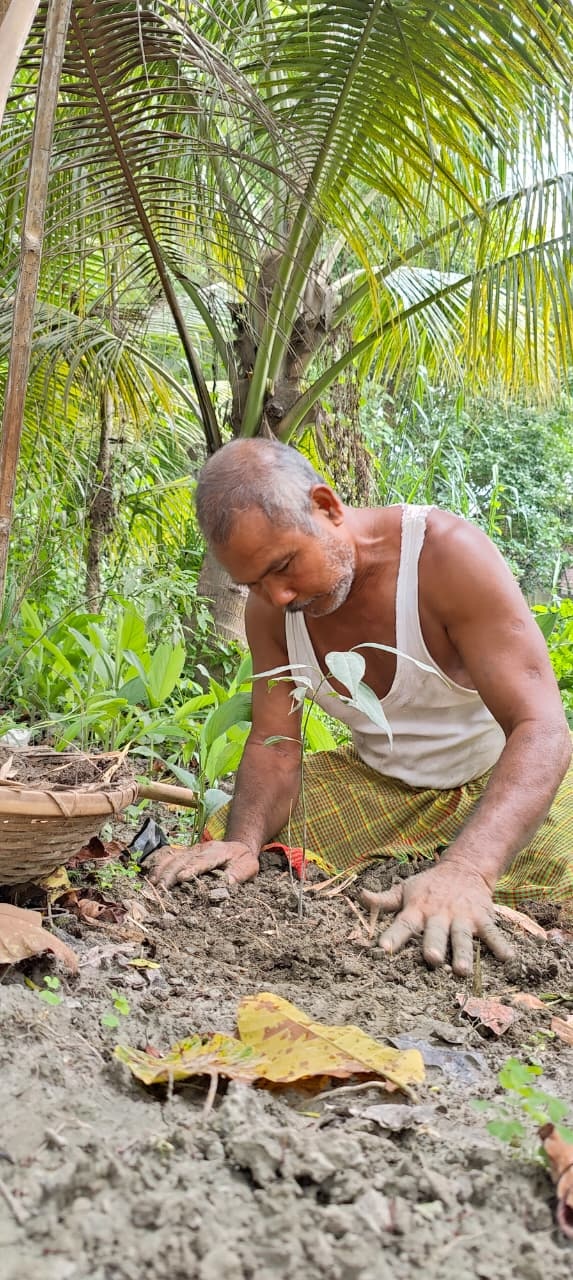
The mighty Brahmaputra is the soul of Assam; a mythical land since antiquity where legend and fact often commingled along the sweltering banks of the river and its various tributaries. With over two thousand islands and sandbars the river is morphodynamically complex and studies on it are ongoing till date. Decades ago, on one such remote river island - where shifting sands stretched endlessly under the harsh tropical sun - a quiet revolution took root, one sapling at a time. At the heart of this transformation stands Jadav Payeng, widely known as the “Forest Man of India.” For over four decades, Payeng has single-handedly nurtured a barren landscape into a thriving forest, offering those who care to observe, a living example of resilience, patience, and the profound impact of individual action.
As the world marks World Rewilding Day today, Payeng’s story resonates more deeply than ever. At a time when climate change, deforestation, and biodiversity loss dominate national and global discourse, his work stands as both inspiration and instruction—a reminder that restoration is not only possible, but essential.
Payeng’s journey began in 1979, as a young boy living on Majuli, one of the world’s largest river islands. After a particularly severe flood, he noticed numerous dead snakes on a barren, uninhabited sandbar. He realized that the scalding sun and the absence of vegetation had made the sandbar uninhabitable for wildlife. While others were resigned to this state of affairs, Payeng was incited to action. With little more than determination, he began planting trees on the barren sandbar.
“I didn’t start with a big plan,” he recalls. “I just wanted to help nature heal.”
What followed was not a short-lived effort but a lifelong commitment. Starting with a few bamboo seedlings, Payeng spent day after day, season after season, planting and protecting his ever growing green oasis, often working in isolation. In the early years, his efforts went unnoticed, and at times, even unappreciated. The harsh climate, lack of resources, and the sheer scale of the task would have discouraged most. But for Payeng, persistence was not a choice—it was a way of life.
Over time, the land began to change. What was once a desolate expanse slowly transformed into dense greenery. Today, the forest he created—often referred to as Molai Forest—spans hundreds of hectares and supports a rich ecosystem. The mighty Tiger proudly patrols his territory, colossal elephant herds roam freely, beady eyed rhinos bathe in the mud and patrol the grasslands while deer graze under the canopy, and birds fill the air with life. The rewilding of this tract has not only restored biodiversity but has also helped stabilize the soil and mitigate the effects of erosion in the region. From a barren sandbar to a jungle island all because of one man.
For Payeng, however, the success of the forest is not measured in hectares or headlines. It is measured in life. “When I see animals return, when I see trees growing strong, I feel happy,” he says. “That is enough for me.”
His understanding of rewilding is simple yet profound, absent any complexity. While the term often appears in scientific and policy discussions, Payeng reduces it to its essence: helping nature to regenerate and reclaim its lost territory. “Nature knows how to take care of itself,” he explains. “We just need to support it, not destroy it.”
This philosophy is particularly relevant today, as large-scale environmental solutions often overshadow the role of individuals. Payeng’s story challenges that notion. Working alone for many decades, he has demonstrated that meaningful change does not always require vast resources or institutional backing. Instead, it requires commitment, patience, and a deep connection to the natural world.
“People think they are too small to make a difference,” he says. “But every big forest starts with one tree.”
Despite his many plaudits—a grateful nation honoured him with the Padma Shree in 2015—Payeng remains deeply grounded. He continues to live a simple life with the same routine, tending to his forest and advocating for environmental conservation at the grassroots level. His humility is striking, especially in contrast to the magnitude of his achievement.
He emphasizes the importance of local involvement, noting that those who live closest to nature are often its most effective guardians.
For young people, his message is clear and simple. In an age dominated by digital engagement and rapid consumption, he urges a return to the basics—planting trees, conserving resources, and respecting the environment.
Looking ahead, Payeng remains committed to his mission. He continues to plant trees and care for the forest that has become his life’s work. While he does not speak in terms of legacy, his impact is undeniable—not only in the physical landscape he has transformed but also in the minds he has inspired.
On World Rewilding Day, as nations and organizations discuss strategies to restore the planet, the story of Shri Jadav Payeng, Padma Shri serves as a powerful reminder that the seeds of change often lie in the simplest of actions. His journey underscores an enduring truth: that even in the face of overwhelming challenges, one person, with unwavering dedication, can make a difference.
In a world searching for solutions, the Forest Man’s quiet revolution offers hope—not as an abstract ideal, but as a living, growing reality of grassroots conservation led by private citizens.
The author is a wildlife conservationist and is a consultant for sustainable wildlife projects.