The helicopter that made the Arabian Sea feel smaller
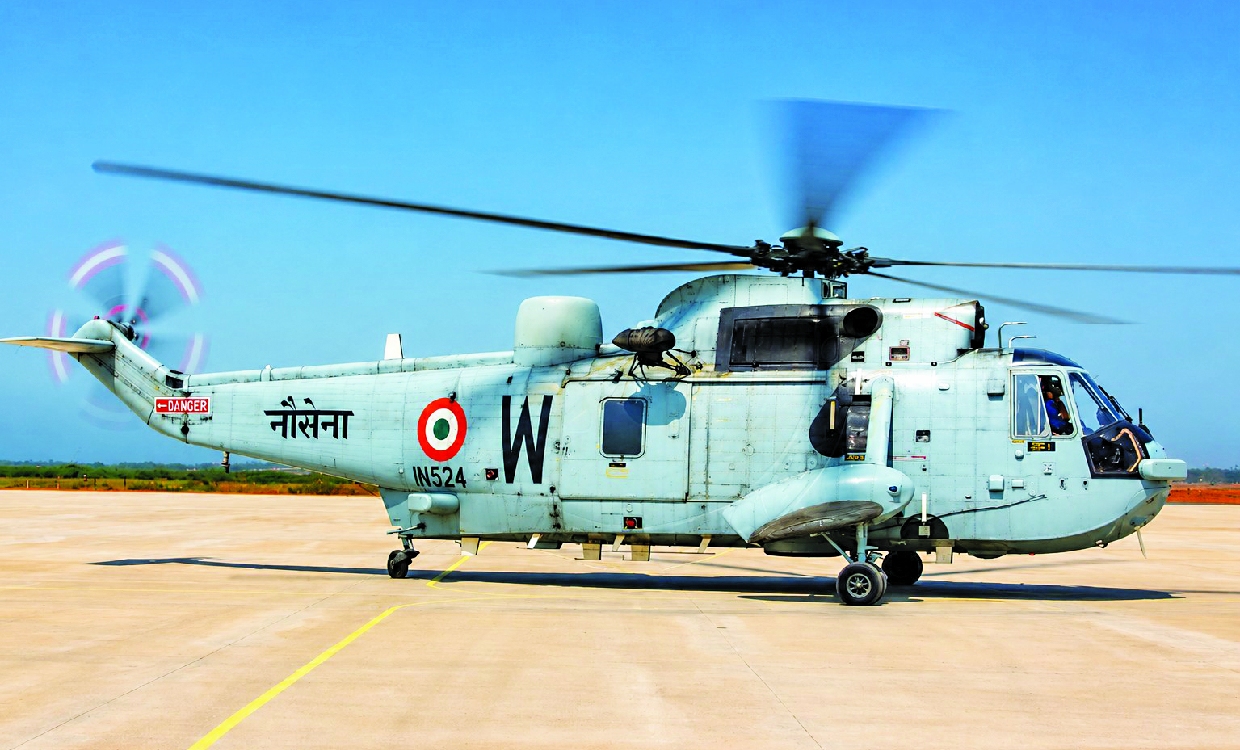
On 14 June, the Indian Navy softly closed a remarkable chapter in its aviation history. The Sea King 42B helicopters—known affectionately across generations of naval aviators simply as the "Bravo"—has seen its operational journey come to an end with the number-plating of INAS 330, nicknamed the "Harpoons."
In naval aviation nomenclature, number-platting does not mean death. It means preserving a squadron's identity while retiring the aircraft that defined it. Yet for hundreds of officers and sailors who spent their youth around Sea King, the moment feels deeply personal. Military history is often written around wars, ships, missiles, and admirals. Rarely is it written around an aircraft. The Sea King deserves an exception. For more than fifty years, the Sea King family has been woven into the story of the Indian Navy. The original variants arrived in 1971, participated in the Bangladesh Liberation War, and helped shape India's naval aviation doctrine. But it was the Sea King 42B, inducted during the late 1980s, that transformed how the Navy thought about maritime warfare. Built originally by Westland Helicopters under license from Sikorsky Aircraft, the Sea King was never designed to be glamorous.
It was designed to endure. Weighing close to ten tonnes, powered by twin Rolls-Royce Gnome engines, and capable of operating hundreds of miles from its parent ship in some of the world's harshest maritime conditions, the aircraft earned a reputation that few naval helicopters have matched.Across navies worldwide—from the United Kingdom and India to Canada and Germany—the Sea King became synonymous with reliability, versatility, and survivability. In Indian service, however, it evolved into something more. The Sea King 42B was not merely a helicopter; it became an airborne extension of the fleet itself, carrying sensors, weapons, and capabilities that fundamentally changed how the Indian Navy fought at sea.
To understand why, one must appreciate the era into which it arrived. The Cold War was still alive. The Indian Navy was expanding rapidly. Aircraft carriers INS Vikrant and INS Viraat were operational. Guided missile destroyers and frigates were entering service. Yet one challenge remained constant: the ocean is vast, and ships can only see so far. The Sea King changed that equation. Perhaps, for the first time, the Indian Navy possessed a helicopter capable of doing nearly everything its parent warship could do. Equipped with advanced radar, anti-submarine sensors, sonobuoys, torpedoes, electronic surveillance systems and the formidable Sea Eagle anti-ship missile, the Sea King became what naval officers fondly called a "flying frigate." Its radar could peer hundreds of kilometers beyond a ship's horizon. Its sonar could hunt submarines hidden beneath the waves. Its missiles could strike hostile vessels far beyond visual range. In a single sortie, it could search for surface ships, switch to anti-submarine warfare midway, conduct electronic intelligence gathering, and return to its deck carrying information that could shape an entire fleet's battle plan.
One such veteran, speaking in the recently released Meluha Maritime Conversations podcast hosted by Cmdre. Srikant B. Kesnur, an Indian Navy veteran and naval historian, perhaps captured its legacy best when he opined that the Sea King had the capability to make the vast Arabian Sea feel no larger than a pond. That may sound like nostalgia speaking. It is not. At the time, few naval helicopters in the world combined so many capabilities on a single platform. While other navies operated specialized helicopters for individual missions, the Indian Navy's Sea Kings evolved into true multi-role combat systems. They extended the fleet's eyes, ears and striking arms far beyond the horizon. But aircraft do not create legends. People do. Listening to former operators recount their experiences reveals that the Sea King's real story lies not in hardware but in human endeavour.
Night anti-submarine missions remain part of naval aviation folklore. Picture a moonless Arabian Sea. A helicopter hovers 52 feet above black water. The sonar is lowered into the depths below. Two pilots maintain a delicate hover while operators at the rear scan acoustic signatures, attempting to locate a submarine commander equally determined not to be found.
For four hours, both sides engage in an invisible contest of patience, skill and nerves. The pilot worries about engine failures. The sensor operator worries about missing the faintest acoustic clue. The submarine captain below worries about being detected. That was the world of the Sea King. The aircraft also demanded a level of teamwork rarely seen elsewhere. Every mission depended on pilots, tactical coordinators, sensor operators, engineers and maintainers functioning as a single organism. Veterans still recall standing shoulder-to-shoulder rehearsing emergency drills, each crew member knowing precisely what to do should disaster strike. And then there were the rescues. While much attention is paid to anti-submarine warfare and anti-ship missions, the Sea King's humanitarian record is equally impressive. Whether responding to maritime disasters, floods, search-and-rescue operations, or medical evacuations, the aircraft repeatedly demonstrated that military aviation serves people as much as strategy.
Perhaps that explains why so many former Sea King operators speak about the aircraft with emotion rather than professionalism. In the said podcast episode, one retired rear admiral revealed that he carries a tattoo of the Sea King on his hand. Another described how veterans from around the world are travelling back for the squadron's farewell. These are not reactions typically associated with machines. They are reactions associated with identity. The Indian Navy is, of course, moving forward. The MH-60R Seahawk, alias "The Romeos," represents a new generation of maritime helicopters. It is more advanced, more networked, and better suited to the requirements of a twenty-first-century navy. Progress is inevitable.
Yet every modern capability rests upon foundations built by those who came before. The Sea King arrived at a time when India was still discovering its maritime ambitions. It served through the rise of the Indian Navy from a regional force into a genuine blue-water navy. It flew from four different aircraft carriers, supported countless deployments, participated in major operations, and helped shape generations of naval aviators. In many ways, the story of the Sea King is also the story of a Navy finding its confidence. When the last Sea King Bravo lifted off and the squadron standard was lowered, the aircraft left behind more than a service record. It left behind a culture. A culture of professionalism, camaraderie, innovation, and quiet excellence. The Sea King may be leaving active service. But for the men who flew it, hunted submarines from it, maintained it, rescued lives with it, and grew up around its unmistakable roar, the Arabian Sea will always sound a little different without it.