Stalled promise: Why the Nari Shakti Vandan Vidheyak failed in Parliament
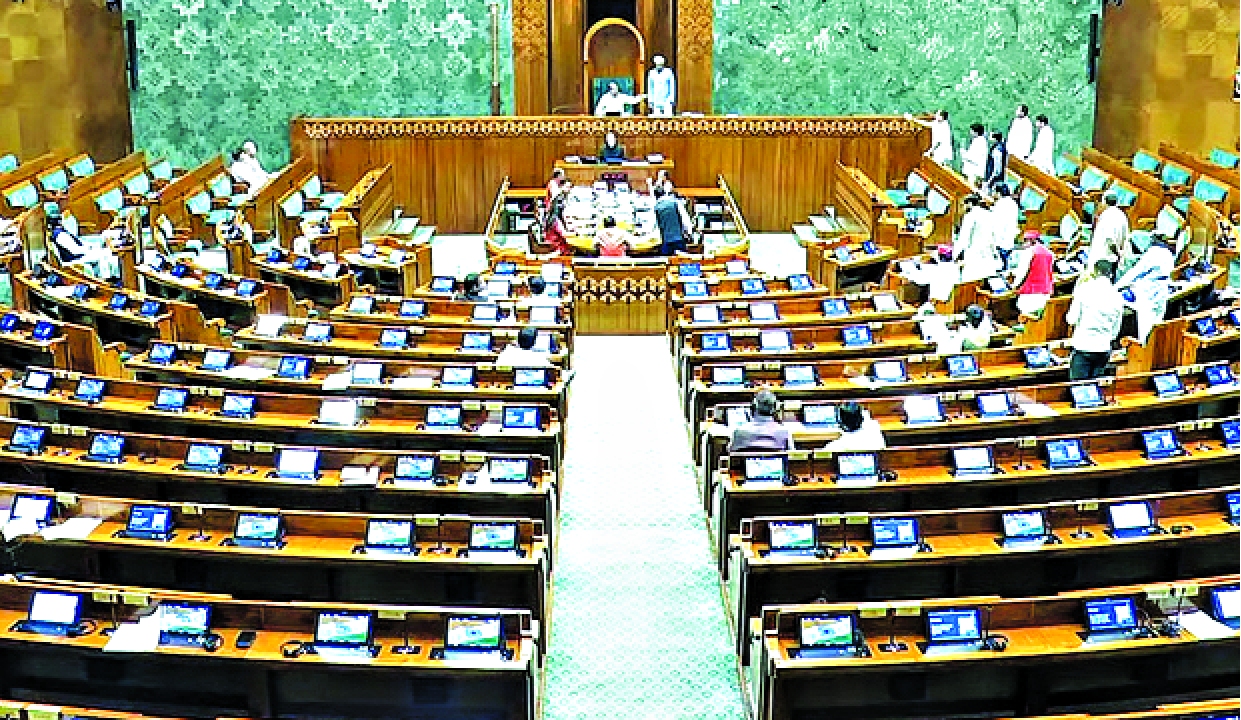
The Nari Shakti Vandan Vidheyak, also known as the Women’s Reservation Bill, is perhaps the first Constitutional Amendment Bill that could not secure Parliament’s approval since Narendra Modi took office as Prime Minister. On one earlier occasion, in the context of the GST Act, when the numbers in the Rajya Sabha were not in the government’s favour, the government still succeeded in getting the Bill passed after initial hiccups. The question that arises is: why did the Nari Shakti Vandan Vidheyak fail to pass this time, compelling the government to withdraw two other associated Bills as well?
To comprehend this situation, we must examine this legislation within its historical context. In 2023, the ‘Women’s Reservation Act’ was passed, providing for 33 per cent reservation for women in the Lok Sabha and State Legislative Assemblies. Although this legislation was enacted into law, it could not be implemented immediately. The reason was that the Act explicitly stipulated that it would come into effect only after the completion of a new Census and the subsequent delimitation process (the redrawing of electoral constituency boundaries). The Census, scheduled for 2021, was postponed due to the COVID-19 pandemic. The Census process is currently underway but is unlikely to be completed before 2028. As for delimitation, it can only be undertaken once the Census is complete, as the demarcation of parliamentary and legislative assembly constituencies is feasible only after the Census data has been compiled. Evidently, this entire process could not realistically be accomplished in time for the 2029 general elections.
In this context, with a view to expediting the implementation of the women’s reservation law, the government introduced a new Women’s Reservation Bill (Nari Shakti Vandan Vidheyak). It stipulated that delimitation of constituencies for the Lok Sabha and State Legislative Assemblies be carried out on the basis of the 2011 Census. However, the Bill was defeated in the Lok Sabha on 17 April 2026 due to the lack of a two-thirds majority, thereby freezing the possibility of providing reservation for women in the Lok Sabha and State Legislative Assemblies in the near future.
There is intense resentment within the ruling coalition regarding this issue, as well as among women at large. In this context, it is necessary to ascertain whether the Opposition possesses any substantive grounds for voting against this Bill, or whether their opposition is merely politically motivated. What arguments do Opposition parties put forward in this regard? Is it possible to arrive at a resolution on women’s reservation by amending or clarifying the Bill that was rejected by Parliament?
The Opposition has presented several arguments regarding this Bill, both within and outside Parliament, and the relevance of these arguments warrants examination. The 230 members of the Lok Sabha who voted against the Bill include members from the Congress, DMK, Samajwadi Party, and Trinamool Congress, among others. Opposition members-particularly those from the DMK-contend that if this Bill is passed, then in the delimitation exercise, southern states such as Tamil Nadu will lose their proportional share of seats and, therefore, representation in the Lok Sabha. This is because they have successfully controlled population growth, whereas northern states such as Uttar Pradesh and Bihar, which have experienced rapid population expansion, would gain.
To address these concerns, the government proposed a ‘50 per cent formula’ in Parliament, under which the total number of Lok Sabha seats would increase from 543 to 850, while southern states would be allocated an additional 50 per cent of seats each, proportionate to their current strength. Under this formula, Karnataka would receive 42 seats instead of 28; Tamil Nadu, 59 instead of 39; Andhra Pradesh, 38 instead of 25; Telangana, 26 instead of 17; and Kerala, 30 instead of 20. Previously, under the chairmanship of N.K. Singh, the 15th Finance Commission had accorded weightage to parameters other than population for the allocation of financial resources, enabling these states to receive a substantial share despite smaller populations. In light of this, opposition to the Act on such grounds appears unjustified.
The Congress and other Opposition parties assert that, although they are not opposed in principle to women’s reservation, linking it to delimitation and the Census is inappropriate. They argue that the Bill has inextricably tied women’s reservation to a nationwide delimitation exercise-a process that, in their view, is unrelated to women’s empowerment-and that this constitutes an attempt to fundamentally alter India’s electoral map. However, this argument does not hold, given that the 2023 Act also explicitly linked the implementation of reservations to the Census and delimitation. The defeated Bill of 17 April 2026 merely proposed using the 2011 Census to fast-track this process. This is not the first instance of delimitation. Since 1951, delimitation has been a routine administrative exercise conducted after each Census until 1971. In 1976, the process was frozen until 2001 and later extended to 2026 through constitutional amendments. Although a limited delimitation exercise took place between 2002 and 2008, it did not change the total number of Lok Sabha seats. With the freeze ending in 2026, a fresh delimitation exercise is now due.
Therefore, the Congress party's claim that women's reservation is being arbitrarily linked to delimitation appears untenable. Delimitation is a constitutionally mandated process, not a discretionary measure. It is a necessary procedural step; without it, effective implementation of women's reservation and broader political empowerment is difficult. The argument that the government is using this as a political pretext is also unconvincing, as delimitation would occur after the next Census regardless of this Bill.
By opposing the Bill, the Congress has only delayed the redrawing of constituencies, not prevented it. Delimitation will inevitably take place after the Census, likely by 2028. Moreover, concerns regarding changes to OBC, Dalit, and Adivasi representation lack strong grounding, as these are constitutionally protected.
Overall, the Opposition's objections appear misleading, contributing to delays in implementing women's reservation.
The writer is the National Co-convener, Swadeshi Jagran Manch, and a former Professor at PGDAV College, University of Delhi; Views presented are personal.