Satya Niketan: Accountability, not scapegoating

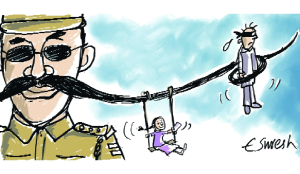
The Satya Niketan building collapse demands accountability, but accountability cannot begin and end with identifying the officer occupying the chair when tragedy struck
When a building collapses and lives are lost, the first instinct is to find someone to blame. The more difficult — and far more important - task is to determine who was actually responsible.
The tragedy at a PG accommodation in Satya Niketan has rightly triggered public anger and demands for accountability. There can be no argument with the need for answers when human lives are lost. But accountability must follow facts, law and evidence. It cannot become a predetermined search for an individual to carry the burden of a failure that may have developed over years and involved several institutions. This is particularly relevant to the intense media scrutiny of the incumbent Commissioner. The question is not whether a Commissioner should be accountable. Of course, he should. The real question is: accountable for what?
A Commissioner can reasonably be held responsible for decisions taken under his authority, failures to act where a clear statutory duty existed, matters specifically brought to his notice, and enforcement powers that were lawfully available to him. If evidence establishes that a dangerous condition was known to the competent authority, that there was a legal power to intervene, and that an avoidable failure occurred during his tenure, scrutiny is not only justified but necessary.
But accountability has boundaries.
An incumbent Commissioner cannot automatically be held personally responsible for every unauthorised construction that predates his tenure, every historical enforcement failure, every matter falling within another statutory authority, or every violation of which the administration had no knowledge. The fact that a problem continues into a particular tenure does not, by itself, establish personal negligence. Nor does the mere occurrence of a tragedy prove that the officer occupying the chair caused it.
This distinction is particularly important in Delhi. Planning, building control, land use, fire safety, licensing, policing and enforcement can involve different institutions and different statutory powers. Responsibilities can overlap, intersect or be divided between agencies. The Commissioner may be the most visible administrative authority, but visibility should never be mistaken for exclusive jurisdiction.
There is a deeper problem in the way administrative failures are often discussed. Every new Commissioner inherits properties, complaints, files, litigation, enforcement backlogs and practices accumulated over years. Some problems may have existed for decades. Some properties may have been inspected previously; others may never have come to official notice. Some matters may have been dealt with - or ought to have been dealt with - by another authority.
To attribute the entire accumulated burden to the person currently occupying the chair is to confuse continuity of office with personal culpability. The proper investigation must therefore proceed backwards through the entire chain of responsibility. When was the property constructed or altered? What was its sanctioned use? When did any violation arise? Were permissions obtained? Were complaints received? Were inspections conducted? What did officials find? Which authority had jurisdiction at each stage? When did the competent authority acquire knowledge of a potential danger? What statutory powers were available? What action was required, and what action was actually taken?
These are the questions that establish responsibility. The easier question — “Who was Commissioner when the building collapsed?” — does not. The media has every right to ask uncomfortable questions, and the public has every right to demand answers. But complicated administrative matters should not be reduced to a search for a convenient individual to absorb public anger. Commentary becomes counterproductive when definitive judgments are pronounced without examining the documentary record, the institutional chain and the division of statutory responsibilities. There is an additional danger in turning accountability into a media trial. Public officials may become more concerned with headlines than with confronting difficult legacy problems. Defensive administration replaces decisive administration. The incentive becomes not to identify and correct danger, but to avoid being associated with it.
That is not accountability. It is scapegoating disguised as accountability.
The Satya Niketan tragedy should instead become the catalyst for systemic action. Vulnerable PGs, hostels and residential premises converted to intensive commercial or quasi-commercial use should be identified and subjected to appropriate safety and regulatory scrutiny. Where a structure or use can lawfully and safely be regularised, it should be. Where it cannot, it should be sealed and, where necessary, demolished. Most importantly, a sealed or condemned property must not simply reappear under another operator, another name or another purported use without a fresh legal and safety assessment. Otherwise, enforcement becomes temporary theatre rather than prevention.
None of this is an argument for shielding any Commissioner or public official. If evidence establishes negligence, dereliction of duty or failure to exercise lawful powers, responsibility must follow. If responsibility is distributed across several agencies, successive administrations, property owners or other actors, it must be apportioned accordingly.
The governing principle should be simple: the person in the chair is not necessarily the person responsible for everything that has accumulated before him. The victims and their families deserve more than a media trial and a convenient name to blame. They deserve an evidence-based reconstruction of what happened, who had the duty and power to act, what warnings existed, why action was or was not taken, and what must change. There should be no immunity for negligence - but neither should there be guilt by incumbency.
The ultimate test of accountability is not how quickly the system finds someone to blame after a tragedy. It is whether it has the courage to trace responsibility to its source, confront institutional failure wherever it exists, and identify the next dangerous building before it collapses.
That is the accountability Delhi and the victims of Satya Niketan — deserve.
The ultimate test of accountability is not how quickly the system finds someone to blame after a tragedy. It is whether it has the courage to trace responsibility to its source, confront institutional failure wherever it exists, and identify the next dangerous building before it collapses
The writer is a retired IAS officer; Views presented are personal.