Safeguarding the Republic through challenging times
Congratulations, we have marked the 76th year, of giving ourself the Constitution and marking this day as Republic Day. It highlights the transition from monarchial setup, to the setup which believes in an elected head of the state. Demonstrating the best example of how “We the people”, brings into the practice, a popular theory known as social contract.
Much to the credit, our constitution as adopted, has influences of primarily, Government of India Act (1935), American constitution, soviet constitution, Irish Constitution, etc. Often this becomes point of criticism as it is constitution full of plagiarism and does not suit the Indian demands, but there is no harm in allowing the flow of wisdom from every direction. Adding further such claims falls flat on face if we read provisions like article 40 which directs for organization of village panchayats, article 18 which abolishes titles, so on and so forth. This showcases, though adoptions from various constitutions have been done, but they have been duly altered by constituent assembly members by way of deliberations and discussions.
The journey of 76 years for the constitution of India was never a smooth one, in fact our constitution was time and again squeezed between the power tussle of legislature and executive. Sometime such squeezing in form of amendments was necessary and sometimes it had political overtones.
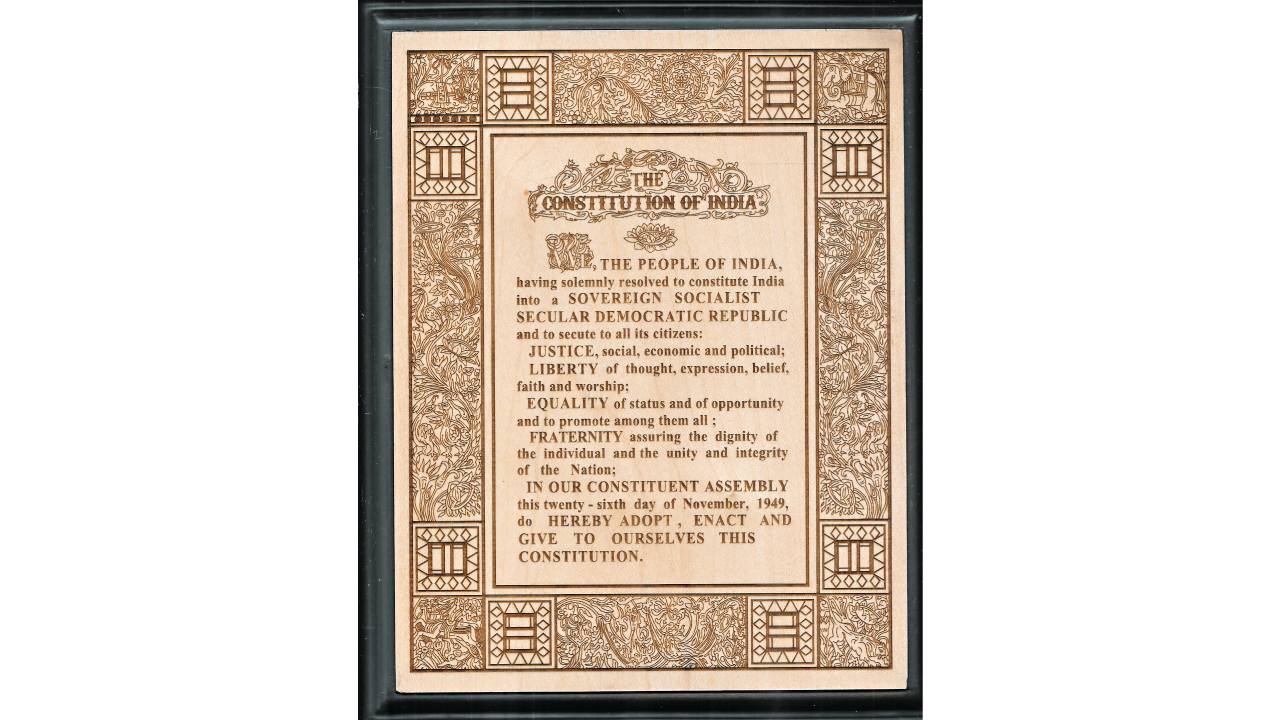
Nevertheless, out of all struggles, it revolves around four cardinal objectives, i.e., Justice, Liberty, Equality and Fraternity.
Justice being the first one, it has three facets i.e., social justice, economic justice and political justice. They cannot be read mutually exclusive and hence, are so intervened that they often over-laps each-other. Like, social justice which might be understood as having a just stature in society, may be read as right to vote irrespective of caste, religion etc., which is also considered a political right. Economic justice, in form of equal pay for equal work helps creating a just society which enables social justice. Where social justice thrives, the political justice is the only logical corollary.
Then comes, liberty, which is to be demonstrated by way of thoughts, beliefs, faith and worship. Reflected in article 19(1)(a), in form of thoughts, the religious shade is covered under articles 25-29 of the Indian Constitution. This attribute of the Constitution keeps India away from the practice of theocracy and creates an ample space for every religion to thrive and spread its ideals in a civilized manner.
Talking of necessary reforms which were imperative for an equal society, affirmative actions by virtue of Article 15 and Article 16 had a great role to play when it comes to the upliftment of people from socially and educationally backward classes of citizens, women and economically weaker section (103rd Constitutional Amendment Act). Again, this constitutional provision has been exploited in form of political tool and comes with a caveat, which is in constitution itself, i.e., Article 335 which takes into consideration the administrative efficiency vis a vis reservation. Furthermore, Supreme Court in Mukesh Kumar and Anr. v. State of Uttarakhand has held that affirmative actions under article 16 cannot be claimed as matter of right, hence making article 16 only an enabling provision.
Fraternity, which is claimed to be stemmed out of French revolution, means the idea of brotherhood, which can be easily understood by famous Bollywood song “Saathi haath badhana, ek akela thak jayega, milkar bojh uthama”, often giving signal for collective efforts to assure dignity of individual and unity and integrity of the nation. Also, Dr. Ambedkar considered fraternity to be the most important among equality and liberty. The combination of Liberty, equality and fraternity often being called as trinity.
Though constitution has been subject to various alterations which were intended for political motives. The best example stands of emergency era. 39th Constitutional Amendment Act, exempted the election of Prime Minister, President, Vice President and Speaker from judicial scrutiny; 42nd Constitutional Amendment Act bringing an overhaul change in constitution, is often termed as mini constitution. Despite such attempts, constitution survives and continue to guide the legislations, constitutionality of which are often tested on the anvil of golden triangle (Article 14, 19 & 21)
Though it will be wrong to blame only legislature to hamper constitution for its selfish gains, but also judiciary has a role to play in this. By way of importing the meaning of “Concurrence” into the word “Consultation” (Second Judges Case) the judiciary has changed the very nature of appointment of judges. It has drifted significantly for the objectives of constituent assembly and such interpretation serves the interest of collegium which has often been accused of opacity and nepotism.
The evolution of constitution out of all such adversity is appreciated as it is not only a set of rules but a socio-political document which evolves with time and follows the spirit of the proverb “change is the only constant”. In IR Coelho case (2007), it was rightly observed by Hon’ble Supreme Court that, constitution is an organic document. It can be very well seen, if we see the adoptions of relevant amendments, as per the need of society, eg., 73rd & 74th CAA, which implemented the directive under article 40 of the Indian Constitution, 103rd CAA brought EWS into the ambit of affirmative action, 106th CAA which brought Nari Shakti Vandan Adhiniyam.
Hence, the constitution in its 76th year, acts like a lighthouse which guides the organs of the government to attain the greater objective of democracy and republic, which is the nature of Indian polity. It thrives to the idea of antyodaya, i.e., to ensure the rise and development of the last person in society.
Author, Kishlaya Mishra is an Advocate based in Delhi.; views are personal