Modi at 76: From longevity to legacy
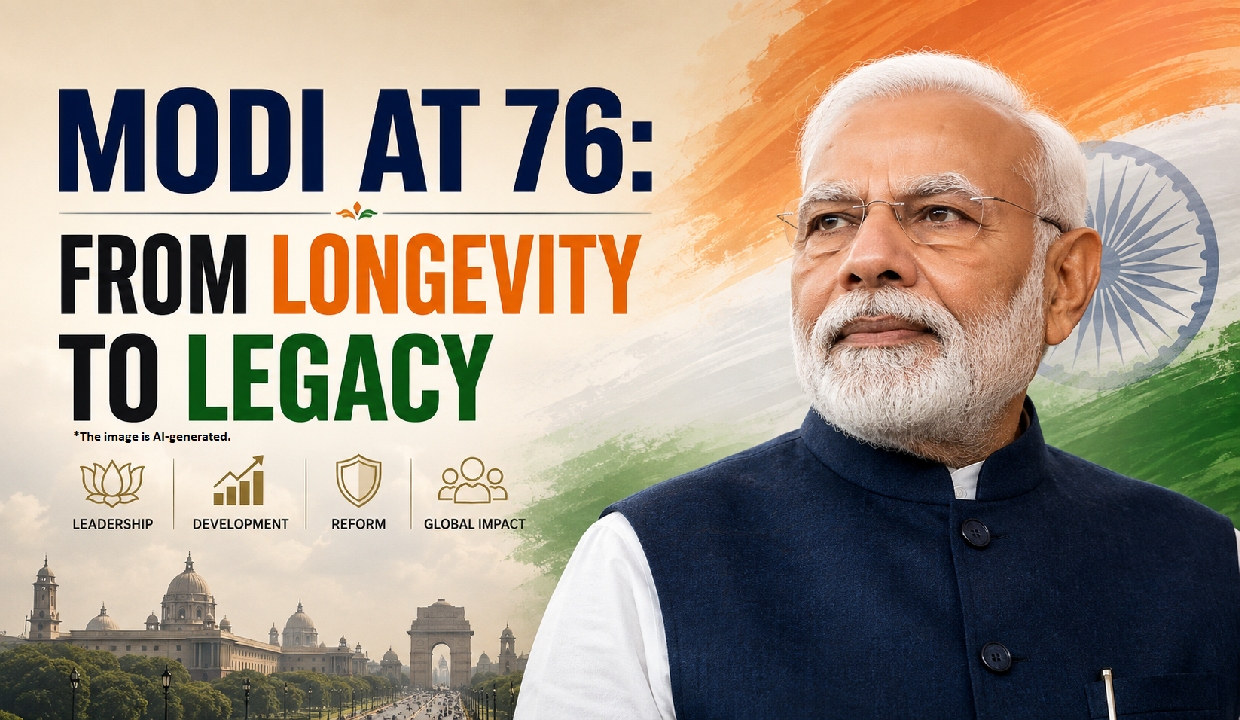
As the BJP begins a month-long celebration of Modi’s 25 years in power, the milestone invites a larger reckoning: what has his tenure changed, and at what cost?
Narendra Modi turned 76 on September 17th, and the BJP has converted the date into a month-long liturgy. The Seva Sankalp Abhiyan, launched on his birthday and running to October 17, pairs blood donation camps and cleanliness drives with bike yatras linking Vadnagar, his birthplace, to Varanasi, his constituency. The arithmetic behind the campaign is real: on October 7, he completes 25 years as a head of government - Gandhinagar from 2001, New Delhi since 2014. An unbroken quarter-century in executive office is rare in any democracy. Rarer still is the scale on which one man has rewritten the terms of a nation’s politics. The ledger has substantial entries. Bank accounts, cooking gas, toilets, piped water and houses reached households that had waited three generations for the state to notice them. Digital public infrastructure — Aadhaar, UPI, direct benefit transfer — turned welfare from patronage into plumbing, and is now studied from Lagos to Lima.
Highways, ports and airports were built at a pace the licence-permit republic could not imagine. Article 370, the Ram temple, Chandrayaan-3, the G20 presidency and Operation Sindoor supplied the emotional grammar of a self-assured India. The economy grew 7.8 per cent in April-June, the fastest of any major economy, through a tariff war that was supposed to break it. In May, the BJP took West Bengal and a third term in Assam.
However, there have been gaps as well. Growth has not translated into work: unemployment among graduates under 25 runs near 40 per cent, and a quarter of India’s youth are neither studying, training nor employed. Parliament legislates with less debate than it did in 1952. Investigative agencies move with a partisanship the opposition calls persecution, and the Election Commission’s roll revisions have drawn charges the ECI has failed to convincingly answer. Federalism has shrunk to an argument over transfers.
Polarisation has been an instrument rather than an accident, and minorities have been at the receiving end. Demonetisation remains the costliest experiment no one has been held accountable for. Then came June. A satirical outfit calling itself the Cockroach Janta Party turned an exam-leak scandal into the largest youth mobilisation in decades, and a government famous for never conceding, conceded — a minister resigned, demands were met, a task force was announced. It was the first genuine retreat since the farm laws. It exposed the single constituency that remains defiant: young Indians who have known no other prime minister and cannot find a job.
But then such challenges are part of the deal. What occupies him now? Viksit Bharat 2047 is the stated horizon. The nearer list is harder — closing the American trade agreement without surrendering agriculture; the 2027 census and the delimitation that follows, which risks setting a growing North against an already resentful South; and the succession he refuses to discuss, the seventy-five rule he once applied to Advani, having quietly lapsed for himself. Longevity is not legacy. The question at 76 is whether the coming years are spent consolidating what he built, or making it survivable without him.