Makkhan se prasad : Krishna’s story through food
At midnight in Mathura, temple bells ring, conches sound and chants rise through the streets as devotees mark the birth of Krishna. In homes far beyond Braj, the same story is retold through food. White butter recalls the mischievous child of Gokul. Poha remembers the humility of Sudama’s offering. Sugar-palm fruit is turned into Taler Bora in Bengal, while rice flour becomes crisp seedai in Tamil Nadu. Across India, ingredients, techniques and memories transform devotion into taste. Janmashtami is therefore not simply a festival with a special menu. It is a journey from fasting to worship, from bhog to prasad, and finally from an offering made to Krishna to food shared among families and communities.
Celebrated in 2026 on Friday, 4 September, Janmashtami falls on the Ashtami, or eighth lunar day, of Krishna Paksha associated with Krishna’s birth. The story begins in Mathura, where Devaki and Vasudeva were imprisoned by the tyrant Kansa. Tradition recounts that after Krishna was born, Vasudeva carried the infant across the Yamuna to Gokul, where he was raised by Nanda and Yashoda. His childhood unfolded in the pastoral world of Braj, among cows, milk, curd and butter, before his life later carried him from Mathura towards Dwarka. That geography helps explain why food occupies such an intimate place in Janmashtami. Krishna is remembered not only through sacred narrative, but through the foods associated with his childhood, friendship, pastoral surroundings and the regions that made his story their own. The 4 September date is also the one listed for the 2026 celebrations in Mathura.
The observance itself is shaped by restraint before abundance. Many devotees fast through the day, but the fast is not merely a dietary exercise or a list of prohibited ingredients. It is a spiritual discipline intended to reduce everyday distraction, cultivate self-control and turn attention towards Krishna. Practices differ between regions and traditions. Some devotees take fruit, milk, nuts or foods prepared from permitted fasting ingredients, while others observe a stricter fast until the midnight worship. For many, purity in preparation is as important as abstention itself. What unites these practices is the idea that restraint prepares the mind for devotion. The day gradually moves towards Nishita, the sacred midnight hour, when Krishna’s birth is celebrated with prayer, singing, abhisheka and the offering of food.
That offering also explains the difference between food and prasad. A preparation may begin in the kitchen as ordinary food, but once it is prepared with care, placed before the deity as bhog and offered in devotion, it is received back as prasad. The transformation is not one of ingredients but of meaning. Food that might otherwise satisfy hunger becomes something shared as grace. This movement from fasting to midnight worship, from bhog to prasad and from prasad to communal sharing gives Janmashtami food its spiritual structure. It also explains why the festival cannot be understood simply as a directory of festive dishes.
At the centre of this tradition stands Makhan Mishri, perhaps the most direct edible memory of Krishna’s childhood. Fresh white butter is mixed with crystals of mishri and offered to Bal Krishna, recalling the affectionate image of Makhan Chor, the child who stole butter from the homes of Braj. Traditionally, curd is churned until the butter separates, then the butter is washed, collected and paired with sugar candy. Its simplicity is precisely its strength. Few ingredients could evoke Krishna’s pastoral world more immediately. Makhan Mishri continues to be closely associated with Krishna devotion in Mathura and Vrindavan.
From the butter pots of Gokul, the story moves naturally to Mathura Peda, one of the defining foods of Krishna’s birthplace. Milk is slowly reduced to khoya, roasted until it develops a deeper caramelised flavour, then mixed with sugar and cardamom before being shaped into small rounds. During Janmashtami, peda is prepared in large quantities in Mathura and is also offered in temples and homes. Here, the sweet does more than satisfy festive appetite. It turns the sacred geography of Mathura into something that can be carried home, shared and remembered.
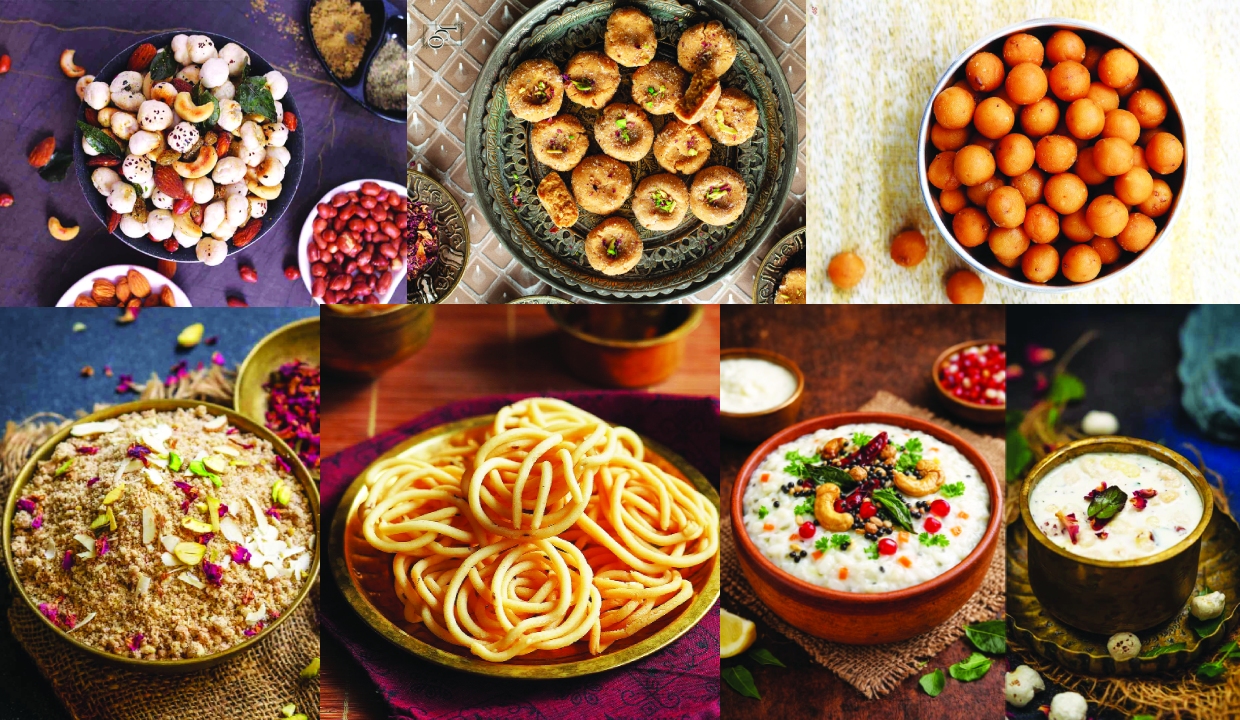
North Indian Janmashtami traditions also include Dhaniya Panjiri, particularly in households where grains are avoided during the fast. Coriander seeds or powder are gently roasted until aromatic, then combined with ghee, powdered sugar, coconut, makhana and nuts. The unusual use of coriander gives it a flavour distinct from ordinary wheat-based panjiri. Makhana Paag offers another characteristic preparation. Fox nuts are roasted in ghee until crisp and then bound with sugar, coconut, cardamom and sometimes nuts or raisins. Both are prepared as offerings and later distributed as prasad, reinforcing the festival’s association with ingredients suited to fasting traditions while still producing texture and richness.
The idea of abundance reaches its grandest expression in Chhappan Bhog, the ceremonial offering of fifty-six foods associated with Krishna worship and often presented during Janmashtami celebrations. Popular tradition links the number fifty-six to the belief that Krishna normally ate eight meals a day and went without them during the seven days he held up Govardhan Hill, leading devotees to offer eight times seven dishes in gratitude. The exact composition varies widely, and that variation is part of its character. Sweets, dairy preparations, fruits, savouries and grains may all appear depending on temple and regional custom. Chhappan Bhog is therefore less a fixed recipe than a statement of devotion expressed through abundance.
As Krishna’s story travels west, Janmashtami food begins to take on distinctly regional forms. In Maharashtra, Gopalkala, also known as Dahikala, is especially associated with the celebrations surrounding Dahi Handi. Poha is mixed with curd and ingredients such as cucumber, grated coconut, roasted peanuts, coriander and green chilli. Some versions add fruit or soaked pulses. Cool, savoury and meant for sharing, it recalls Krishna eating with his cowherd companions and complements the public spectacle of the handi filled with curd or butter. Unlike a formal sweet carefully shaped for presentation, Gopalkala is mixed together and shared communally, which is part of its charm. Dahi Handi itself remains one of Maharashtra’s most prominent Janmashtami traditions.
In some Gujarati households, where devotion to Krishna is strongly connected with Dwarka, Janmashtami menus absorb regional favourites while retaining the larger themes of dairy, fasting and offering. Patra, made by spreading a sweet, sour and spiced flour paste over colocasia leaves, rolling and steaming them before slicing, brings a layered savoury element to the table. Malpuda uses a batter of wheat flour and jaggery that is rested and fried into small rounds, sometimes finished with poppy seeds. Elaichi Shrikhand, made by draining curd until thick and then beating it with sugar and cardamom, returns the menu to the dairy world so strongly associated with Krishna. These are regional expressions rather than compulsory Janmashtami foods, and their value lies precisely in showing how local households celebrate the same deity in their own food language.
In Bengal, the festival enters the late monsoon kitchen through Taler Bora. Ripe palmyra fruit is pulped, combined with rice flour or wheat flour, coconut and jaggery or sugar, then fried into small golden fritters. The fruit ripens around the Janmashtami season, so its presence at the festival reflects not only devotion but ecology and seasonality. The result is fragrant, slightly dense and deeply regional. In Bengali Janmashtami traditions, Taler Bora is prepared as an offering before being shared, making it a striking example of how a local ingredient can become part of the larger story of Krishna.
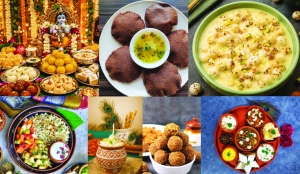
Tamil Nadu’s Krishna Jayanthi traditions bring some of the festival’s most distinctive savouries, although they represent one regional branch of a much wider celebration rather than the entire Janmashtami table. Uppu Seedai is prepared from rice flour and roasted urad dal flour mixed with butter, sesame or cumin, salt and asafoetida. The dough is rolled into tiny balls and fried until crisp, a process that demands careful control of moisture. Its sweet counterpart, Vella Seedai, combines rice flour with jaggery, coconut and cardamom. Together they produce one of the most recognisable sweet-and-savoury pairings associated with Krishna Jayanthi. Seedai and thattai are also recognised among the regional foods associated with Janmashtami celebrations.
Alongside them, Thattai is made by flattening a seasoned rice-flour dough into thin discs before frying, often with chilli, sesame, asafoetida and soaked chana dal. Thenkuzhal uses rice and urad flours pressed through a mould into crisp coils, while Nei Appam provides a softer sweet contrast through a batter of rice, jaggery, coconut and cardamom cooked with ghee until browned outside and tender within. These preparations are valued not only for their taste but for the skill involved in shaping them. In many homes, children learn by watching elders roll seedai, press thenkuzhal or turn appam, allowing ritual knowledge to pass almost invisibly from one generation to another.
Flattened rice creates another bridge between regions and stories. Vella Aval, made by softening poha and combining it with jaggery, coconut and cardamom, recalls the beloved episode of Sudama bringing Krishna a humble gift of flattened rice. The story gives poha a meaning beyond its ingredients. It becomes a reminder that devotion is measured not by extravagance but by sincerity. In some southern households, the same ingredient appears as Aval Puttu, where poha is combined with jaggery and coconut, or Aval Payasam, in which it is gently cooked with milk or coconut milk into a softer sweet. The simplicity of aval sits beautifully beside the grandeur of Chhappan Bhog, showing that Krishna can be honoured through abundance or through a modest offering given with affection.
Beverages carry the same devotional symbolism. Panchamrit, made from milk, curd, ghee, honey and sugar or mishri, is central to many abhisheka rituals and is later received as prasad. Sweetened milk scented with saffron or cardamom may also be offered, while lassi and chaas reflect the dairy culture of Braj and western India. In different homes and temples, these drinks vary in sweetness and seasoning, but their common ingredients return again to the cow, milk and curd that surround the remembered world of Krishna’s childhood. Even the act of drinking can therefore reinforce the festival’s central imagery.
Taken together, these foods reveal two overlapping layers of Janmashtami. At the devotional core are the broad themes of fasting, milk, butter, curd, bhog, prasad and the midnight celebration of Krishna’s birth. Around that centre sit regional expressions shaped by local crops, techniques and inherited household practice. Maharashtra gives Janmashtami Gopalkala, Bengal gives it Taler Bora, Gujarat adapts familiar regional foods for the occasion, and Tamil Nadu’s Krishna Jayanthi is marked by seedai, thattai and other carefully shaped offerings. The festival does not become less unified because its food changes from region to region. Its unity lies in the intention behind the offering.
That may be Janmashtami’s most enduring lesson about food. Heritage survives through practice: in the butter churned at dawn, in the peda patiently reduced over heat, in the seedai rolled between fingers, in the poha mixed with jaggery, and in the plate first placed before Krishna before anyone else eats. Tradition passes from one generation to another not only through texts or ceremonies, but through repeated gestures in the kitchen. This Janmashtami, families can preserve that inheritance by preparing at least one traditional dish with younger members, explaining why it is made, whom it is offered to and what story it carries. When the next generation learns both the recipe and the reason behind it, food becomes more than memory. It becomes a living tradition, renewed every time bhog becomes prasad and prasad is shared.
The writer is Secretary, Cuisine India Society; Views presented are personal.