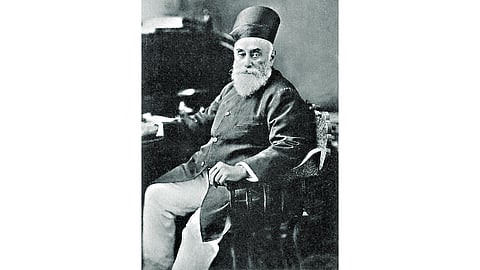

On March 3, as India marks the birth anniversary of Jamsetji Nusserwanji Tata, it is worth reflecting on a question that remains strikingly relevant more than 150 years after he laid the foundations of the Tata enterprise: Why do some companies endure for generations, while others fade despite early success?
Jamsetji Tata did not build businesses merely to manufacture goods or generate profit. He believed enterprise was a means to strengthen the nation, advance science and education, and improve the lives of people. That belief - a deeply held sense of purpose - continues to shape the Tata Group more than a century later. It also offers a powerful lens through which to understand corporate longevity.
Purpose is often spoken of today, but rarely with clarity. In his book Deep Purpose, Harvard Business School professor Ranjay Gulati argues that purpose, when genuinely embedded, becomes an organization's operating system - guiding decisions, shaping culture, and sustaining performance over time. Larry Fink, co-founder, Chairman and CEO of BlackRock, reinforces this idea, noting that purpose must act as both a strategic compass and a guide for everyday behaviour, not a symbolic slogan.
It helps to distinguish between three layers of purpose, a distinction that is often blurred but critically important. At the most basic level is functional purpose. This is operational in nature and answers the question: How do we run the business efficiently? It focuses on processes, productivity, and execution. Every organization needs this layer, but on its own it rarely inspires loyalty or longevity.
The second layer is strategic purpose, which supports competitive advantage and medium-term goals. It aligns teams, strengthens brands, and builds customer trust. Strategic purpose asks: How do we create and sustain advantage? Many successful companies operate effectively at this level, yet it remains largely instrumental.
The deepest layer is core purpose - the organization's raison d'être. It is enduring, values-driven, and largely stable over time. Core purpose answers the fundamental question: Why should we exist at all? For Jamsetji Tata, that answer lay in using enterprise to advance national self-reliance, scientific capability, and social progress-not merely commercial success. It shapes culture, ethics, leadership behaviour, and an organization's responsibility to society. Crucially, it guides decision-making in moments of crisis and transition.
This layered view helps explain why some business groups endure for decades - sometimes over a century - while others struggle to survive leadership transitions or environmental shocks. Functional and strategic purposes can deliver performance; only core purpose delivers permanence.
This idea of purpose-driven endurance is not confined to an earlier era or to Indian enterprises alone. Contemporary examples from global business echo the same logic. The American outdoor apparel company Patagonia, for instance, has explicitly placed environmental stewardship at the heart of its existence, declaring that "Earth is now our only shareholder." Founder Yvon Chouinard embedded this belief not merely in brand messaging but in ownership structure and governance, ensuring that the company's profits are channelled toward environmental causes. Patagonia's success demonstrates that when purpose is treated as a governing principle rather than a marketing slogan, it can guide strategy, shape culture, and sustain relevance even in intensely competitive markets.
Jamsetji Tata's life offers a compelling illustration. He did not establish textile mills in Nagpur merely to manufacture cloth. Beyond demonstrating Indian industrial capability and promoting self-reliance, he pioneered organised worker welfare - introducing provident fund-like schemes, along with measures such as gratuity and accident compensation, long before these became the norm. Business success and social responsibility were inseparable in his worldview.
His commitment to nation-building extended well beyond industry. Believing education to be the foundation of progress, he established the J N Tata Endowment in 1892 to support "the best and the most gifted" Indian students for higher studies overseas. Since then, the Endowment has supported more than 5,700 scholars, including former President K.R. Narayanan and renowned astrophysicist Jayant V. Narlikar.
Jamsetji's vision for scientific advancement was equally bold. In 1893, during a chance meeting with Swami Vivekananda aboard SS Empress of India from Yokohama to Vancouver, he discussed his dream of establishing a research university. He later pursued this idea with Lord Curzon, the Viceroy of India. Jamsetji did not live to see its fruition, but in 1909 - five years after his death - the Indian Institute of Science was established in Bangalore, fulfilling one of his most enduring aspirations.
Other Indian business founders articulated similar deep purposes. Ghanshyam Das Birla, influenced by Mahatma Gandhi's philosophy of trusteeship, viewed wealth as a social trust. His enterprises aimed to develop skills, spread education, generate employment, and help build an independent India free from poverty and disease.
The Godrej family's business philosophy was grounded in equally firm beliefs: that business must serve society, ethics are non-negotiable, national self-reliance is a moral obligation, and wealth carries responsibility rather than entitlement.
It is therefore no coincidence that groups such as Tata, Birla, and Godrej - operating across different industries and eras - have endured for over a century. Nor is it accidental that other long-lived Indian groups such as the JK Organisation, the Kirloskar Group, the Murugappa Group, the TVS Group, and the Wadia Group were founded on a shared conviction that enterprise is a form of stewardship. They did not merely pursue profit; they pursued purpose.
Globally, the pattern is similar. The longest-surviving companies - including Barclays, Coca-Cola, DuPont, HSBC, Mitsubishi, Nestlé, Procter & Gamble, Siemens, Toyota and Unilever- tend to share three characteristics: a core purpose beyond profit, an ability to adapt strategy without losing identity, and strong institutional values transmitted across generations.
In the long run, deep purpose is not a slogan; it is the most reliable multiplier of organisational longevity. Companies that define their purpose beyond profit do more than just survive - they become institutions.
The writer Professor of Practice, IILM University, Gurgaon; views are personal