Is India’s electoral system losing its citizen focus?
As technology reshapes governance, India’s electoral machinery has adopted state-of-the-art digital systems-collectively embodied in ECINet-across most electoral processes. Yet, the bureaucracy operating these systems continues to struggle with procedural inertia and outdated thinking. Modernising elections, therefore, is not merely about deploying technology, but about transforming the institutional mindset that governs it.
Not long ago, the Election Commission of India (ECI) actively promoted voter participation, even enlisting celebrities to encourage citizens to vote. Over the past year, however, this relationship appears to have been fundamentally inverted. Instead of facilitating voters, the system has compelled large sections of the electorate to queue up-often with folded hands-seeking inclusion, correction, or relief.
What is particularly striking is the breadth of those affected: from former Secretaries to the Government of India, senior civil and police officials, Director Generals, and police chiefs, to members of the judiciary, as well as professionals from science, technology, academia, and the media. This is no longer an isolated administrative inconvenience; it reflects a systemic shift in which the burden of compliance has been transferred from the institution to the citizen. Hardly any sector remains untouched, raising serious concerns about accessibility, accountability, and institutional intent.
At the centre of this transformation stands the current Chief Election Commissioner (CEC), an IIT Kanpur graduate with a doctorate from Harvard, whose administrative experience across Kerala and at the national level has consolidated unprecedented authority within the ECI. Under his tenure, the institution has dominated public discourse to an extraordinary degree-occupying space across citizens’ minds, the media, the higher judiciary, and the broader political-administrative landscape for nearly a year. Measures such as SIR (Special Intensive Revision), though not new in concept, have assumed a scale and intensity that have effectively reshaped electoral governance for a billion-plus electorate. This centralisation of influence, coupled with an unyielding administrative posture, raises important questions about institutional balance, accountability, and the limits of authority in a constitutional democracy.
At the heart of the current challenge lies a fundamental disconnect between a techno mindset and a bureaucratic attitude. A techno mindset treats technology as an enabler of transparency, efficiency, and real-time accountability-designed to simplify processes, empower users, and build trust through data-driven decision-making. In contrast, a bureaucratic approach often reduces technology to a superficial layer over legacy procedures, preserving opacity, control, and compliance-heavy workflows.
The result is a structural paradox: advanced platforms such as ECINet exist, yet their potential remains underutilised, while citizens continue to face complexity and uncertainty. Bridging this gap requires more than the deployment of digital tools; it demands a cultural shift from rule-bound administration to responsive, technology-led governance that places the citizen at its core.
Seen in this context, the concerns raised here are not adversarial but principled-anchored in the doctrine of “na kaahoo se bair, na kaahoo se dostee”. They reflect the lived experience of ordinary, law-abiding citizens who fulfil their constitutional duties and expect, in return, that their fundamental rights will not be disrupted without cause. Yet, for over half a year, millions have faced uncertainty and anxiety while navigating the opaque and often arbitrary processes surrounding SIR 2.0. The issue is not technology itself, but the mindset governing it: when digital systems amplify complexity rather than reduce it, they risk becoming instruments of distress-undermining both credibility and public trust in the electoral process.
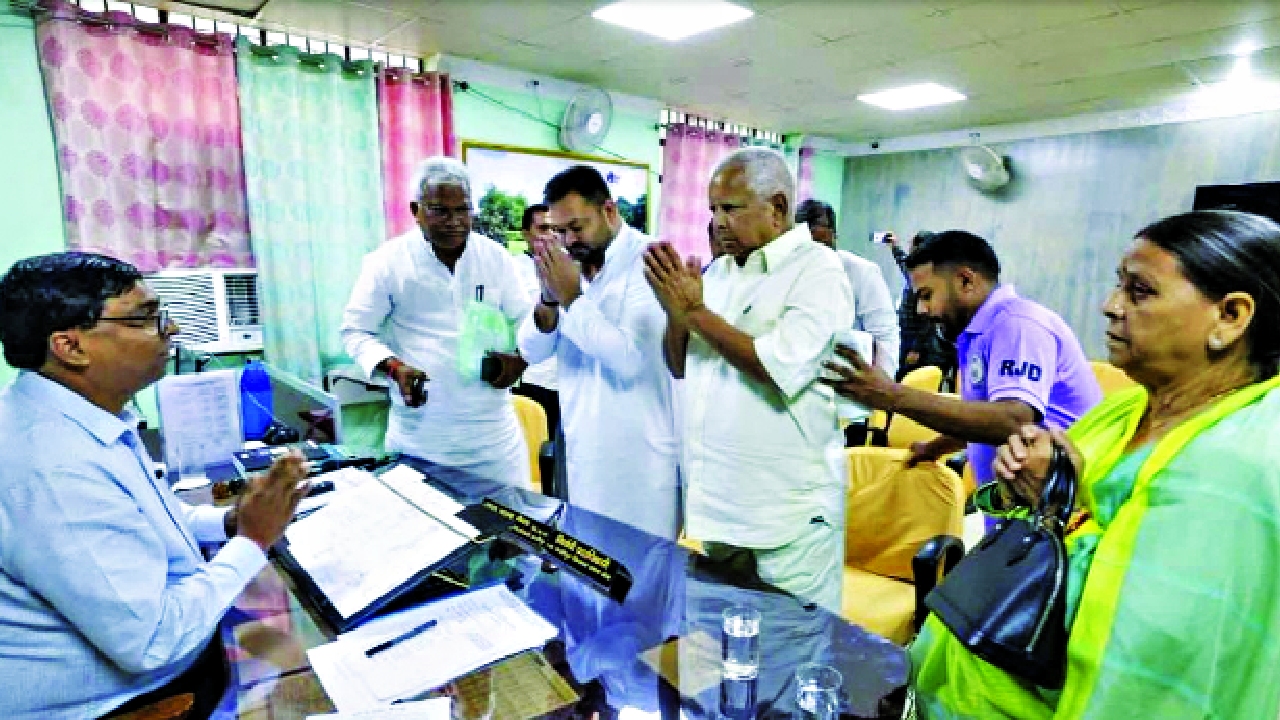
Perhaps the most telling irony of the present system is the visual and behavioural contrast witnessed during nomination filings: the Election Officer remains seated, while elected representatives and candidates stand-often with folded hands-submitting their papers. This is not merely a matter of protocol; it reflects a deeper institutional attitude. Are we so bound by outdated bureaucratic customs that an official remains fixed to his chair, even as public representatives stand in deference? In a citizen-centric democracy, such interactions should reflect mutual respect, not hierarchical distance. At the very least, institutional conduct should convey that authority flows from the people, not above them.
This posture reveals more than a procedural habit-it signals a mindset. The bureaucracy, despite operating within a democratic framework, often projects itself as a controlling authority shaped by residual colonial attitudes rather than as a facilitating service.
In a responsive system, officials would engage with stakeholders as equals, guiding and supporting them through enabling processes. Instead, such scenes reinforce an implicit hierarchy, where the system appears elevated and the citizen-represented here by candidates-appears subordinate. This is not merely optics; it reflects an administrative culture that continues to equate position with power rather than responsibility.
Equally important is the second, subtler dimension of this imagery. When candidates stand with folded hands before officials, it creates a powerful visual narrative that is later projected to the public-as if these same individuals embody humility, accessibility, and respect towards citizens. Yet, this symbolism is often illusory. The deference shown before authority is not always reflected in their engagement with the electorate. Such imagery risks becoming a tool of political signalling rather than a genuine expression of democratic conduct.
This duality-deference before the system and assertion before the citizen-creates a misleading perception. It enables political actors to project modesty while maintaining distance from those they represent. The result is a layered illusion: a bureaucracy that appears authoritative and distant, and a political class that appears humble but may not consistently practise that humility in public life. Together, they reinforce a culture where appearances substitute for accountability. In a mature democracy, both institutions must move beyond such symbolic contradictions. Bureaucracy must shed its residual hierarchy and embrace a service-oriented ethos, while political representatives must demonstrate authenticity in their engagement with citizens-not merely through gestures, but through consistent conduct. Otherwise, what appears respectful on the surface risks becoming a carefully staged performance-reminding us that, indeed, everything that glitters is not gold.
In the decades following Independence, ECI functioned largely as a passive institution-more an observer than an enforcer-rarely assertive, seldom feared, and often ignored by the police, district administrations, and state secretariats. This institutional quietude allowed political parties considerable latitude, frequently operating in collusion with local officials and, at times, relying on muscle power to influence outcomes. Voting slips were commonly distributed by party agents or candidates themselves, reflecting the Commission’s limited authority and reach. In such an environment, electoral malpractices, including selective rigging, were not uncommon-underscoring the systemic weaknesses of a bureaucratic framework that lacked both resolve and effective enforcement.
This legacy was decisively overturned with the arrival of T. N. Seshan, widely regarded as the “Bulldog” of electoral reform. As the then sole CEC, he brought rare fearlessness, persistence, and uncompromising resolve to an institution long seen as passive. He enforced the Model Code of Conduct with unprecedented rigour, introduced voter identity cards, imposed strict limits on campaign expenditure, and ensured the deployment of officials from outside poll-bound states to curb local collusion. Malpractices such as voter bribery and intimidation, misuse of state machinery, communal appeals, distribution of liquor, and unregulated campaigning were firmly checked. His directives were treated as final and non-negotiable, with non-compliance inviting swift consequences-fundamentally altering the conduct of political actors and administrative machinery alike. Under his leadership, the ECI emerged as a strong and credible constitutional authority.
The concentration of authority during this period was so pronounced that the Commission was subsequently restructured into a multi-member body, with decisions taken collectively-an institutional recalibration aimed at balancing decisiveness with procedural safeguards.
In the decades that followed, India’s electoral system continued to evolve, with the nation annually observing National Voters’ Day as a reaffirmation of its constitutional commitment to democracy. The Commission can legitimately point to a succession of significant milestones-the enforcement of the Model Code of Conduct, the introduction of Electronic Voting Machines (EVMs), Elector Photo Identity Cards (EPIC), VVPAT systems, and the provision of NOTA-each strengthening electoral integrity and enhancing voter confidence. Building on this trajectory, ECINet has been introduced as a comprehensive digital backbone for voters, candidates, and electoral governance. Notably, elements of this platform had been operational in beta form for over a decade, enabling users to access and complete various electoral procedures online. As with any system operating at the scale of a billion-plus population, occasional glitches were inevitable, reflecting both the complexity and ambition of this digital transition.
Yet, despite these successive transformations, one principle has remained constant: in the world’s largest democracy, the voter is supreme. Across decades of reform, ECI has ultimately stood in service of the citizen, encouraging participation and approaching the voter with institutional humility. While it has exercised firm control over the electoral machinery when required, it has consistently recognised that democratic legitimacy flows from the free and willing exercise of the right to vote. In this enduring relationship, authority rests not with the institution, but with the citizen-an equilibrium that has long defined the system.
This long-standing equilibrium appears to have been fundamentally altered with the advent of SIR 2025-26 under the current CEC, who assumed office about a year ago. Initiated as part of the SIR, beginning with Bihar, the exercise marked a significant departure from established practice-both in scale and in its impact on citizens. What was historically an administrative process aimed at improving electoral rolls assumed a more expansive and intrusive character, placing unprecedented procedural demands on voters. The shift was not merely operational but structural, signalling a reversal in the traditional relationship between the institution and the citizen.
Paradoxically, these developments coincide with a period of significant technological and institutional advancement in the electoral system-milestones that should have strengthened voter confidence. Yet, voter sentiment reflects growing disillusionment, marked by anxiety, uncertainty, and the fear of exclusion from electoral rolls or entanglement in opaque procedures. This erosion of trust is not born of democratic apathy, but of lived experience, where genuine voters find themselves in a state of persistent vulnerability. The deeper concern lies not in technology itself, but in enduring mental and institutional constraints-digital hesitations and entrenched bureaucratic attitudes-that continue to limit the transformative potential of an otherwise capable and mature technological framework.
India’s digital transformation is advancing rapidly, positioning the country as a global leader in scale and innovation. Yet, the administrative apparatus remains anchored in outdated processes, hierarchical mindsets, and residual notions of control. This widening gap between technological capability and bureaucratic practice risks undermining service delivery, governance outcomes, and public trust. Bridging this divide requires more than new platforms or incremental upgrades-it calls for a fundamental shift in institutional thinking towards transparency, accountability, and citizen-centric design.
At its core, ECINet operates through two interdependent layers: the front end, which citizens interact with, and the back end, where decisions and processes are governed. While the front end has seen visible improvement, the back end often continues to reflect legacy bureaucratic structures-complex, opaque, and compliance-heavy. Reform must therefore focus on re-engineering these underlying processes by simplifying rules, enabling real-time decision-making, ensuring traceability, and establishing clear accountability. Technology should not merely digitise existing workflows; it must transform them.
A genuine techno mindset requires a shift from control to facilitation, from opacity to openness, and from procedure-centric administration to outcome-oriented governance. This entails proactive disclosure of information, seamless grievance redressal, minimal human discretion in routine processes, and continuous user feedback. Without this alignment, even platforms designed for scale and efficiency remain underutilised in spirit, leaving citizens to navigate a fragmented hybrid of technology and bureaucracy.
Only when bureaucratic attitudes evolve in step with technological systems can platforms like ECINet realise their full potential-restoring trust, reducing friction, and reaffirming the primacy of the citizen in India’s democratic framework. It is hoped that future iterations, including SIR 3.0, will align more closely with these technological and governance expectations-reducing excessive reliance on bureaucratic processes and moving decisively towards a more transparent, efficient, and citizen-centric electoral system.
The writer is a Tech-Education Policy Consultant, a former Professor of Computer Science at IIT Kharagpur, IIT Kanpur, BITS Pilani, and JNU, and a former scientist at DRDO and DST; views are personal