India-Swiss ties need a fourth T: Tracking
Switzerland’s President Guy Parmelin’s second visit to India this year signals a relationship moving beyond traditional commerce
When a Swiss president makes his first state visit to India, his second trip here this year naturally means that the relationship between the two countries is growing. Guy Parmelin’s three-day visit, which began on Monday, marks the first anniversary of the India-EFTA trade agreement, and Bern wants to see what a year of free trade has delivered. The agenda follows the “3Ts” framing of India’s Ministry of External Affairs: trade, technology and talent.
Trade is anchored by the Trade and Economic Partnership Agreement (TEPA), in force since October 1, 2025. Its headline promise is $100 billion of investment from the four EFTA states over 15 years, $50 billion in the first 10, and one million direct jobs. Parmelin attends the second India-EFTA Prosperity Summit on Wednesday to take stock.
The two sides signed a Migration and Mobility Partnership offering multiple-entry visas of up to five years and renewable one-year student permits, alongside a young professionals’ exchange agreement. A further memorandum covers electric vehicles, ropeways, tunnelling and the circular economy. Prime Minister Modi also spoke of new avenues in military exchanges and defence manufacturing, and of expanded nuclear energy cooperation, a widening of the scope of a relationship long defined by commerce.
The relationship is old and largely uncomplicated. Ties have been cordial since independence, helped by Indian non-alignment and Swiss neutrality. The leaders met in New Delhi in February, at the AI Impact Summit, and in Geneva in June. Switzerland hosts the next global AI summit in 2027, a move Delhi has welcomed.
The economic ledger, however, is lopsided. In 2024-25, India imported $21.8 billion of goods from Switzerland and exported $1.47 billion. Swiss direct investment totalled $10.87 billion between April 2000 and June 2025, and over 330 Swiss companies operate in India. Swiss capital is visible on the ground: a Zurich Airport subsidiary operates Noida International Airport, and Swiss technology helped build the Varanasi ropeway.
There has been friction too. Switzerland suspended the most-favoured-nation clause in its tax treaty with India from January 2025, after the Supreme Court’s Nestlé ruling, a reminder that goodwill needs tax certainty to survive.
Investors will also read the $100 billion target for what it is: a figure that companies, not governments, must ultimately deliver. India’s task is to make that easy, through predictable taxation, regulatory clarity and speed.
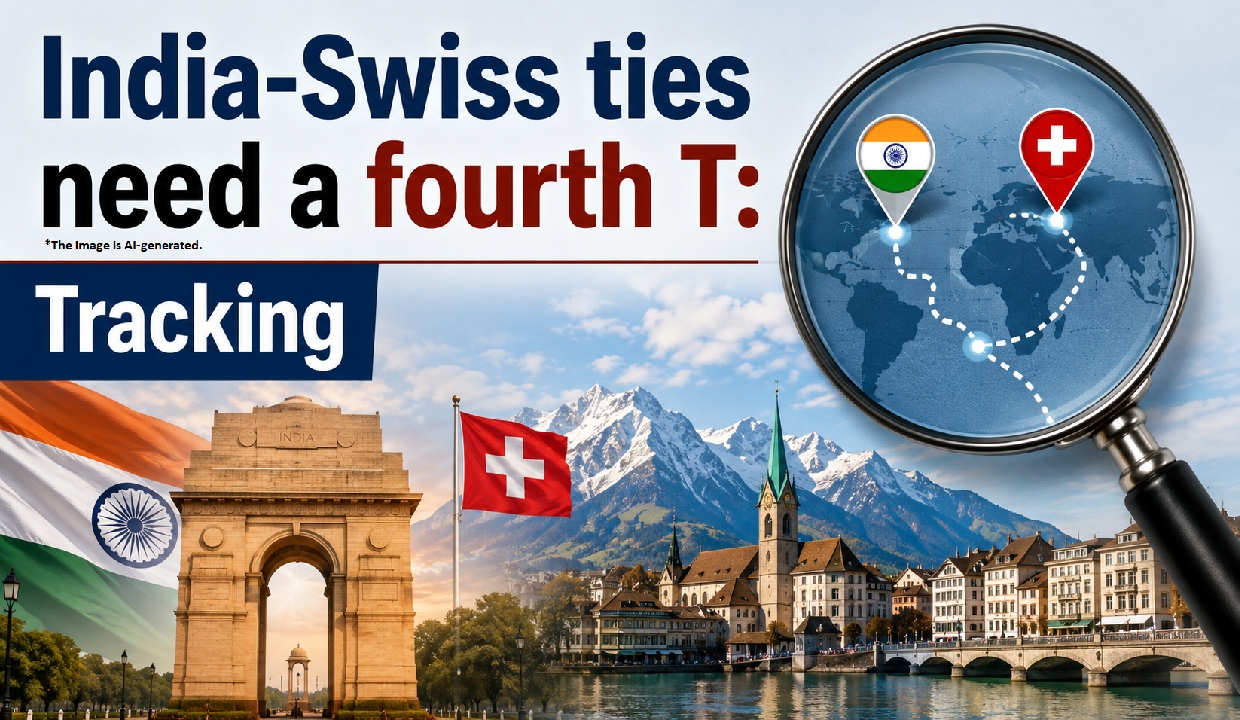
Parmelin called his visit a “stepping stone”, and the phrase fits. The 3Ts need a fourth: tracking. A joint annual review of investment flows, jobs created and visas issued would turn a handsome promise into a measurable one. The next year will decide whether this partnership is remembered for its summits or for its factories, laboratories and jobs.