Pakistan’s Yemen dilemma deepens
For years, Pakistan maintained an extraordinary military relationship with Saudi Arabia while carefully avoiding one commitment, ie, boots on the ground in Yemen. When Riyadh intervened against the Houthis in 2015, Pakistan’s Parliament called for neutrality. Islamabad continued training and deploying personnel to Saudi Arabia and made clear that it would defend the Kingdom against threats to its territory, but it would not become a combatant in Yemen.
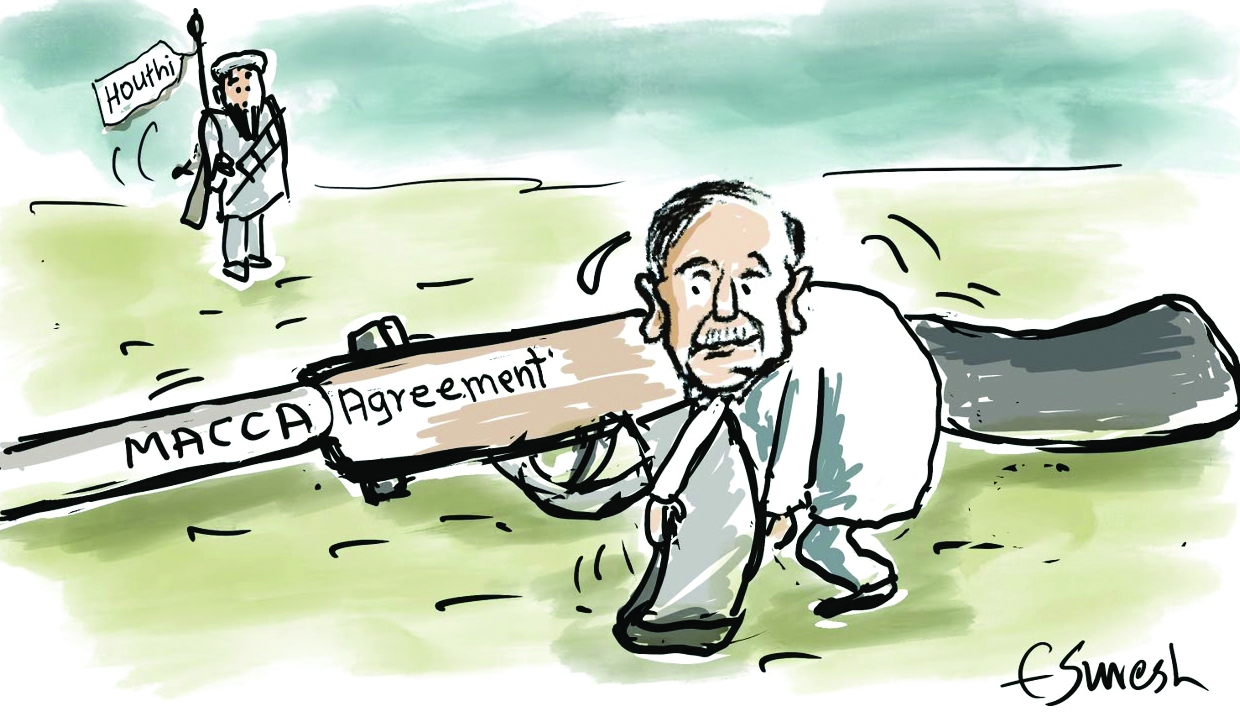
The recently signed Makkah Joint Defence Agreement may have changed that equation. Signed by Pakistan, Saudi Arabia and Türkiye on August 7, 2026, the agreement provides that an armed attack against one member is to be regarded as an attack against all. Islamabad has described it as a defensive arrangement and linked it to the right of collective self-defence under Article 51 of the UN Charter.
The crucial question now is whether Pakistan is actually preparing the political, public and institutional ground for acting on that commitment. From solidarity to military coordination, the recent change in language is striking. As recently as September 10, Pakistan said that no military response under the Makkah pact had been discussed following Houthi attacks on Saudi Arabia. Since then, the rhetoric has moved considerably further.
Pakistan condemned a reported Houthi attack directed towards Makkah as a threat to Saudi sovereignty and the security and sanctity of the Two Holy Mosques. The military chiefs of Pakistan, Saudi Arabia and Türkiye subsequently met to discuss intelligence sharing, military coordination and capability integration. Then came the most consequential statement. Pakistan’s Defence Minister, Khawaja Asif, said Pakistan was bound to defend Saudi Arabia and that “whatever means” Pakistan possessed would be available to the Kingdom. He stopped short, however, of confirming Pakistani participation in airstrikes.
None of this proves that Islamabad has decided to enter the Yemen war. But it does suggest that the machinery, and increasingly the political language, for possibly doing so is being assembled. For that eventuality, Pakistan has to overcome its ghosts of sectarianism that linger subliminally and violently, should the Shia Houthis in Yemen be attacked. Unlike predominantly Sunni Türkiye, Pakistan has a substantial and wary Shia population, comprising about 25 per cent of the population, across various denominations. Such a move could inflame and implode Pakistan from within.
In 2015, Islamabad had an easy distinction available: defend Saudi Arabia, but do not fight Yemen’s war. The Makkah Agreement makes that position harder to sustain. If an attack on Saudi Arabia is formally characterised as an armed attack covered by the agreement, Pakistan can no longer treat the issue simply as a bilateral Saudi request for assistance. It becomes a question of whether a treaty commitment is being honoured.
That does not necessarily mean Pakistani troops must enter Yemen. Collective defence could involve air defence, intelligence, logistics, maritime security, reinforcement of Saudi territory or other military assistance. But the political cost of doing nothing becomes greater. A treaty that declares an attack on one member to be an attack on all ultimately has to demonstrate what “all” means.
Preparing the public narrative will always be key. This is where the growing emphasis on Makkah and the ‘Haramain’ becomes particularly significant. A Pakistani government asking its population to participate in the Yemen war would face the same question that confronted Islamabad in 2015: why should Pakistan become involved in another country’s conflict? But the emerging narrative offers a different answer: Pakistan is not joining a Yemeni civil war; it is defending Saudi Arabia under a collective-defence agreement.
And if the attacks are presented as threatening Makkah and the Two Holy Mosques, the political argument becomes even more potent. Religious rhetoric could go further, with some political or religious voices portraying the Houthis as reckless sectarian or even ‘kufr’ actors threatening the Holy Land. Such descriptions are theological and political polemic, not objective classifications. But their political function is clear: they can shift the public question from “Should Pakistan fight the Houthis?” to “Can Pakistan stand aside while the land of the Two Holy Mosques is attacked?”
That is a profoundly different proposition.
The threshold may be moving towards one of eventual case-building towards a ‘justifiable’ action from the Pakistani side. That is not yet an announcement of Pakistani combat participation, but seemingly a directional work-in-progress. But it is a marked departure from the cautious position Pakistan maintained in 2015, and even from Islamabad’s statement earlier this month that no military response under the pact had been discussed.
The decisive next step would be for Islamabad to explicitly declare that Houthi attacks constitute an “armed attack” under the Makkah Agreement, followed by a formal Saudi request for a specific Pakistani military response. If that happens, the question will no longer be whether Pakistan supports Saudi Arabia. It will be whether Pakistan is prepared to make the Makkah Agreement mean what it says. For now, Pakistan still has room to remain outside direct offensive operations in Yemen. But the political ground for crossing that line appears to be taking shape.