
- HOME
- INDIA
- WORLD
- BUSINESS
- STATES
- LAW & JUSTICE
- ENTERTAINMENT
- SPORTS
- VIEWPOINT
- LIFESTYLE
- TECH
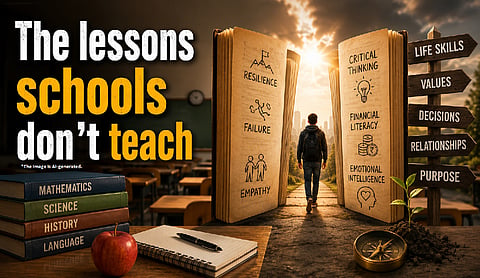
Even though our kids spend years studying for exams, some of the most significant tests they will encounter in life don’t have textbooks, grades or answer keys. Children learn fractions, mathematics, grammatical rules, scientific ideas, and a plethora of other topics from us as educators and parents. Additionally, we celebrate high percentages and flawless results while preparing students for exams, competitions and entrance exams. However, in the process of finishing the curriculum and getting ready for the next exam, we might be forgetting to ask a straightforward question: Are we educating kids just to do well in school or are we also training them to function with confidence outside of it? Consider a student who is adept at calculating percentages but lacks the knowledge necessary to handle a monthly budget.
Someone else can produce a compelling article about environmental responsibility, but they are unable to prepare a simple dinner or handle a small emergency. Teenagers may be familiar with a number of mathematical formulas, but they may not understand how loans operate, what insurance is or the importance of consistent saving. These are not signs of a lack of intelligence rather, they show a disconnect between what kids learn and what life ultimately demands of them. Naturally, academic knowledge is crucial. Science teaches inquiry, literature broadens perspectives, mathematics fosters reasoning, and history aids in our comprehension of society. Replacing these subjects is undoubtedly not the solution. The challenge is whether education can accommodate a different type of information the knowledge needed to get by in daily life.
One such area is financial literacy. Instant payments, internet shopping, subscriptions and easy access to credit are all part of the environment that children are growing up in. They should learn the distinction between requiring and desiring, borrowing and saving and income and expenditure before they start earning. A child may be better prepared for adulthood by a straightforward classroom exercise involving a home budget than through a chapter alone. Emotional education comes next. We frequently advise kids to be confident, handle stress or control their anger without actually teaching them how. It’s not a soft extra to know how to handle disappointment, express emotions, settle disputes and seek for assistance. Throughout life, these skills influence relationships, the workplace and one’s own well-being. Additionally, schools can teach kids practical skills like basic cooking, first aid, personal safety, comprehending essential paperwork, basic home repairs and disaster preparedness skills that earlier generations frequently learned organically at home. Being able to take care of oneself is a sign of dignity. At eighteen, independence shouldn’t start all at once. The same consideration should be given to communication. In addition to writing grammatically accurate responses, education should generate young adults who can talk properly in front of others, listen patiently, disagree politely and most importantly, introduce themselves with confidence. When a youngster learns to communicate with empathy, they take that learning with them outside of the classroom. However, there is one risk.
Allow the youngster to create a budget. Instead than only explaining first aid, let kids to take part in a demonstration. Maybe one afternoon every two weeks might be transformed into a Life Lab with no textbook and no competition. Children cannot be prepared for every scenario they may face through education. Uncertainty will always exist in life.
Students will still have to deal with money, relationships, obligations, disappointments and themselves years after they have forgotten a formula or an exam date. Maybe that’s the test we ought to be getting them ready for.
The writer is an educator and a councillor; Views presented are personal.