Artificial Intelligence and the Anvil of Ahimsa, Satya, Sarvodaya
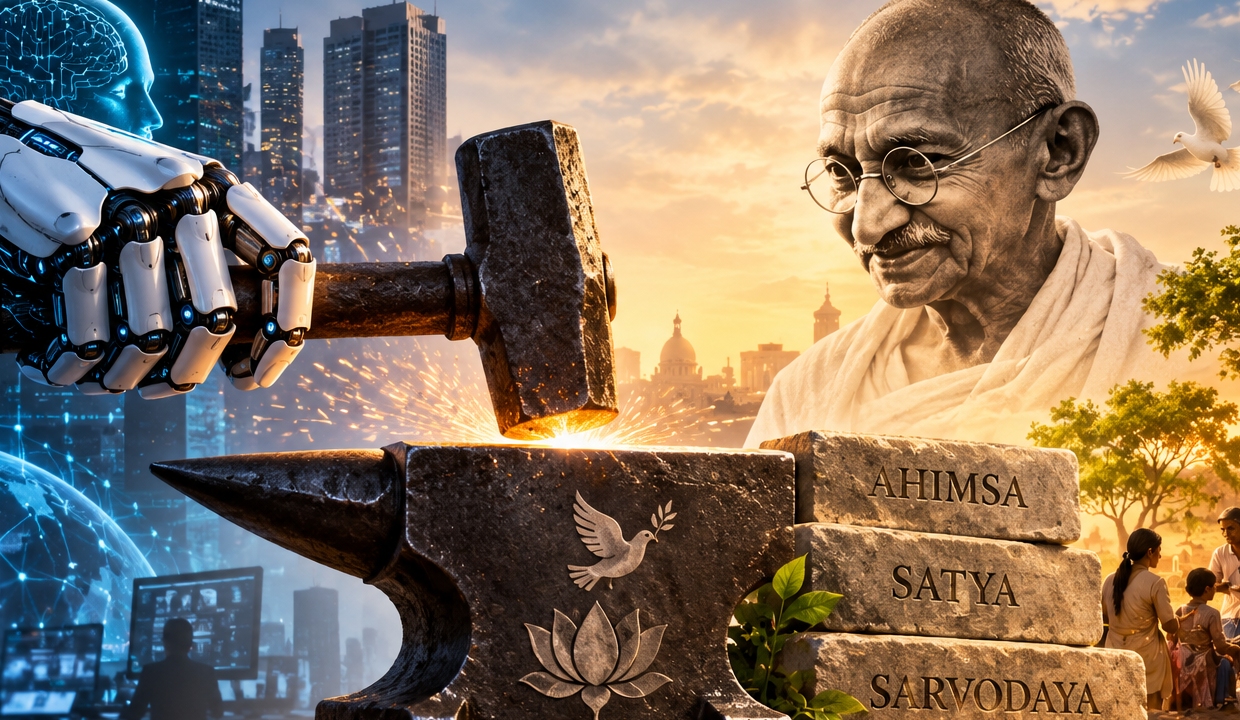
Advocates of Artificial Intelligence (AI) promise an era of unprecedented productivity and abundance, scientific breakthroughs and economic growth. Its critics, on the other hand, warn of job displacement, surveillance, loss of human control, and new forms of inequality. Beneath such competing predictions, we are confronted with a more fundamental question: what kind of human beings and what kind of society should our technologies help us become?
This is a question worth asking through three ideas that were central to Mahatma Gandhi’s philosophy: Ahimsa (non-violence), Satya (truth), and Sarvodaya (welfare of all).
Gandhi’s Ahimsa did not mean reducing the idea of non-violence to the mere absence of physical violence. It was a much broader ethic and discipline of refusing to inflict harm, humiliation or exploitation on another human being.
This principle demands today that we examine an AI system’s broader consequences for human dignity. An AI system used for efficient surveillance can contribute to the erosion of privacy. An algorithm used for efficient recruitment may reproduce and amplify biases. Autonomous weapons make us ask the question: should decisions related to warfare ever be delegated to machines? The fact that something can be done does not mean that it should be done. Gandhi would remind us that Ahimsa in the age of AI would mean that human dignity and the minimisation of harm must come before technological prowess. AI safety should not just mean averting a distant catastrophe; rather, it should be a part of everyday guidance in dealing with such technology.
The second principle is Satya. For Gandhi, truth was more than avoidance of lies.
It meant a lifelong discipline of seeking reality and aligning one’s conduct with what one believes to be right. A society that may fail to distinguish truth from machine-generated fabrication becomes vulnerable to manipulation. Gandhi’s idea of Satya asks us to build systems that encourage transparency, accountability and verification. In the absence of these, the very honesty and openness that Satyagraha demanded of the powerful remain unfulfilled. Gandhi regarded truth and non-violence as inseparable, like two faces of the same coin. A means that deceives can never serve an end that liberates.
At this critical juncture of the AI development trajectory, we should resist both technological utopianism and technological pessimism. That brings us to Sarvodaya, the Gandhian principle of welfare and advancement of all. Gandhi’s reservations about machines were not about opposing technology as such. His concern was with an economic order where machines could lead to concentration of wealth, displacement of livelihoods and subordination of human beings to systems of production.
Today, machines are moving beyond factories. They are entering classrooms, hospitals, offices, courts and creative professions. For the first time, technology is not just replacing physical labour but is entering the realm of the mind. We need to ask ourselves whether machines are extending human capabilities or merely concentrating power in the hands of those who own them.
This is where the Gandhian idea of Sarvodaya offers an important test. Progress is only meaningful when it enlarges human opportunity.
The talisman he offered in 1947 tells us to recall the face of the poorest and weakest person we have seen, and ask whether the step we contemplate will be of any use to her. We must ask who benefits, who is displaced, who has access and who is left behind. The future of AI will ultimately be determined not only by engineers and entrepreneurs, nor only by governments and regulators, but by the values that society chooses to embed in the systems it creates.
Harpreet Kaur is Vice-Chancellor, National Law University Jodhpur, & Niranjan Rajpurohit is Associate Professor, NLU Jodhpur