India-Russia: Exploring new frontiers for economic cooperation and partnership
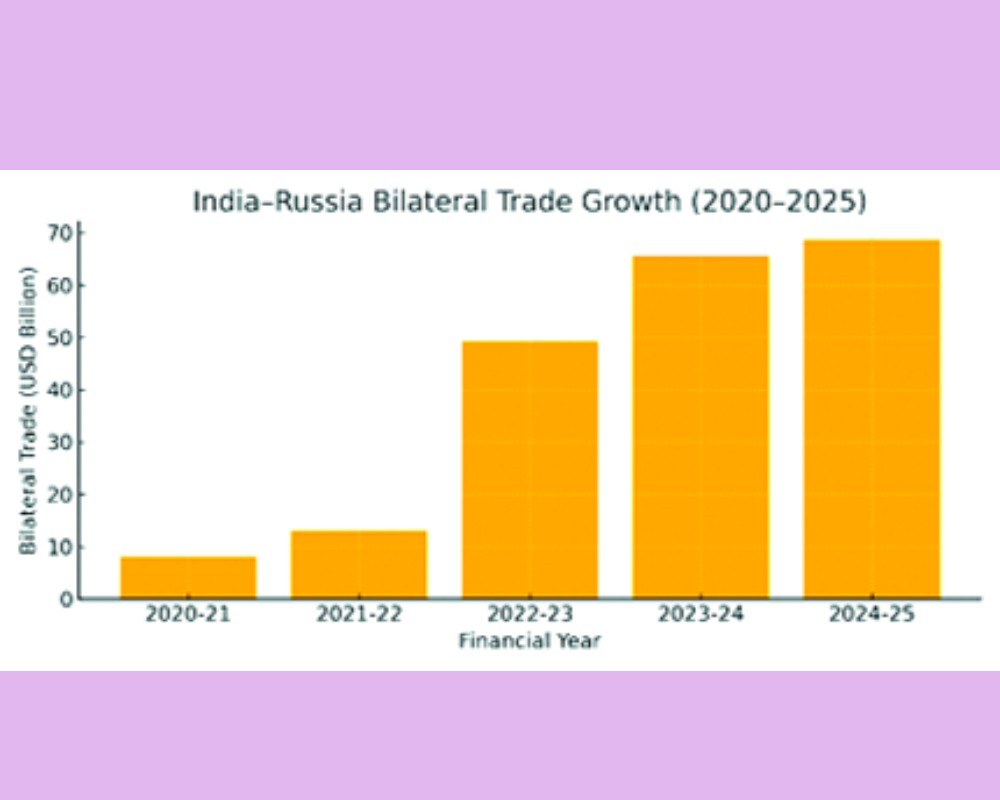
India and Russia remain extremely close and reliable partners on the economic and defence fronts. In FY 2024-25, bilateral trade reached a record US $68.7 billion, with India importing nearly US $63.8 billion worth of goods from Russia. Following the outbreak of the Russia-Ukraine conflict, Russia steadily emerged as India’s largest crude-oil supplier, accounting for more than one-third of India’s total crude imports in 2025. Russia has also become India’s top fertiliser supplier, with fertiliser imports rising by nearly 370 per cent over the past two years.
India’s exports to Russia, although modest at around USD 5 billion, include pharmaceuticals, tea, engineering goods, marine products, textiles, and organic chemicals, and are expected to grow further as both countries work to reduce the trade imbalance.
Alongside this expanding economic corridor, tourism between the two countries carries immense untapped potential. The flying time between major Indian and Russian cities is comparable to several popular long-haul routes, making Russia a viable and attractive destination for Indian travellers, particularly if visa procedures continue to ease. In 2024, around 1.2 lakh Indians visited Russia, whereas more than 50 lakh Indians travelled to Southeast Asia in the same period. This comparison clearly highlights the possibility of exponential growth in Indo-Russian tourism. As visa-free group travel becomes operational, this potential could increase many times over.
Thousands of Indian students pursue higher education in Russia, especially in medicine, engineering, and technical sciences, creating sustained cultural familiarity and long-term interpersonal networks.
These exchanges deepen social understanding on both sides. Similarly, Russian visitors to India frequently engage with India’s cultural, spiritual, and wellness traditions-from yoga and Ayurveda to heritage tourism-creating a growing community of cultural ambassadors in both countries. Travel companies note that the new framework will open the route to families, students, MSME delegations, and budget travellers who were previously deterred by procedural complexity. Indian arrivals in Russia rose from 60,000 in 2023 to 120,000 in 2024, while Russian visitors to India increased to 175,000 in the same period. Combined travel volumes could surpass 400,000 in 2025. Moscow also recorded a 26 per cent rise in business travellers from India in 2023, signalling renewed corporate interest in Russian markets.
The tourism revival is anchored in three factors: improved direct flight connectivity, a rebound in post-pandemic travel, and Russia’s 2023 introduction of e-visas for Indian citizens.
Impact on the Travel Economy
Industry analysts estimate that the visa-free mechanism could expand the bilateral tourism economy by USD 80-110 million annually through higher spending on flights, hotels, local transport, and packaged tours. Travel associations add that the shift may also encourage more cross-border corporate travel, particularly in energy, pharmaceuticals, education, and technology services.
“The India-Russia travel corridor is entering a high-growth phase. Visa-free group travel will significantly widen the market and bring in first-time international travellers from India’s Tier-II and Tier-III cities,” said a senior official from the Indian Association of Tour Operators (IATO).
Cultural and Academic Links
While economics forms the backbone of the new framework, cultural and educational exchanges also stand to gain. Beyond leisure travel, India can expand medical, wellness, and spiritual tourism, while Russia’s winter destinations offer new options for Indian travellers seeking seasonal experiences.
Policy Perspective
Officials familiar with the matter say the initiative aligns with broader efforts to diversify engagement beyond traditional defence and energy cooperation. For India, the agreement fits into a larger strategy of expanding international tourism, especially as outbound travel continues to rise among middle-income households.
To accelerate this momentum, both governments could consider complementary policy measures such as subsidised travel corridors, simplified visa-on-arrival schemes, and dedicated tourism desks for MSMEs and student exchanges. “Visa simplifications always expand mobility,” says a senior member of the Indian Association of Tour Operators (IATO). “Russia is not a new market for India, but the revival of affordable direct connectivity and easier entry will make it far more attractive for families and students.”
Outlook
If implemented smoothly, the visa-free group travel framework has the potential to reshape how both nations interact at the citizen level. With demand already rising and both governments prioritising mobility reforms, the India-Russia tourism corridor may emerge as one of the most dynamic bilateral travel routes in the coming years.
For tourists, the upcoming changes promise easier access, lower travel costs, and more varied itineraries. For the economy, they signal new opportunities across aviation, hospitality, education, and trade. Above all, the initiative reflects a shift towards closer, more frequent, and more meaningful people-to-people engagement between India and Russia.
The writer is an Associate Professor at the Atal Bihari Vajpayee School of Management and Entrepreneurship, Jawaharlal Nehru University, New Delhi, India; views are personal