India—New Zealand free trade agreement : Steps towards a developed nation with self-confidence
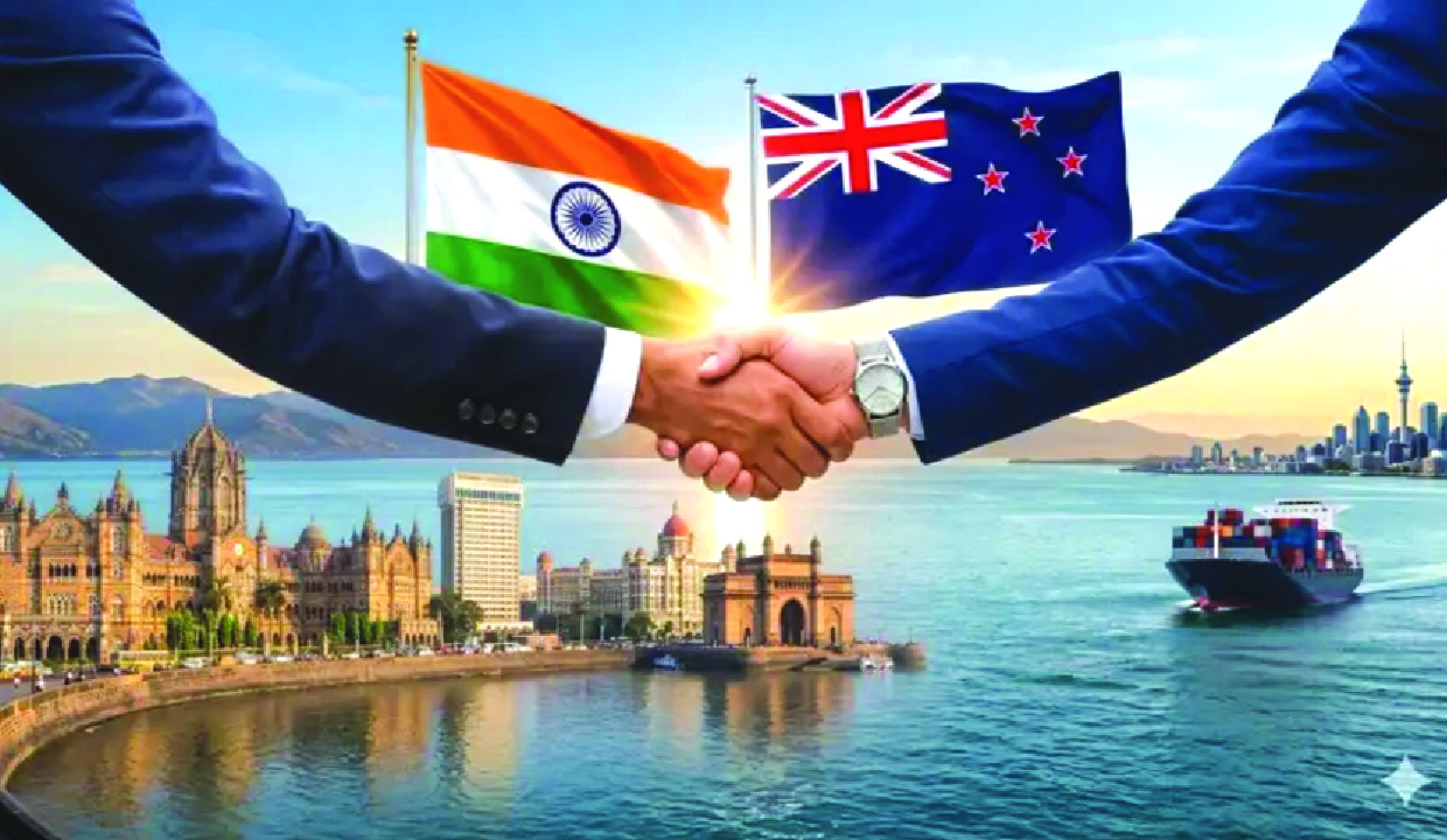
The India — New Zealand Free Trade Agreement has been signed, on April 27, 2026, encompassing goods, services, investment, mobility, and regulatory cooperation. This agreement is not merely concerned with the conventional act of reduction in tariffs; rather, it also incorporates Micro, Small, and Medium Enterprises (MSMEs), innovation and standards.
It is noteworthy that, currently, various types of trade agreements are observed across the globe. One such category is of multilateral agreements. Based on the ‘GATT’ agreement, the World Trade Organisation (WTO) came into existence in 1995; this was a multilateral trade agreement that, at that time, included 123 member nations. Subsequently, additional countries joined the pact, thereby becoming part of the World Trade Organisation. Today, the World Trade Organisation has 166 members.
Furthermore, regional trade agreements are frequently concluded, involving multiple nations within a specific geographical region. Examples of such free trade agreements include the North American Free Trade Agreement (NAFTA), the ‘ASEAN’ Free Trade Area (comprising nations in Southeast Asia), the European Union (EU), the Southern African Customs Union etc.
Customs Unions are, also a type of regional agreement in which member countries eliminate tariffs (duties) among themselves and apply a uniform tariff on goods imported from outside the bloc. The Regional Comprehensive Economic Partnership (RCEP) is an example of a major regional trade agreement; it comprises the ten ASEAN nations, along with China, Japan, South Korea, Australia, and New Zealand.
The Comprehensive and Progressive Agreement for Trans-Pacific Partnership (CPTPP) is another example of a regional trade agreement. Frequently, individual countries also enter into trade agreements with regional trade blocs. There are numerous global examples of this; for instance, the The India — European Union (EU) Free Trade Agreement (FTA) falls into this category.
Furthermore, we often observe large-scale regional trade agreements involving multiple countries from diverse geographical regions.
Additionally, many trade agreements are bilateral — that is, concluded between two specific countries. The India — New Zealand Free Trade Agreement is one such example. India has previously entered into similar bilateral agreements with various nations; notable examples include the India–United Kingdom Comprehensive Economic and Trade Agreement(CETA), the Australia-India
Economic Cooperation and Trade Agreement (ECTA), the Comprehensive Economic Partnership Agreement of India and Japan (CEPA), and now, the India-New Zealand Free Trade Agreement.
It is noteworthy that in recent times — due to actions by the United States such as arbitrarily raising tariffs in violation of World Trade Organisation (WTO) rules, withholding its financial contributions to the organisation, and contributing to deadlocks at ministerial conferences — countries across the globe are becoming increasingly disillusioned with the WTO.
All major nations are realising the necessity of re-evaluating global trade agreements. Consequently, the appeal of bilateral trade agreements among nations is steadily on the rise. Moreover, bilateral agreements are currently being pursued with greater frequency than regional agreements.
In 2019, just as India was poised to join the Regional Comprehensive Economic Partnership (RCEP), it became apparent that participating in this agreement could inflict severe damage upon the country’s agriculture, dairy, and industrial sectors. In light of this, Prime Minister Narendra Modi took a firm decision to opt out of the RCEP. It is noteworthy that the negotiations for this agreement involved 16 countries, including the ten ASEAN nations, Australia, New Zealand, Japan, South Korea, China, and India.
With the sole exception of China, India already has bilateral agreements in place with all the countries participating in the RCEP. Significantly, due to China’s adoption of unfair practices, India does not wish to enter into any form of trade agreement with the country.
All of India’s exports to New Zealand will receive a 100 per cent exemption from import duties; this will particularly benefit goods such as textiles and apparel, leather products and footwear, pharmaceuticals, and engineering goods. In return, India has granted import duty exemptions to 95 percent of New Zealand’s exports, with 30 per cent of these items receiving immediate exemption. Import duties on the remaining items will be reduced gradually.
Consistent with India’s approach in several previous agreements — where certain sensitive sectors were excluded from free trade pacts — sectors such as dairy, sugar, edible oils, spices, and rubber have been excluded from this agreement as well, in order to protect domestic farmers and producers.
It is anticipated that this agreement will facilitate market access in New Zealand for 118 categories of services provided by India, including IT and digital services, financial and professional services, as well as tourism and education services. Furthermore, New Zealand has committed to investing $20 billion in India over the coming years — investments likely to be directed toward infrastructure, technology, manufacturing, and agricultural value chains.
The agreement also addresses mobility and visa facilitation, offering easier visa access to skilled professionals, students, and practitioners of Yoga and AYUSH (traditional Indian medicine systems) from India.
Provisions such as work visas, a Working Holiday Scheme, and post-study work rights have been incorporated into the agreement. While New Zealand’s agricultural products —such as apples, kiwis, meat, and seafood — will be permitted for export to India, their entry will be subject to specific import quotas.
As import duties are phased out, careful consideration will be given to ensuring that the agreement does not cause any detriment to India’s farmers or the dairy sector. Following this agreement, the objective is to boost the total bilateral trade between India and New Zealand — currently standing at $1.3 billion — to $20 billion within a few years.
Notably, India’s foreign trade has historically been confined to a limited number of traditional partners; this agreement, therefore, presents an opportunity to significantly expand the scope of India’s global trade footprint. Concurrently, non-tariff barriers to trade will be eliminated through improvements in standards, customs procedures, and transparency in business operations.
Bilateral agreements concluded with most of India’s trading partners demonstrate that India is actively striving to promote free trade by engaging effectively in negotiations with its counterparts. Moving beyond the traditional framework of free trade agreements, India is now seeking to incorporate provisions regarding investment, mobility, and economic cooperation into these pacts.
This also signals that India is not merely forging agreements with developing nations; it is now engaging in more assertive negotiations — on an equal footing — even with developed economies.
The India — New Zealand Free Trade Agreement is one such example. India has previously entered into similar bilateral agreements with various nations; notable examples include the India – United Kingdom Comprehensive Economic and Trade Agreement (CETA), the India-Australia Economic Cooperation and Trade Agreement (ECTA), the Comprehensive Economic Partnership Agreement of India and Japan (CEPA), and now, the India-New Zealand Free Trade Agreement, serve as recent examples of this trend.
We observe that the proposed India-US FTA remains in limbo, indicating that India is in no haste to accept terms that do not align with its best interests. Following the US Supreme Court’s decision to overturn tariffs imposed by the Trump administration, India has also slowed the pace of its negotiations with the US; given these recent developments, we may potentially secure further concessions.
The trade agreement with New Zealand once again affirms that India is resolutely moving forward to conclude trade pacts even with developed nations, all while safeguarding its own interests. This reinforces the vision of a ‘Developed India’ and, through this agreement, fosters the expansion of supply chains and drives export-led growth.