From royal retreat to living heritage
It is often said that Maharaja Ranjit Singh’s heart lived in Amritsar, even though his royal court was held in Lahore. Despite ruling a vast empire, he chose Amritsar as the emotional and cultural centre of his kingdom. To stay close to this sacred city, Maharaja Ranjit Singh built a beautiful palace in the Ram Bagh area of Amritsar. This palace was used mainly during the summer season, when the Maharaja would come here to escape the heat. Because of this, it became known as the “Summer Palace”. Today, after nearly 15 years of restoration, the palace has now been reopened to the public, offering visitors a chance to experience the rich legacy of the Sikh Empire. As soon as you enter the palace, a grand entrance welcomes you. One of the most striking displays shows Maharaja Ranjit Singh seated on his throne. On his left is General Fateh Singh, and on his right is the famous warrior Hari Singh Nalwa. This powerful scene gives a glimpse into the strength and leadership of the Sikh Empire.
Joginder Singh, historian, while revealing the historical facts, said, “When Maharaja Ranjit Singh began ruling from the Lahore Fort, he realised that Amritsar also needed a strong administrative centre like Lahore. That is why he started the construction of the Summer Palace around 1817-1818.” Singh informed that “the construction was supervised by Kirpa Ram, the son of Diwan Moti Ram. This palace was not just a residence. Whenever the Maharaja stayed here, he brought his full administrative system with him. Important official work and governance were also carried out from here.”
The palace is currently maintained by the Department of Cultural Affairs and the Archaeology Department of the Punjab Government. According to information displayed here, the palace complex was developed over an area of about 84 acres, and a model of the original layout is also shown to visitors. Inside the museum, there are many interesting displays. One section shows a scene from the Maharaja’s wedding, helping visitors understand royal traditions of that time. On the ground floor, historical coins and objects from his era are carefully preserved and displayed.
Gurdeep Singh, caretaker, Summer Palace, said, “This Summer Palace was the summer residence of Maharaja Ranjit Singh. It was built by him, and from around 1818 to 1837, the Maharaja used to stay here regularly. He would spend about three months in Amritsar and the remaining nine months in Lahore. After Maharaja Ranjit Singh took control of Amritsar in 1802, the construction of this palace was started. The work was carried out under the supervision of Azizuddin, Jassa Singh, and Lehna Singh, and it cost a significant amount at that time.”
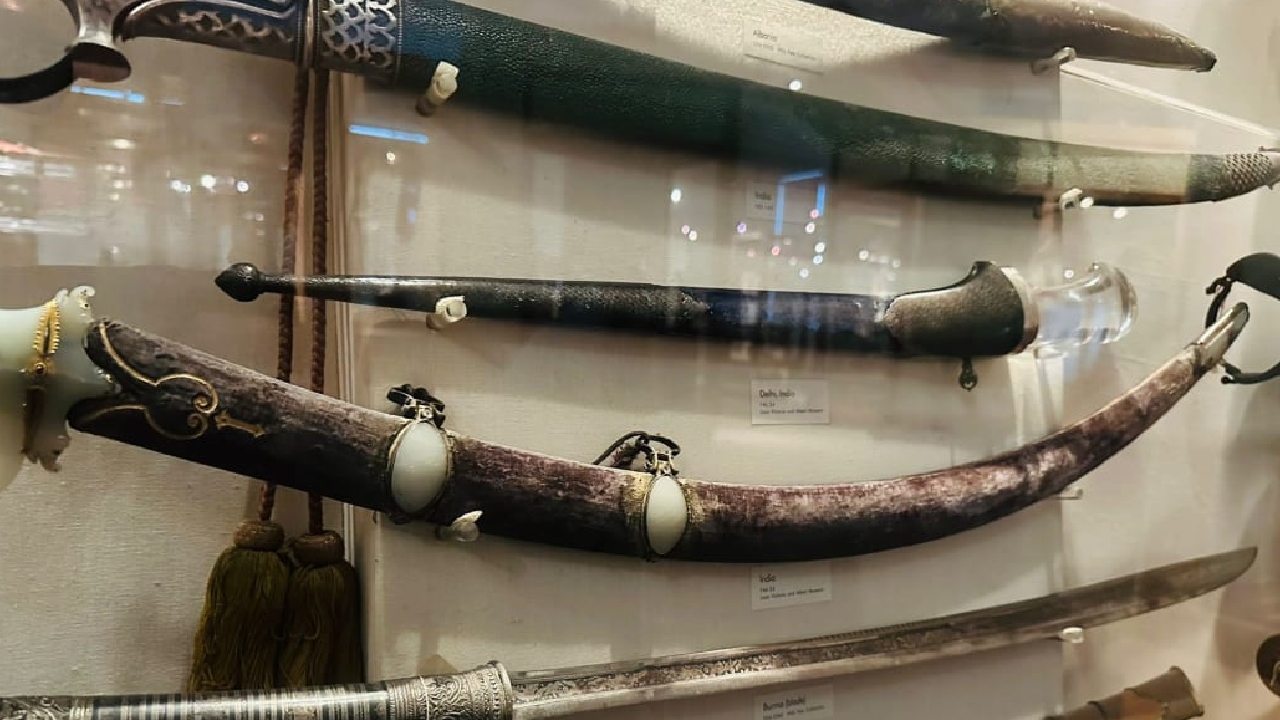
The Summer Palace is a two-storey building, and its architecture is impressive. Visitors can see beautiful carvings on the ceilings and walls. We also spoke to the caretaker, Gurdeep Singh, who shared that the palace was designed with a large number of windows. This helped keep the building cool during Amritsar’s hot summers, which is likely why it came to be known as the Summer Palace. One of the key attractions here is a replica of the famous Koh-i-Noor diamond, which continues to be a topic of global discussion. In addition, a wide collection of weapons from the Maharaja’s time is displayed, including bows, arrows, swords, and other arms.
Gurdeep Singh further added, “Inside the palace, weapons related to Maharaja Ranjit Singh’s time are displayed. Silicone statues have also been created to give visitors a real-life experience. These displays help tourists understand and observe history in a more engaging and visual way.”
The information panels inside the palace also highlight the strength of Maharaja Ranjit Singh’s army. It is mentioned that his army was a combination of traditional Indian and European military systems. He started with around 5,000 cavalry soldiers, and by 1839, the strength had grown to nearly one lakh soldiers. A small recreated “Darbar” inside the palace shows figures of Maharaja Kharak Singh, Kunwar Nau Nihal Singh, and several ministers. Statues of Maharani Jind Kaur and Maharaja Duleep Singh are also placed here, connecting visitors to different phases of Sikh history.
What makes this place special is the way history is presented. Every room uses multimedia displays, statues, written information, and real artefacts to tell the story of the Sikh Empire in a simple and engaging manner. Today, this Summer Palace has been officially named the Maharaja Ranjit Singh Museum by the Punjab Government’s cultural and archaeology departments. Efforts have been made to restore it as close as possible to its original form. Standing in the heart of Amritsar, this palace is not just a historical building. It is a symbol of the pride, vision, and legacy of Maharaja Ranjit Singh. It reminds us of a time when Punjab stood strong, united, and prosperous under his leadership.
The writer is an independent broadcast journalist; views are personal