Friendship renewed, strategy deepened
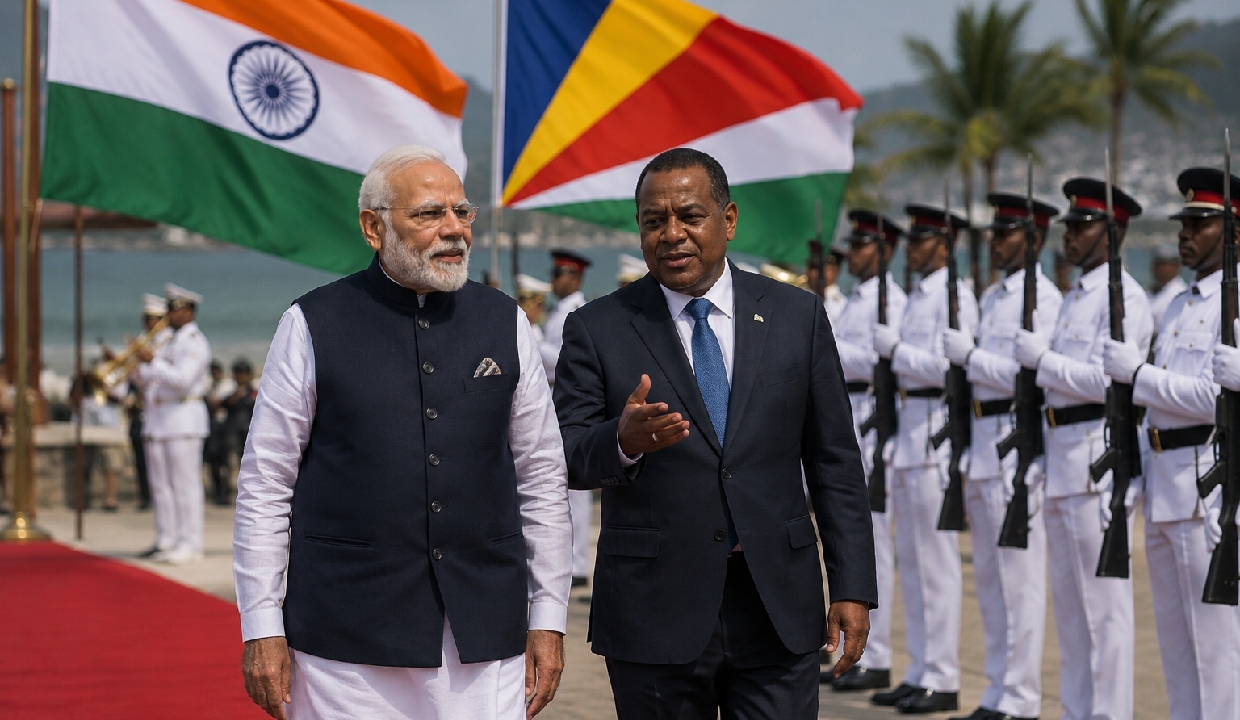
Seychelles marked fifty years of independence even as both nations marked fifty years of diplomatic relations established in 1976. Modi’s last visit, in 2015, had set the template for India’s outreach to Indian Ocean island states; this return — only the second by an Indian prime minister since 1981 — signalled that it has moved from a foreign-policy footnote to a recurring engagement, even if the eleven-year gap leaves room for more frequent high-level contact going forward.
The highlights were unusually rich for a National Day visit. Modi stood as Guest of Honour at the Golden Jubilee parade, where an Indian Armed Forces contingent marched alongside Seychellois troops and two Indian Navy warships anchored offshore — a quiet but pointed reminder of Delhi’s naval reach. More significant was the substance behind the ceremony: Modi became the first Indian prime minister to address Seychelles’ National Assembly, a gesture that elevated a transactional partnership into something closer to a parliamentary kinship between the world’s largest democracy and one of the Indian Ocean’s smallest.
Modi handed over the Made-in-India fast patrol vessel PS Lespwar to the Seychelles Coast Guard, along with ambulances, utility vehicles and laser radial boats meant to strengthen surveillance of an exclusive economic zone roughly 1.3 million square kilometres in size. This builds on years of quieter support — Dornier surveillance aircraft, a coastal radar network — and points to a partnership measured less in declarations than in delivered capability, an increasingly important currency in a region where promises often outpace performance.The real architecture, though, was laid earlier this year.
President Herminie’s February state visit to India produced the SESEL Joint Vision framework, seven memoranda covering maritime security, digital cooperation, the blue economy and education, and a $175 million package — a $125 million rupee line of credit plus $50 million in grants. This visit was less about fresh announcements than about reviewing implementation: a Seychelles Hydrographic Unit taking shape with Indian assistance, and a planned joint hydrography consultation later this year, suggest the relationship is shifting from pledges to project management.Strategically, the visit fits within Vision MAHASAGAR, India’s evolving Indian Ocean doctrine, which treats Seychelles as a sentinel guarding sea lanes connecting the Gulf, East Africa and South Asia. That the visit overlapped with Seychelles’ own commemorations of fifty years of ties with China is a useful reminder: India’s edge will rest on consistency and follow-through rather than sentiment alone.
Ceremony aside, is this: the visit’s true worth will be judged by whether the hydrographic unit, the credit line and the promised joint exercises actually materialise. For Seychelles, India offers an unusually equal partnership for an island nation of barely 120,000 people. For India, sustaining that goodwill is the price of credibility as an Indian Ocean power. Fifty years on, the relationship has matured past symbolism — what it needs now is patient, unglamorous follow-through.