Dr Ashutosh Mukherjee: The pioneer of Bengal’s intellectual awakening
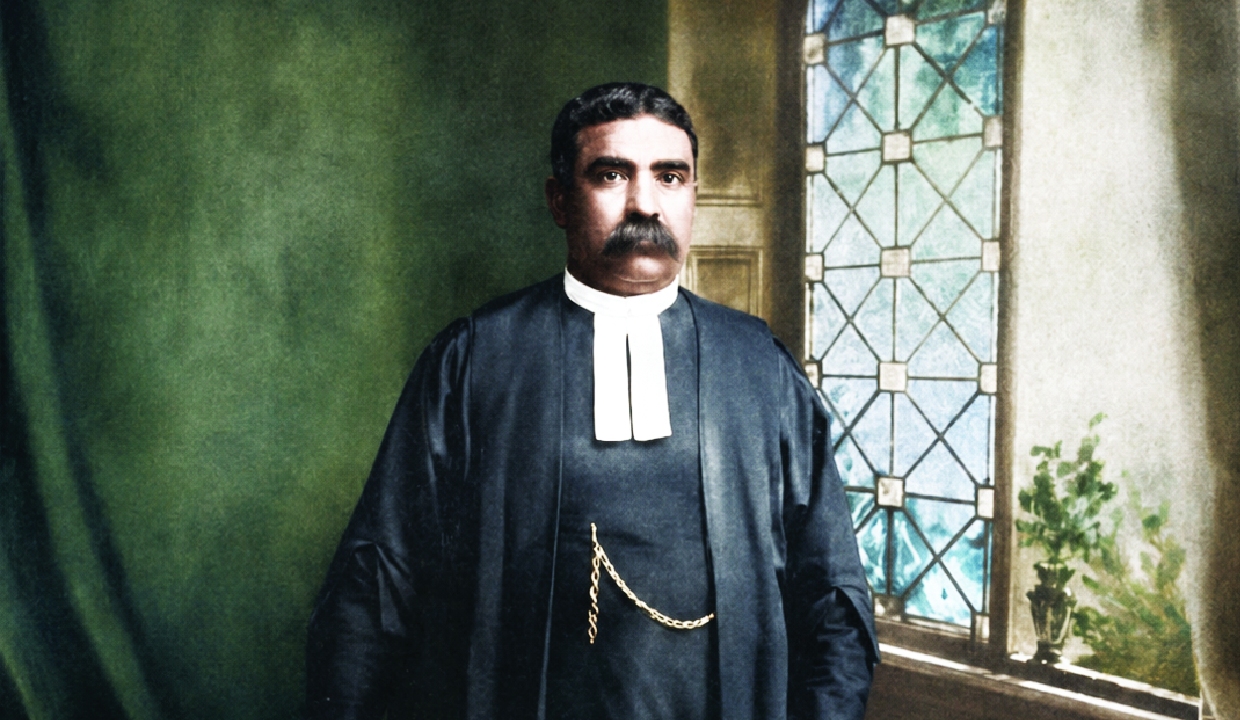
Tiger.” The world knows him as a great educationist and as the Vice-Chancellor of the University of Calcutta, but his personality was multidimensional.
Ashutosh Mukherjee was born on 29th June 1864 into the lineage of the great poet Krittivas Ojha, author of the Bengali Ramayana, to Dr. Gangaprasad Mukherjee. Unfortunately he passed away at the age of just 59. Even in his short life, the contributions he made in the fields of education, justice, mathematics, literature, and public life are inscribed in golden letters in the history of modern India. The present age seems to have all but forgotten this intellectual giant of history.
Today, on the occasion of his 162nd birth anniversary, there is an opportunity to remember him with reverence.
Ashutosh Mukherjee was a brilliant student from childhood. At Presidency College, he kept company with stalwart students such as Swami Vivekananda, Prafulla Chandra Ray, and Mahendranath Roy. He was the first student of the university to obtain a double degree-an M.A. in Mathematics and an M.Sc. in Physics. Ashutosh wrote a book on geometric conics, which was widely acclaimed. Had he remained entirely in the field of mathematics, he could have become a world-renowned mathematician, but his talent was multifaceted. He was accomplished in all fields-mathematics, law, history, language, culture and what not.
In 1883, Surendranath Banerjee was arrested on charges of contempt of court in connection with an article criticising an order of the Calcutta High Court. This sparked protests, and a group of students under Ashutosh’s leadership decided to demonstrate right in front of the Calcutta High Court. Perhaps this incident further strengthened his resolve to build a career in the world of law. He began his legal studies at City College, Calcutta, where he won the ‘Tagore Gold Medal’ for three consecutive years (1884, 1885, and 1886). In 1888 he obtained his degree and registered as an advocate at the Calcutta High Court. He began working in the chambers of Rashbihari Ghosh, a leading barrister of the bar at that time.
In 1885, he married Yogmaya Devi Bhattacharya. They had seven children, of whom the second son, Dr. Shyama Prasad Mukherjee, carried forward his father’s legacy. Shyama Prasad became the youngest Vice-Chancellor of the University of Calcutta at the age of just 33. As independent India’s first Minister of Industry, he laid the industrial foundation of the country. By founding the Bharatiya Jana Sangh, he gave a renewed awakening to national consciousness.
Proclaiming “In one country there shall not be two constitutions, two heads, and two emblems,” he struggled for the integration of Jammu and Kashmir and, in 1953, sacrificed his life under mysterious circumstances. Sir Ashutosh and the world of education could not be kept apart for long, and by 1897 he had obtained the degree of ‘Doctor of Law’ and taken up the position of ‘Tagore Law Professor’ at the University of Calcutta.On 5 August 1899, the University of Calcutta sent him to the Bengal Legislative Council, where he played the role of an extremely active member for the next five years. In the Council, together with Surendranath Banerjee, he opposed the Mackenzie Bill on each of its clauses, because it was undemocratic and unjust.
The purpose of this municipal law, in keeping with Lord Curzon’s tendency, was on the one hand to bring the Calcutta Municipality under government control, and on the other to give precedence to European commercial interests at the cost of the interests of Indian taxpayers-even though in reality it was the Indian taxpayers who were the greatest mainstay of the municipal system.
Ashutosh Mukherjee firmly advocated for the interests of teachers and opposed the existing disparity in the pay scales of the education service compared with the judicial and executive services. He said, “You appoint both in the same college. The work taken from them is also of exactly the same nature; yet when the question of remuneration arises, you pay one double the salary of the other.”
In 1902, Sir Ashutosh was appointed a member of the University Commission. On 4 January 1904, Sir Ashutosh became a member of the Imperial Legislative Council. Even in his brief tenure, he left a mark that would be remembered for a long time. In the Imperial Council, he strongly opposed Curzon’s University Bill alongside Gokhale. As a member of the Calcutta University Commission (Sadler Commission: 1917-19), he made a noteworthy contribution.
Sir Ashutosh Mukherjee’s greatest contribution lies in the development of the University of Calcutta. He dedicated the University of Calcutta to the service of the nation. The establishment of departments of Indian languages was the crowning achievement of his life, making it possible to obtain the highest degrees in one’s mother tongue. He promoted research. He demonstrated that Indian universities could provide research and higher education even without foreign aid.
He emphasised the harmony of technical education, industry, and education. The University had its own press and published the ‘Journal of the Department of Letters.’ During Sir Ashutosh’s tenure as Vice-Chancellor, extensive work was done on ancient Indian history, language, culture, economics, and scientific subjects. He encouraged scholars to study Maratha history, Prakrit literature, and the like.
As Vice-Chancellor, he was under heavy pressure to expel Subhas Chandra Bose from the university for the assault on Professor Oten. Concerned about protecting the career of the young Bose, Ashutosh had him transferred to another college-the Scottish Church Missionary College. Since the colonial government regarded the University as a hotbed of sedition and sought to impose conditions and controls on the functioning of the Vice-Chancellor, Sir Ashutosh declined a sixth term.
Viceroy Lord Curzon invited Sir Ashutosh to become a judge of the Calcutta High Court. He said that if his mother permitted, he would accept the position. Upon receiving his mother’s consent, he assumed the office of judge in 1904 and remained in that post until 1923, during which time he also twice held charge as Acting Chief Justice. Of the hundreds of judgments Sir Ashutosh delivered as a judge, many are still cited today as examples of judicial skill.
Sir Ashutosh was a devout Hindu by faith and every year performed Durga Puja with great grandeur at his house in Bhowanipore. He was highly progressive in social matters and opposed untouchability. Even while bearing the opposition of the orthodox Hindus of the time, he had his widowed daughter remarried. For this act Ashutosh had to endure a great deal, but he remained unshaken. He held immense respect for other religions.
Owing to his inclination towards Buddhism, he served as President of the Maha Bodhi Society of India from 1911 to 1924. On 25 May 1924, in Patna, the mortal frame of the Bengal Tiger, Dr. Ashutosh Mukherjee, came to an end; but his ideas, the institutions he built, and his roar for truth and justice continue to inspire the ages even today.