Colonised minds: Modi didn’t speak the whole truth
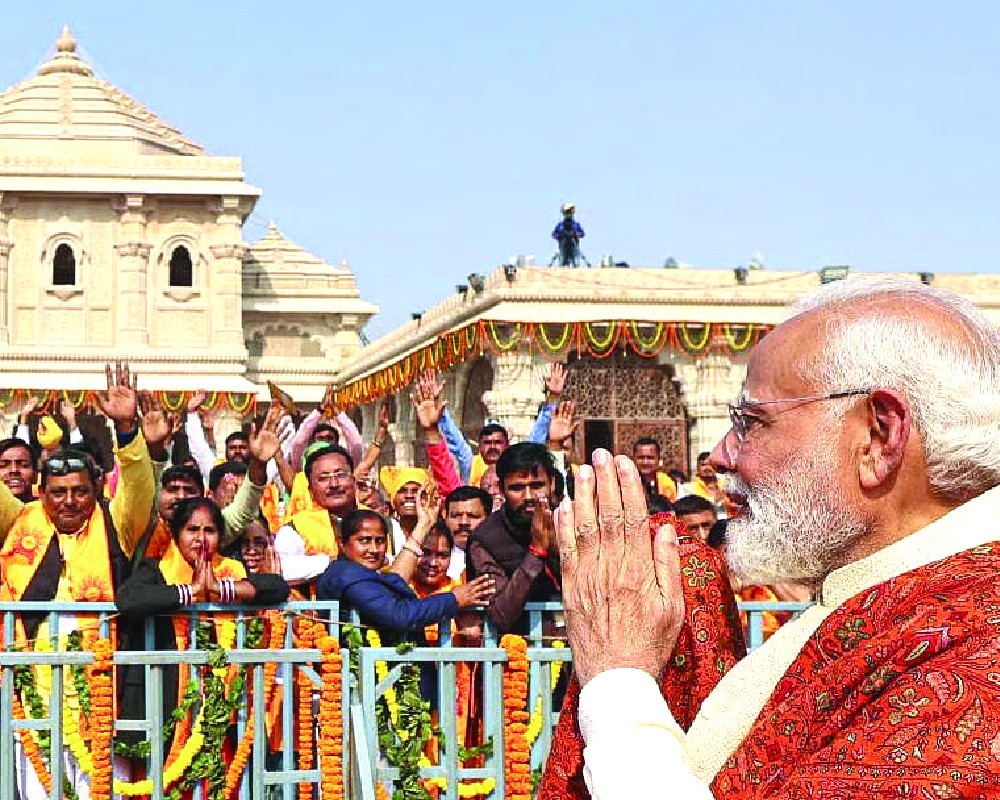
Recently, Prime Minister Narendra Modi vowed to liberate India completely from the Macaulayite mindset. In his words: “Alongside pride in our heritage, one more task is equally vital-and that is the complete eradication of the mindset of servitude. Nearly 190 years ago, in 1835, a Briton named Macaulay sowed the seeds of uprooting India from her civilisational roots. It was Macaulay who laid the foundation of India’s mental colonisation. Ten years from now, in 2035, that unfortunate episode will complete two hundred years. Only a few days ago, at another event, I urged the nation to adopt the coming decade as a mission-a resolve that in these ten years, we shall free India entirely from this mindset of slavery.”
PM Modi hit the nail on the head, and what better place than Ayodhya to do so. The seven-decade delay in building the Shri Ram Janmabhoomi Temple symbolises the lingering scars of colonised mindsets. The temple could have been constructed soon after independence and marked the conclusion of India’s struggle to reclaim its self-respect and identity.
However, opposition driven by Macaulay-Marxist influences turned it into a Hindu-Muslim issue. Their colonial mindset created misleading narratives, resulting in endless litigation, damage to Hindu-Muslim relations, and the loss of many innocent lives and properties. I have explored this topic in detail in my book-’Tryst with Ayodhya: Decolonisation of India’.
What Modi said about the Macaulay mindset is true, but unfortunately not the whole truth. India’s influential political, intellectual, and social elite has long been influenced not only by Macaulay but also by the ideological legacy of Karl Marx. Since independence, this powerful network has worked tirelessly-both jointly and separately-to carry forward the unfinished agenda of these two, who never met but shared a hatred for India’s timeless civilisation.
Thomas Babington Macaulay was a staunch capitalist and imperialist. In contrast, Karl Marx was the pioneer of Leftist ideology, focusing on class struggle while sharply criticising capitalism. Despite their ideological differences, both shared a common goal: to diminish India’s presence in the minds and hearts of its people. As a result, when the British, in collusion with the Muslim League, moved the subcontinent towards an inevitable partition, the contemporary Left intelligentsia not only justified it but also mused about breaking India into more than fifteen smaller pieces.
Macaulay’s 1835 education policy aimed at shaping a class of Indians who would be “Indian in blood and colour, but English in taste, in opinions, in morals and in intellect”-a group that would support British rule. His policies encouraged Indians to look down on their own civilisational roots and to detach mentally from their cultural foundations. So strong was his disdain that he famously claimed the entire “native literature of India” and learning was not “worth” even a “single shelf of a good European library”.
Macaulay’s project was not merely colonial; it was deeply evangelical. Writing to his father on October 12, 1836, he declared: “…Our English schools are flourishing wonderfully… The effect of this education on the Hindoos is prodigious. No Hindoo who has received an English education ever continues to be sincerely attached to his religion. Some continue to profess it as a matter of policy, and some embrace Christianity… It is my firm belief that, if our plans of education are followed up, there will not be a single idolater among the respectable classes in Bengal thirty years hence…”
Macaulay’s thoughts aligned with the 1813 Charter Act of the East India Company, which encouraged European missionaries’ evangelical efforts in India. From this colonial origin, divisive ideas like the ‘Aryan Invasion Theory’, the ‘Dravidian Movement’, and the claim that “India is not a nation” arose, still influencing Indian politics and academia.
British rule in India, ironically, fulfilled Marx’s worldview, at least in one way. His satisfaction is evident in his column — ‘The Future Results of British Rule in India’-published on 8 August 1853 in the ‘New York Daily Tribune’, where he wrote: “The British were the first conquerors superior, and therefore inaccessible to Hindoo civilisation. They destroyed it by breaking up the native communities, by uprooting the native industry, and by levelling all that was great and elevated in the native society.”
Mark these words, “they destroyed it by breaking up the native communities, by uprooting the native industry…”. This sentence by Marx, over 170 years old, summarises how India was culturally and economically destroyed by colonial powers. Marx celebrated this destruction of Indian culture and industry as necessary for revolution, as culture and economics are intertwined-destroying one kills the other.
He further added in ‘The Future Results of British Rule in India’: “England has to fulfil a double mission in India: one destructive-the other regenerating-the annihilation of old Asiatic society and laying the material foundations of Western society in Asia.”
Marx’s contempt for Indian traditions was further exposed in another New York Daily Tribune article, ‘The British Rule in India’, dated 25 June 1853: “…We must not forget that these little communities were contaminated by distinctions of caste and by slavery, that they subjugated man to external circumstances instead of elevating man the sovereign of circumstances, that they transformed a self-developing social state into never-changing natural destiny, and thus brought about a brutalising worship of nature, exhibiting its degradation in the fact that man, the sovereign of nature, fell down on his knees in adoration of Hanuman, the monkey, and Sabala, the cow…”
Marx authored this caricature without visiting India, yet many of his ideological successors spread this disdain in independent India. Sanatan philosophy views man as part of the cosmic order, not its master. India’s Vedic culture, with deep roots, supported a thriving economy from the first to the seventeenth century, acknowledged by global research.
The liberation from the colonial Macaulay-Marx mindset-an emancipation that should have started immediately after independence-only gained momentum after 2014, with some exceptions. The Guardian’s May 18, 2014 editorial highlighted this shift-”Narendra Modi’s victory in the elections marks the end of a long era in which the structures of power did not differ greatly from those through which Britain ruled the subcontinent. India under the Congress party was in many ways a continuation of the British Raj by other means. The last of midnight’s children are now a dwindling handful of almost 70-year-olds, but it is not the passing of the independence generation that makes the difference.”
Post-independence, there was a unanimous demand in Ayodhya from civil society, the political leadership of United Provinces (as Uttar Pradesh was called then), and the top echelons of state bureaucracy for handing over the Shri Ram Janmabhoomi site to Hindus, but the colonialists led by the then Prime Minister Nehru wouldn’t let that happen.
In this context, the Shri Ram Janmabhoomi Temple in Ayodhya stands as a living symbol of Sanatan resurgence and a national resolve to break free from colonial consciousness.
When, amid Vedic rituals on November 25, the PM raised the standard of Sanatan in Ayodhya, it was a definitive statement about India’s civilisational renaissance and its quest to dismantle the colonial mindset. No wonder the Macaulay-Marxist pack is in a funk.
The writer is an eminent columnist and the author of ‘Tryst with Ayodhya: Decolonisation of India’ and ‘Narrative ka Mayajaal’; views are personal