Cauvery water: Old dispute, new warriors
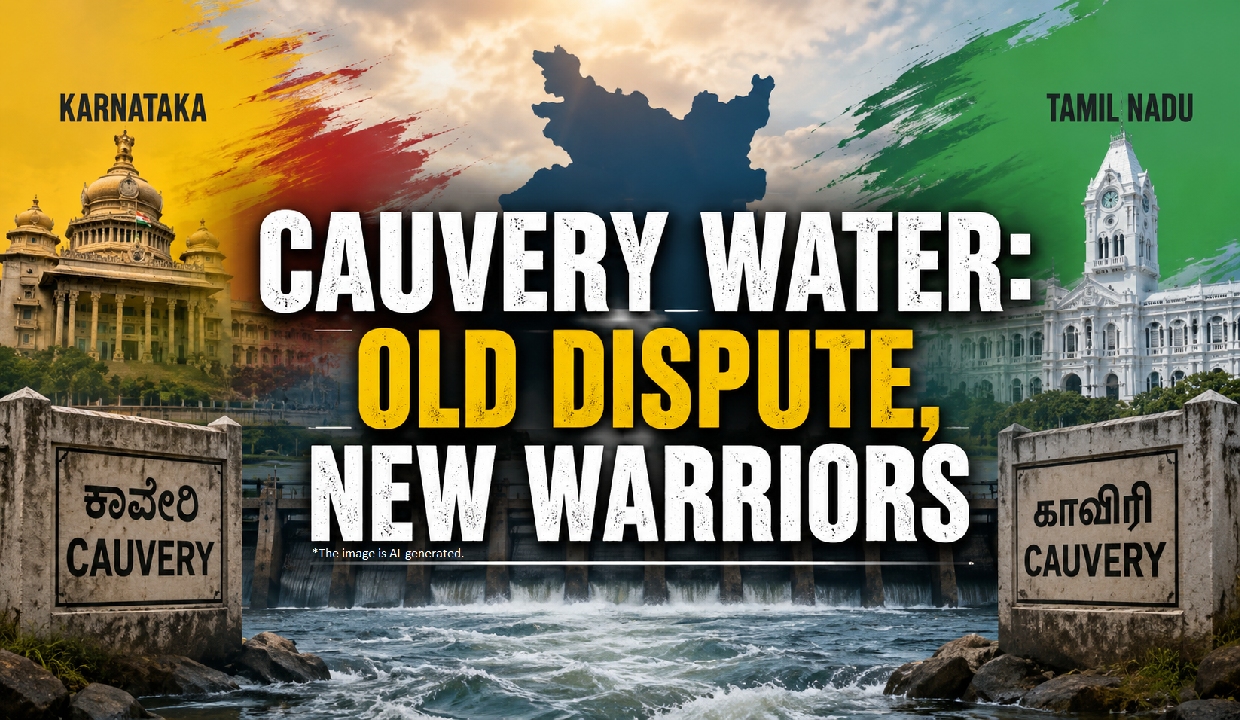
Every August, as the southwest monsoon falters, the Cauvery once again becomes less a river than a courtroom argument. This year is no different
Cauvery water disputes have become a perennial dispute. At the beginning of this month, Tamil Nadu pleaded before the Supreme Court that Karnataka is again withholding its share of the Cauvery's waters. CM Vijay's government told the court that Karnataka has ignored the Cauvery Water Regulation Committee's July 28 order to release 3,500 cusecs a day at Biligundlu through August 12. A day earlier, Karnataka Chief Minister DK Shivakumar had convened an all-party meeting in Bengaluru, uniting the Congress and the BJP behind a familiar plea: the state is in the grip of a poor monsoon and cannot spare water that its own farmers need.
Same river, same season, same impasse; only the names across the table have changed. The dispute is older than the republic itself. Two colonial-era pacts, in 1892 and 1924, apportioned the Cauvery between Madras and the princely state of Mysore; the 1924 pact lapsed in 1974, and Karnataka's push to expand irrigation reignited the quarrel. Tamil Nadu's plea led to the Cauvery Water Disputes Tribunal in 1990, whose final award in 2007, after seventeen years, gave Tamil Nadu a far larger share than its 1991 interim order had. Both states appealed, and in February 2018 the Supreme Court recalibrated the numbers: 284.75 thousand million cubic feet for Karnataka, including extra water for Bengaluru's drinking needs, and 404.25 TMC for Tamil Nadu.
To implement this, it ordered the creation of the Cauvery Water Management Authority and its technical arm, the Cauvery Water Regulation Committee, meant to turn an annual political brawl into hydrology and formula. It has not worked out that way. Every deficient monsoon still triggers the same sequence: a CWRC order, Karnataka's reluctance, citing its own distress, and Tamil Nadu's return to the apex court. Layered onto this is Karnataka's long-pending Mekedatu balancing reservoir, which it says will store surplus monsoon flow for dry years without affecting Tamil Nadu's entitlement, and which Tamil Nadu calls an upper riparian's ploy to control the tap.
Hearing Karnataka's plea last November, the Supreme Court called Tamil Nadu's objection premature. The Cauvery Water Management Authority already has the legal architecture to arbitrate on hydrology rather than politics; what it lacks is an automatic, real-time enforcement mechanism that does not require Tamil Nadu to plead before the Supreme Court every August. Publicly verifiable, real-time flow data would settle the perennial argument over how much water actually exists before it ever reaches a courtroom. Mekedatu's fate, too, should be settled where the Supreme Court has already sent it: before the CWMA and the Central Water Commission on engineering merit, not through parallel litigation and competing all-party theatre on both banks of the border.
Karnataka and Tamil Nadu have new Chief Ministers facing an old grievance for the first time. They would serve their states, and the basin's tens of millions, better by trusting the institutions already built for this purpose than by reaching, yet again, for the Supreme Court's number.