BRICS: India to balance Global South and West
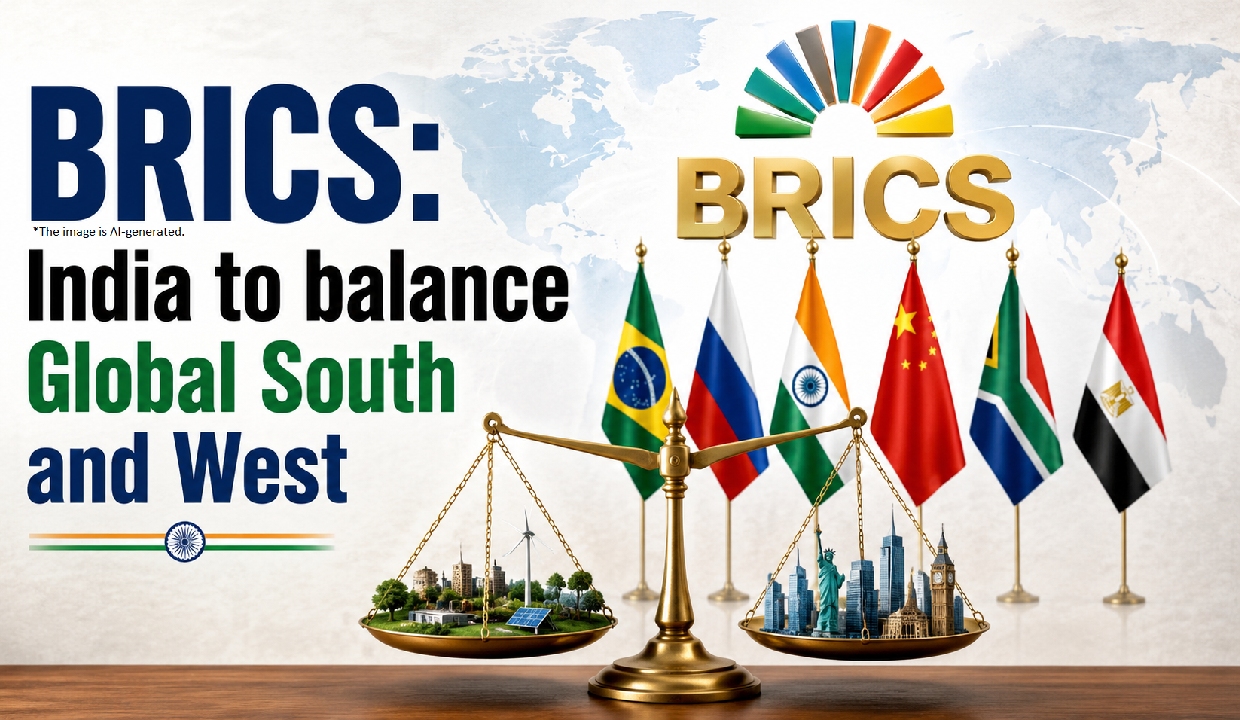
The BRICS summit at Delhi offers India a chance to project itself as the Global South’s convenor without becoming an anti-Western camp
When Narendra Modi welcomes Vladimir Putin, Cyril Ramaphosa, and counterparts from an eleven-nation bloc to New Delhi on September 12-13, it will mark India’s first BRICS chairmanship — its most consequential hosting since the 2023 G20 presidency. The theme — “Building for Resilience, Innovation, Cooperation and Sustainability” — is compelling; the agenda is not: reformed multilateralism at the UN and IMF, balanced trade and smooth services flows within the bloc, supply chains for semiconductors and critical minerals, a Startup Innovation Fund, an AI governance framework, and an Agricultural Trade Conduct Protocol aimed at food security.
For India, the summit matters less for any single deliverable than for positioning. Hosting a bloc representing roughly 40 per cent of global GDP and nearly half of humanity lets New Delhi frame itself as the Global South’s pragmatic convenor - present at the table with Beijing and Moscow, but unwilling to be cast as anti-Western.
The guest list underlines this: India has invited the sitting chairs of the African Union, ASEAN, CELAC, and the Gulf Cooperation Council as observers, plus UN Secretary-General António Guterres as an expected special guest — a roster built to say New Delhi speaks for the wider developing world, not just for BRICS.
That distinction matters more this year, as Washington’s tariff pressure over India’s Russian oil purchases pushes New Delhi to hedge harder towards Moscow and Beijing while still resisting a bloc-wide anti-dollar posture.
The talking points to watch: India will push local-currency settlement and payment-system interoperability, while rejecting a common BRICS currency that would invite further American retaliation. Counter-terrorism and terror financing will get prominent language, a long-standing Indian priority. And the India-China thaw — seeded at the 2024 Kazan summit - will be visible.
The complication is that BRICS is not an instrument India fully controls. Iran and Russia want sharper anti-Western language than New Delhi is comfortable issuing as chair; the West Asia conflict had already sunk consensus at May’s foreign ministers’ meeting; and Saudi Arabia’s ambivalent participation, alongside Argentina’s withdrawal, shows this is a looser coalition than the G20 India ran in 2023. Critics have called the presidency a “crown of thorns” — diplomatic exposure for uncertain reward.
The likely outcome is not a triumphant joint declaration but a carefully hedged chair’s statement: sharp language on trade facilitation, food security, and institutional reform; softer, vaguer language on Gaza and Ukraine; and modest, concrete wins such as the innovation fund and a digital-payments push.
That is India doing what it does best at these forums - converting it into proof of its own indispensability, without surrendering strategic autonomy.