BR Ambedkar: His life, legacy and beyond
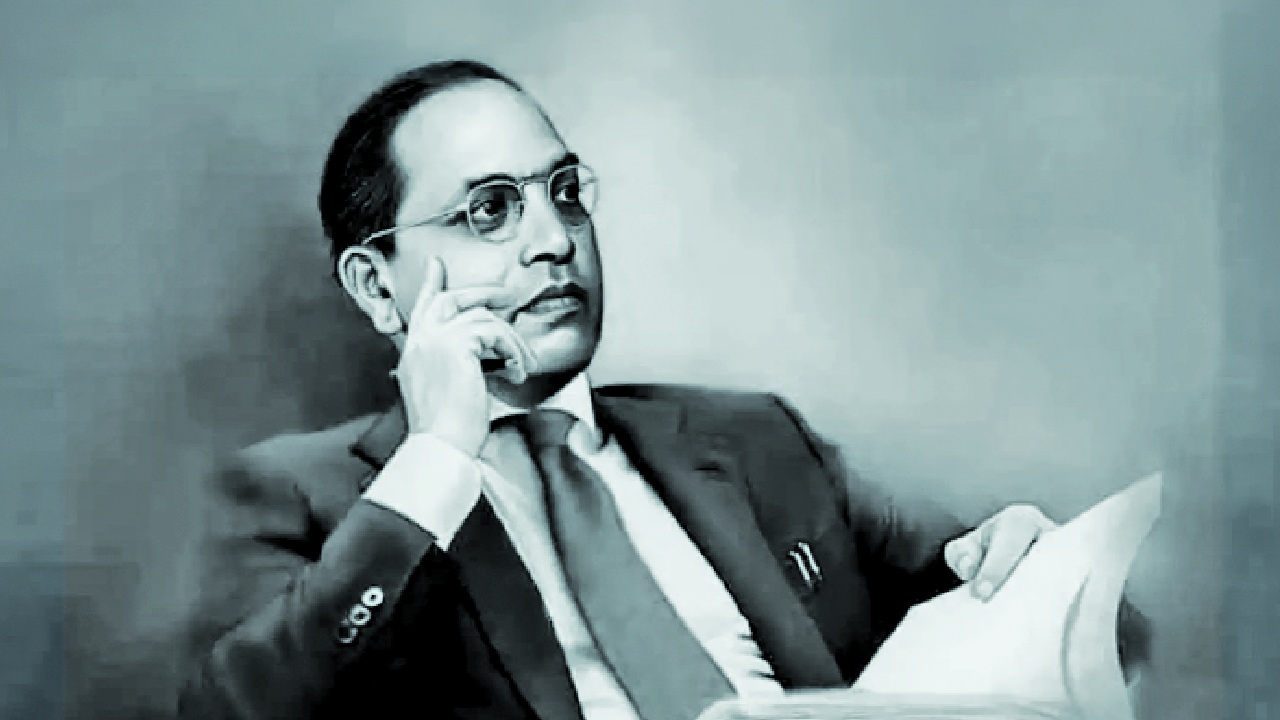
India is a nation built on the shoulders of extraordinary individuals, men and women who dared to dream of equality, justice and dignity for all. Among those towering figures, one stands apart - not merely as a statesman, jurist or economist, but at the intersection of law, public morality and social justice. His name: BR Ambedkar. As we commemorate him today, I would like to take a moment not only to delve into the life of an individual who transcended the brutal circumstances of birth to become one of the finest legal and intellectual minds of the twentieth century, the principal architect of the Constitution of the Republic of India, but also to shed light on the post-independence political marginalisation and, ultimately, the slow but deliberate reduction of his legacy.
Our story begins 135 years ago on this day, 14 April. The year was 1891, and in a small town called Mhow (now BR Ambedkar Nagar in modern-day Madhya Pradesh), a baby was born to the family of Ramji Maloji Sakpal and Bhimabai, their 14th child. The family belonged to the Mahar caste, classified as ‘untouchable’, thereby subjected to one of the most systematic and dehumanising forms of social discrimination the world has ever known.
From a very young age, Ambedkar faced harsh social exclusion. In school, he was made to sit separately. He was not allowed to touch water vessels. If he needed water, someone from a higher caste had to pour it for him, if they agreed at all. Many times, he simply went without water. These experiences were not isolated incidents. They reflected a deeply unjust social system that denied basic dignity to entire communities.
Despite these hardships, BR Ambedkar showed exceptional intelligence and determination. A teacher gave him the surname “Ambedkar”, replacing his original surname. While this small gesture became part of a much larger journey, it lit a fire of determination and zeal in a child who was denied basic rights, pushing him to become one of the most educated and influential minds of his time.
In 1907, a young Ambedkar passed his Matriculation examination from Bombay University with outstanding results. He subsequently joined Elphinstone College in Mumbai in 1908, a prestigious institution that very few Dalits of that era could even aspire to enter. In 1912, he graduated in Political Science and Economics from Bombay University.
In 1913, following his father’s death, Ambedkar departed for the United States to study at Columbia University in New York, where he was awarded a PhD for his thesis ‘The Evolution of Provincial Finance in British India’. His very first published article, ‘Castes in India: Their Mechanism, Genesis and Development’, announced to the world the arrival of a scholar of the first rank.
He returned to India briefly and then travelled to England, where he studied at the London School of Economics and qualified at Gray’s Inn to be called to the Bar. During his time in London from 1920 to 1923, he completed another landmark thesis titled ‘The Problem of the Rupee’, for which the University of London awarded him the degree of DSc. The multitude of recognition from prestigious institutions worldwide confirmed his standing as one of the most academically accomplished men of the twentieth century. However, for all practical purposes in his own country, he was still seen as an untouchable, with discrimination and prejudice making it very difficult for Ambedkar to find acceptance among the elite of India at that time. Yet, he remained firm in his resolve to use education as a tool for social change.
After returning to India, Ambedkar dedicated himself to the upliftment of the oppressed. In 1920, he started the newspaper Mooknayak (Leader of the Silent) to raise awareness among Dalits. His activism was practical and structured. He believed in creating institutions and movements to bring change. In 1923, he founded the Bahishkrit Hitkarini Sabha to promote education and improve the economic condition of the downtrodden. In 1927, he led the Mahad Satyagraha at the Chowdar Tank, asserting the right of Dalits to access public water. This was a major moment in the fight against caste discrimination.
In 1930, he launched the Temple Entry Movement at the Kalaram Temple in Nashik, demanding equal religious rights.
A major turning point came in 1932 with the debate on separate electorates for the Depressed Classes. The British Communal Award granted this provision, which Ambedkar supported. However, Mahatma Gandhi opposed it and began a fast unto death. Under immense pressure, Ambedkar signed the Poona Pact, replacing separate electorates with reserved seats.
This was the start of many differences between Ambedkar and Mahatma Gandhi, with the fundamental difference being that while Mahatma Gandhi referred to untouchables as ‘Harijans’ and sought reform from within Hinduism, Ambedkar, who had experienced untouchability in the flesh, believed that the caste system was fundamentally incompatible with human equality and dignity and needed to be abolished entirely.
His 1936 work, Annihilation of Caste, strongly criticised the caste system. However, the Congress party at that time was not aligned with this and felt that Ambedkar was going against the work of Mahatma Gandhi. This difference is seen aptly in the 1945 writing of Ambedkar titled What Congress and Gandhi Have Done to the Untouchables, a damning account of how the Congress party had repeatedly failed the Depressed Classes, prioritising the interests of the upper-caste Hindu majority over the rights of those at the bottom of the social order.
Ambedkar’s contribution to India’s freedom struggle is sometimes misunderstood. It is rather unfortunate that this misunderstanding has been encouraged, deliberately or otherwise, by those who preferred to see him as a sectional leader rather than a national one. The truth is more complex, and considerably more honourable.
Ambedkar’s vision of freedom was categorically different from that which dominated the Congress-led national movement. For him, freedom without equality was hollow. He wrote and argued repeatedly that the independence of India from British rule, while necessary, would mean little to millions of Dalits if the new rulers simply replicated the social hierarchies and injustices of the old order. For Ambedkar, freedom without equality and equality without freedom could lead to absolute dictatorship.
We see his efforts to tackle this in one of his most monumental contributions to a newly independent India, the heart and soul of our democracy, the Indian Constitution.
Within weeks of our country gaining independence, on 29 August 1947, the Constituent Assembly established a Drafting Committee to prepare a Constitution for the new republic and elected Ambedkar as its Chairman. The task was of an almost impossible magnitude. The Constituent Assembly ‘moved, discussed and disposed of as many as 2,473 amendments’ during its deliberations. Rajendra Prasad, Chairman of the Constituent Assembly, acknowledged the zeal and devotion of the members of the Drafting Committee and especially its Chairman, Ambedkar, in delivering our nation a Constitution despite deteriorating health and in conditions of extraordinary difficulty. Ambedkar ensured that our Constitution included robust protections for Scheduled Castes, Scheduled Tribes and Backward Classes. He insisted on the separation of powers, an independent judiciary, and the fundamental rights of every citizen regardless of caste, creed, sex or religion. He advocated democracy in every field: social, economic and political. For him, social justice meant maximum happiness for a maximum number of people.
The tragedy of Ambedkar’s post-independence years is inseparable from the tragedy of the Congress government’s failure to honour one of its own greatest servants. Having used his towering intellect and prodigious labour to draft the Constitution, Ambedkar was subsequently marginalised, humiliated and politically destroyed by the very party whose government he had served. When differences emerged between him and the ruling government of Jawaharlal Nehru, he chose to resign from the government rather than remain part of what he did not believe was making the necessary efforts to uplift the Dalits, oppressed and marginalised classes.
This apparent slight was not forgiven by the Congress, which made sure to undertake measures in the 1952 elections to effectively torpedo Ambedkar’s political career. As the first independent elections in India approached, Ambedkar contested from the Bombay North Central constituency as the candidate of his Scheduled Castes Federation. Not only did the Congress field a former assistant of Ambedkar against him, they decided to work with the other major party in the region to effectively deny one of our greatest minds the opportunity to stand in the Lok Sabha and raise the issues of those he fought his entire lifetime for.
The toll of elections, politics and long health issues eventually took its toll, and Ambedkar died in 1956. Rather than celebrate his legacy, his name remained in practical political isolation. It took until 1990, close to thirty-four years after his death, and forty-three years after independence for the Indian State to formally confer the Bharat Ratna upon BR Ambedkar. It was the cabinet of the seventh Prime Minister, V. P. Singh, that took that step. The Congress governments that preceded him had not seen fit to extend this honour to the man who had given India its Constitution, rather choosing to confer it upon themselves.
BR Ambedkar gave India its Constitution and a vision of equality and justice. He rose from deep social discrimination to become one of the greatest thinkers of modern India. His life reminds us that democracy must be built on dignity and equal rights.
He was not only a leader of the oppressed but a nation-builder of the highest order. His ideas remain central to India’s progress. His iconic call to “Educate, Agitate, Organise” continues to guide generations not just in India but across the world at large.
To honour Ambedkar is to uphold constitutional values and fight injustice. His legacy is not just history; it is a collective responsibility that must continue to be passed down to generations so that they are made aware of the man who gave his today for our tomorrow and forever.
The writer is a Member of Parliament (Lok Sabha), Panel Speaker, and retired DGP; views are personal