Beyond borders: A joint strategy for common growth
In his Independence Day address from the Red Fort on 15 August 2020, the Prime Minister of India said, “Today, neighbours are not the only ones with whom we share geographical boundaries, but also those with whom we have close and harmonious relations.” He further emphasised the value of regional cooperation, observing that “the world’s one-fourth population lives in South Asia” and “we can create countless opportunities for the welfare of such a large population through cooperation and partnership.”
Since times immemorial, Bharat has been a subcontinent with a common civilisational bond with the countries that are our neighbours which were earlier a part of Vrihada Bharat/Akhanda Bharat, that is, the vast and expansive cultural and civilisational influence of the Indian subcontinent till South and Southeast Asia, that was under constant commercial, political and cultural interface. This shared past is not merely an inheritance of memory. It also offers a practical foundation for contemporary regional stability and cooperation, particularly in a world where economic shocks, supply chain realignments and strategic competition increasingly reward cohesive regions that can coordinate interests while respecting sovereignty.
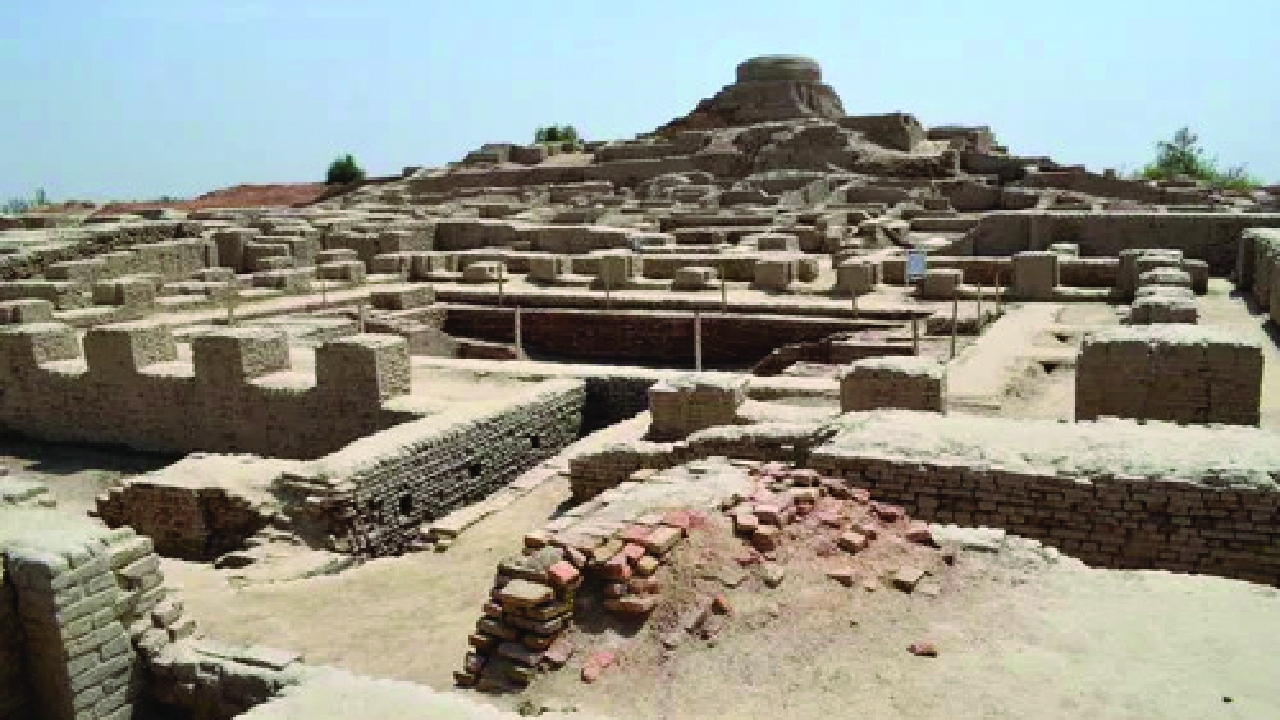
Major urban centres such as Harappa and Mohenjo-daro are located in today’s Pakistan, while sites like Rakhigarhi, Alamgirpur and Daimabad fall in Bharat. As a 218m-long brick basin, Lothal in Gujarat is deemed the world’s earliest dockyard facilitating Bharat’s maritime trade westward. The wide geographical spread of these settlements underscores that Harappan urbanism, craft production and exchange systems represent a common civilisational inheritance, one that transcends contemporary political boundaries and tensions reminds us that modern frontiers, while sovereign and inviolable, sit atop older layers of connectivity that once enabled integrated economic and cultural ecosystems.
Afghanistan, particularly its eastern and southern regions, maintained strong connections with the north-western Bharat through commercial networks of the Harappan civilisation.
During the early centuries spanning the late BCE and early CE periods, Afghanistan emerged as a major centre of Buddhist monastic life beyond the Gangetic plains. Geographical pockets like Gandhara, extending into present-day Pakistan, became dotted with monasteries and stupas that played a crucial role in transmitting Indian Buddhist doctrines and artistic forms into Central Asia and onward to China.
Early Chinese pilgrims, notably Fa-hsien and Hiuen Tsang, journeyed to major Buddhist centres in Bharat, returning with scriptural copies and commentarial travelogues that played a formative role in Chinese Buddhism. The scholarship within the framework of “Greater India” highlights the effective reception and adaptation of Indian Buddhist texts and ideas within the Chinese cultural sphere.
In both the ancient and medieval periods, Nepal was firmly embedded within the broader Indic religious and literary milieu, while simultaneously functioning as a connective zone linking the Indian plains with the Himalayan ranges and Tibetan plateaus. Under the ancient political powers such as the Licchavis, as early as 6th-5th centuries BCE, Sanskrit emerged as a principal language of ritual practice and royal inscriptions, while Pali entered the area through Buddhist transmission.
Contemporary Bhutanese culture is grounded in Tibetan Buddhism, yet its religious and philosophical foundations ultimately trace back to Indian Buddhist currents that travelled across the Himalayan corridors. The region that constitutes present-day Bangladesh has been closely associated with eastern and north-eastern Bharat over thousands of years, from the late Harappan-Gangetic interaction sphere to the emergence of historic kingdoms in Bengal.
Myanmar, formerly Burma, is situated within the historical zone often described by scholars as the “Indosphere”: a civilisational space profoundly influenced by Indian religious, linguistic and artistic traditions, most notably through the spread of Theravada Buddhism.
Long-distance trade links connected eastern Bharat with southern Myanmar and beyond into mainland Southeast Asia, facilitating the spread of Pali and Sanskrit languages and scripts derived from the Brahmi script, including Mon and Burmese, but also the transmission of a wide range of Buddhist and Hindu concepts alongside commercial exchange.
Sri Lanka represents one of the most compelling examples of long-standing and early civilisational connections with Bharat. Its prominent place in our Adikavya Ramayana is universally known.
Early historical Sinhalese chronicles such as the Mahavamsha and Dipavamsha, as well as modern historical accounts, record that Buddhism was introduced to the island in the third century BCE by Mahinda, traditionally identified as the son of the Mauryan emperor Ashoka. Following his successful conversion of King Devanampiya Tissa, Buddhism became the state religion, establishing a lasting Theravada Buddhist connection between Bharat and Sri Lanka.
It is noteworthy that a sapling of the Mahabodhi tree was brought to Sri Lanka from Bodhgaya in Bharat by Sanghamitra, Ashoka’s daughter. In 1193, Bakhtiyar Khilji destroyed the Mahabodhi tree at Bodhgaya. Subsequently, a sapling from Anuradhapura’s Jaya Sri Mahabodhi was used to replant the sacred tree at Bodhgaya.
Historical research on Maldivian origins suggests that the initial settlers were probably Dravidian-speaking groups from Southern Bharat, followed by the arrival of Indo-Aryan speakers from Sri Lanka and the Indian mainland around the 4th to 5th centuries BCE. These successive movements produced a composite ethnic and linguistic profile. The Maldives practised Buddhism as its principal religion before converting to Islam. Spanning the region from Pakistan through Myanmar, and extending to Sri Lanka and the Maldives, scholars of the “Greater India” and the wider “Indic world” point to a set of recurring cultural and historical features that bind these neighbouring nations together:
Religious and philosophical traditions:
The outward transmission of Buddhism, encompassing both Theravada and Mahayana streams, from the Indian heartland to Afghanistan, Nepal, Bhutan-Tibet, Myanmar, Sri Lanka and the Maldives, alongside the spread of Hindu beliefs and ritual practices into Nepal, Bangladesh and parts of Southeast Asia.
Languages and scripts:
The spread of Sanskrit and Pali as liturgical and intellectual media, the development of regional scripts in areas such as Nepal and Myanmar derived from the Indian-Brahmi models and the trans-border presence of Indo-Aryan languages like Punjabi, Bengali, Sinhala and Dhivehi that continue to extend across modern political boundaries.
Art, architecture and urban traditions:
A common legacy of Harappan urban planning shared by Bharat, Pakistan, and Afghanistan is the wide distribution of stupas and Buddhist monastic complexes from Gandhara through Sri Lanka to Myanmar, as well as temple forms and religious iconography rooted in Indian art.
Commercial and maritime networks: Extensive trade routes across the Bay of Bengal and the Indian Ocean connected Bharat with Myanmar, Sri Lanka and the Maldives, facilitating the movement not only of commodities but also of texts, craftsmen and religious practitioners who carried and embedded Indic cultural elements within local societies. These strands reveal that the region historically functioned as an organically interconnected civilisational zone. Political sovereignty today must remain absolute and respected, yet structured cooperation need not undermine independence when deeper bonds provide a foundation for trust. As we have seen, Bharat’s civilisational past is deeply interconnected with that of its neighbouring regions, forged over centuries through population movements, commercial networks, imperial expansions and sustained religious and cultural interactions across the broader “Indic world” or Akhanda Bharat.
Bharat is the fastest-growing economy, with an 8.2 per cent growth rate. If all the neighbouring countries realign with our common civilisational ethos of the collective or cumulative development embedded in the highly cherished ideals such as Vasudhaiva Kutumbakam (All world is one family) and the renowned Shanti Mantra underlining universal happiness,
“Om Sarve Bhavantu Sukhinah, Sarve Santu Niramayah, Sarve Bhadrani Pashyantu, Ma Kashchid Duhkha-Bhag Bhavet, Om Shantih Shantih Shantih”
The entire macro region can advance and prosper by integrating their economic story with Bharat’s economic development. This is akin to the way that umpteen roots of a tree, if they blend and intertwine harmoniously under the ground, it leads to nourishment and overall health of that tree, with its branches reaching far and wide, laden with robust leaves, flowers and fruits. If these neighbouring political powers situate, position and orient themselves and their priorities with a joint endeavour on the lines of Bharat’s growth vision, all can benefit enormously.
At the level of contemporary strategy, such a regional endeavour can be pursued in a manner that strengthens sovereignty rather than diluting it. Practical cooperation on trade facilitation, infrastructure corridors, energy connectivity, digital integration, disaster response, and calibrated maritime coordination in the Indian Ocean can generate collective resilience, reduce vulnerability to external shocks and deepen strategic autonomy for all participating nations. A region that once functioned as a network of intellectual exchange, commercial vitality and spiritual dialogue can again emerge as a coordinated economic and strategic community, sovereign yet aligned, diverse yet harmonious. If guided by prudence, mutual respect and long-term vision, such a compact could enable the macro region not merely to participate in a changing global order, but to help define it.
The writer is the Director of Bharat Ki Soch. He is a retired IPS and has served as Chairman of Haryana Public Service Commission, DG- ITBP, DG- NDRF and Commissioner of Police, Kolkata; views are personal